Commercial Plumbing in Phoenix
Keep your business open. Repairs, maintenance and new work for restaurants, offices, retail and multi-family properties. Licensed and insured, 24/7 emergency service.


Plumbing That Fits How Your Building Runs
A commercial plumbing problem is a business problem. A backed-up floor drain closes a kitchen, a dead water heater stops a salon, and a failed backflow test can bring a notice from the city. We handle the plumbing side so the doors stay open: leaks, drains, sewer lines, water heaters, restrooms, backflow and grease devices.
Every job starts with a licensed and insured plumber, a free estimate and an upfront price. For planned work we schedule around your hours and plan any shutoffs with you first. For emergencies, we offer 24/7 service.
Who We Work With
Commercial Plumbing Services
- Drains and sewer lines. Stoppages, repeat backups and line repair, with commercial drain cleaning, hydro jetting, sewer camera inspection and commercial sewer lateral repair (see also sewer repair). When a building has to stay open, we offer same-day drain stoppage service, sewer backup response and floor drain cleaning.
- Grease traps and interceptors. Interceptor inspection, interceptor repair, grease line jetting and replacement and installation for kitchens. If you'd like, we can coordinate the pumper and pass their charge through on one invoice. See grease trap service.
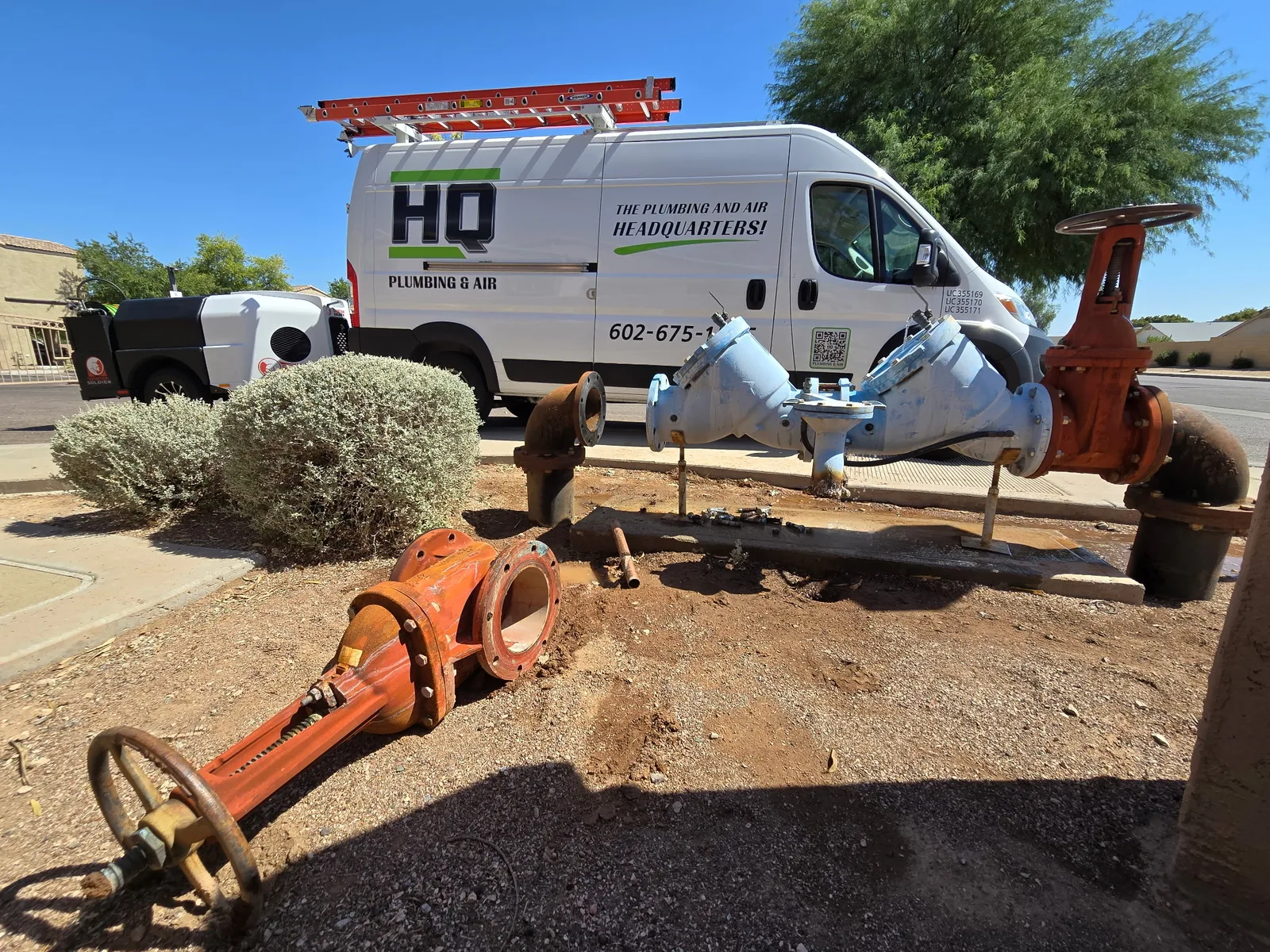
- Backflow. HQ is certified to test and certify domestic backflow assemblies and files the results with the city. Our certified techs also test fire line backflow assemblies. Send us your city notice. We handle commercial backflow testing, leak repair on the assembly, stolen assembly replacement and new assemblies for a new business. For testing requirements, see commercial backflow testing requirements in Arizona.
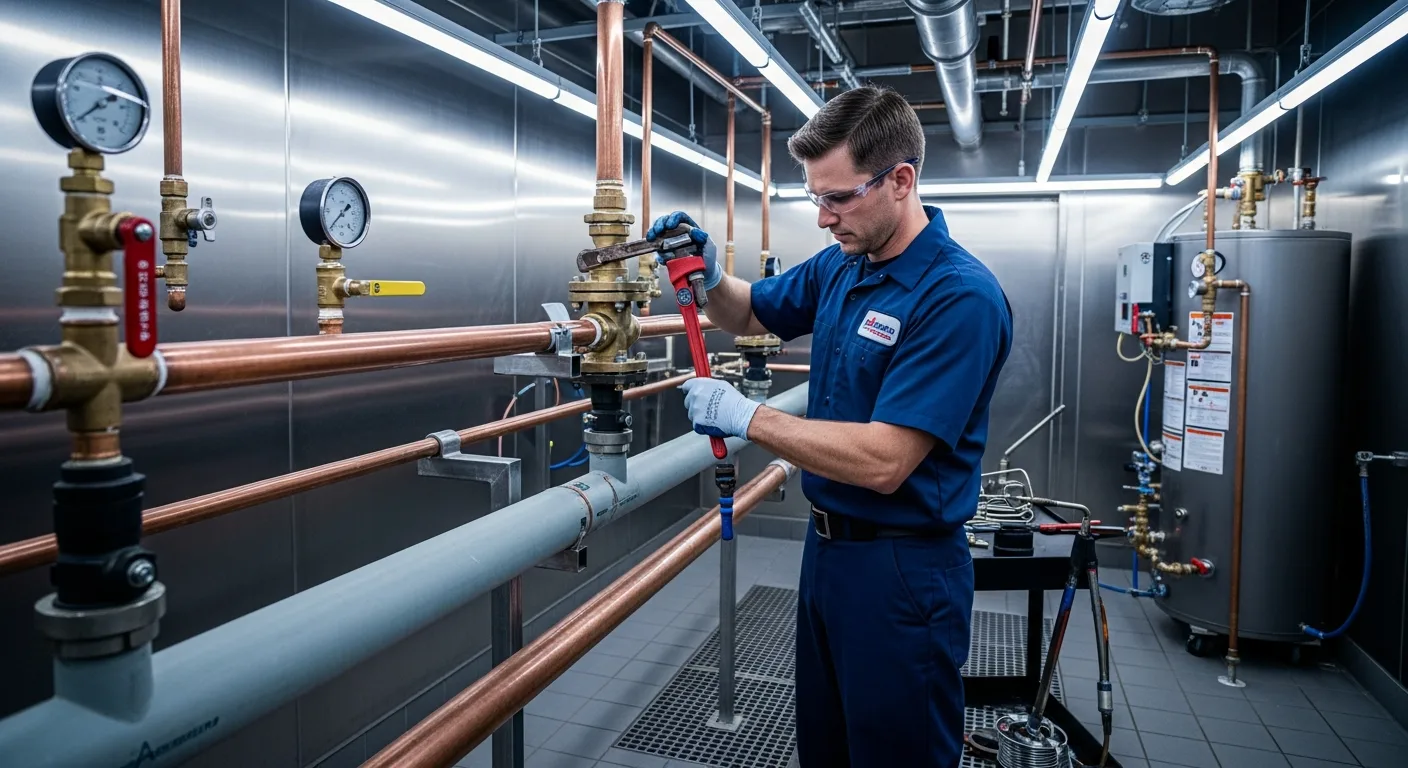
- Water heaters. Repair and replacement of commercial units through our water heater service. To compare units, see types of commercial water heaters. If a unit is leaking now, see a leaking commercial water heater; for how often to service one, read how often a commercial water heater should be serviced.
- Leaks and water lines. Leak detection under concrete and asphalt, water line repair, slab leak repair and shutoff valve replacement, with planned shutoffs. For a line that is pouring water, call for emergency pipe burst repair. Before a shutoff, read planning a commercial water shutoff.
- Gas lines. Commercial gas line repair, including leaks found by an air test from the meter, gas pressure testing and gas hookups for ranges, fryers and other kitchen equipment. See also our gas line service.
- Restrooms and fixtures. Toilet and urinal repair, restrooms that keep backing up and restroom remodel plumbing. For accessibility rules, read ADA commercial restroom plumbing.
- Scheduled maintenance. A preventive plumbing maintenance program that puts jetting, backflow tests and camera checks on a calendar, or a scheduled hydro jetting program for kitchen and trunk lines alone.
- Underground fire line repair. Outside the City of Phoenix, repair of the buried fire line only.
What We Check First at Each Kind of Property
Commercial plumbing in Phoenix starts with the building, because the same backup has a different cause and a different rule behind it at a shopping center, a restaurant or a warehouse. These are the property types we are called to most, and where we start at each one.
- Property managers. A manager needs one plumber across several sites and a record of each job for the owner and the tenant. When sewage comes up in a building with several tenants, stop water use and keep people away from it before anything else. For water pouring from a broken line, see emergency commercial pipe burst repair. Read what to do first in a multi-tenant sewer backup and our plumbing for property management companies.
- Retail centers. Suites in a strip center often drain into one shared building sewer, so a backup in one suite can start in a line the whole building uses. In Phoenix the sewer line from the building to the public main is the property owner's to clean, maintain and repair (Phoenix City Code 28-5). We run a camera from a cleanout and use its locator to mark where the problem is before anyone digs. See commercial sewer camera inspection and who pays for a shared sewer clog in a strip mall.
- Restaurants. Phoenix food businesses must keep their grease interceptors working and keep pumping records for three years. The city's grease manual has gravity interceptors pumped at least every three months and grease traps every 30 days, or sooner once grease and solids reach 25 percent of capacity (City of Phoenix FOG manual). A kitchen line that backs up between pump-outs needs the line cleaned, not just the trap. See restaurant plumbing and how often a Phoenix restaurant must pump its interceptor.
- Warehouses and manufacturing. Long yard lines and big slabs hide leaks. We find water line leaks under concrete or asphalt with a line locator and ultrasonic sounding equipment, so the dig is small and in the right place. A building with a backflow assembly must have it tested at least once a year by a certified tester, with the results sent to the city (Phoenix City Code 37-143), and HQ is certified to test domestic assemblies. See warehouse and industrial plumbing.
Whatever the building, our workmanship carries a two-year warranty. It does not cover a pipe that later fails on its own, and materials carry the maker's warranty, usually one year. Call for a free estimate and an upfront price.
How a Commercial Call Works
Tell us the problem
Call any time. For an emergency, tell us what is backing up or leaking and where the shutoff is.We diagnose it
A licensed and insured plumber finds the cause, with a camera inspection when a line is involved.You get the price
A free estimate and an upfront price before any work starts, with the options explained.We fix it on your schedule
We work around your hours when we can and plan any shutoffs with you first.
How We Handle Kitchen Drains, Interceptors and Gas Lines
We match the equipment to the job. A smaller stoppage gets a cable machine. On a larger restaurant, hotel or retail system, a two-person team runs a high-powered jetter from the cleanouts to pull the grease and sludge out of the line and flush it through to the city main.
We work on grease interceptors of all sizes. When a Maricopa County health inspector flags missing or broken baffles, the interceptor is pumped out, a three-person crew makes the confined-space entry and reinstalls the baffles, and then we jet and camera the lines going in and coming out. See grease interceptor baffle repair.
For a gas leak, we cap every appliance at its connector and air test the system from the meter to find it. When the gas company has shut the gas off and the building needs a gas clearance, we pull the permit, run the air test and get the city inspection passed so the gas company can turn it back on. See commercial gas line repair in Phoenix.
Who Pays, and What Needs a Permit
Two questions come up on almost every commercial call. The first is who pays. It depends on the lease: a triple-net lease usually puts day-to-day interior plumbing on the tenant, and a gross lease usually puts maintenance on the landlord. Read commercial plumbing: tenant or landlord before you order the work.
The second is whether the job needs a permit. Moving or adding fixtures usually does, and a like-for-like swap or a leak repair usually does not. In Phoenix, see the commercial tenant improvement plumbing permit and commercial minor plumbing online permits. Planning a build-out? Start with commercial tenant improvement plumbing.
Backflow, Grease and Inspection Paperwork
Cities check the paperwork as well as the pipes. Backflow assemblies need a yearly certified test, and the requirements differ by city. See which businesses need a backflow assembly in each Valley city. Kitchens keep grease device records; see the grease trap and interceptor rules by city. Restaurants also face health inspections; read what inspectors check in restaurant plumbing.
Fix the Schedule, Not Just the Emergency
The costly calls are usually the ones a schedule would have caught: a grease device past its limit, a missed backflow test, a main line full of roots. A plan puts those on the calendar. See what a commercial plumbing maintenance plan should include and tell us what your building has. We will help you build the schedule during the free estimate.
Businesses that need a plumber they can count on
- Restaurants and commercial kitchens
- Property managers and landlords
- Offices, retail and medical suites
- Apartment communities
- Owners planning a build-out or remodel
What we take on
- Plumbing repair and replacement
- Drains, sewer, and grease device repair and installation
- All domestic backflow assembly testing, certification, leak repair and stolen assembly replacement
- Water heaters and gas lines
- Underground fire line repair (outside the City of Phoenix)
- Fire sprinkler systems
- Fire sprinkler system testing, inspection or certification
What does a commercial plumber in Phoenix do?
A commercial plumber installs, repairs and maintains the plumbing in businesses: water lines, drains, sewer lines, restrooms, water heaters, backflow assemblies and grease devices. The work is planned around the building, its tenants and its hours, not just the pipe.
Do I need a permit to change plumbing in a commercial space?
Usually, if the work moves or adds fixtures. Phoenix requires a commercial building permit with plan review for non-residential remodels, tenant improvements and changes of use. Swapping a fixture in the same spot, clearing a stoppage or stopping a leak is exempt, but replacing a defective concealed pipe counts as new work and needs a permit. Other cities have their own rules, so we check yours first.
How often does a commercial backflow assembly need testing?
At least once a year, and again after any installation, relocation or repair. Arizona rules require a certified tester, and the water provider may require the results to be sent in. Missing the deadline can lead to a notice from the city.
Can you work around our business hours?
Yes. We schedule planned work after hours or in phases when we can, and we plan any shutoffs with you first. For an emergency, we offer 24/7 service.
Do you handle fire sprinkler systems?
HQ is certified to test and certify domestic backflow assemblies. HQ's certified techs also test fire line backflow assemblies where the city's tester rules allow. Fire sprinkler system work is outside what HQ does. We also repair underground fire lines outside the City of Phoenix.
How much does commercial plumbing cost?
It depends on the building, the access, the size of the system and whether the job is a repair, a replacement or new work. We give you a free estimate and an upfront price before any work starts.
Commercial plumbing repairs: tenant or landlord responsibility?
It depends on the lease. There is no single rule. A triple-net (NNN) lease usually puts day-to-day interior plumbing on the tenant, while the landlord keeps structural, roof, and central systems. A gross lease usually puts maintenance on the landlord. The repair clause in your actual lease decides.
Read full answer: Commercial plumbing repairs: tenant or landlord responsibility?What plumbing is involved in a commercial tenant improvement (TI)?
A commercial tenant improvement is the build-out of a leased space for a new tenant. The plumbing depends on the use, but it often means relocating or adding fixtures, floor sinks and drains, a grease interceptor, a water heater, ADA restrooms, and backflow protection, all under a city permit.
Read full answer: What plumbing is involved in a commercial tenant improvement (TI)?What should a commercial plumbing preventive maintenance plan include?
A commercial plumbing preventive maintenance plan should schedule grease interceptor service at the applicable buildup threshold or required interval, whichever comes first, an annual backflow assembly test, periodic drain and sewer jetting with a camera inspection, water heater flushing, fixture and flushometer checks, shutoff valve mapping, pressure checks, and leak monitoring.
Read full answer: What should a commercial plumbing preventive maintenance plan include?How do I plan a water shutoff for my commercial building?
Plan a commercial water shutoff by locating and labeling every valve first, then isolating only the affected zone so the rest of the building keeps service. Schedule it after hours, notify staff and tenants in writing, coordinate the fire line and equipment, relieve pressure, and verify backflow on restart.
Read full answer: How do I plan a water shutoff for my commercial building?Serving The Entire Phoenix Metro
Our crews deliver commercial plumbing across Phoenix and the surrounding Valley. Find your city below:
Explore More Services
Protect Your Operations
Call HQ for a free estimate and an upfront price. We offer 24/7 emergency service across the Phoenix area.