
HOA and Condo Association Plumbing in Phoenix
Who fixes which pipe under Arizona's condo and planned community laws, plus the backflow, pool and sewer rules that land on the association.
Arizona condo law makes the association maintain the common elements and each owner maintain their unit, unless the declaration says otherwise. In Phoenix, an association also tests irrigation backflow assemblies every year, keeps community pool fill lines on an air gap or approved backflow device, and, where it owns the shared sewer line, repairs it out to the public main.
The rules that apply
Each rule links to the official text we read it from. Cities change these, so check the source before a big decision. Last checked 2026-09-29.
Who maintains what in a condo
ArizonaExcept as the declaration provides, the association maintains, repairs and replaces the common elements and each owner maintains the unit. Owners must allow access through the unit on reasonable notice.
Source: A.R.S. 33-1247(A)Lines that cross unit boundaries
ArizonaUnless the declaration says otherwise, a chute, flue, duct, conduit or other fixture partly inside a unit is a limited common element for the part serving only that unit, and a common element for any part serving more than one unit.
Source: A.R.S. 33-1212(2)Who gets billed
ArizonaUnless the declaration says otherwise, costs for a limited common element go to the units it serves and costs benefiting fewer than all units go to those units. Separately, a cost caused by an owner's misconduct can be assessed to that owner.
Source: A.R.S. 33-1255(C), (E)Emergency board action
ArizonaAfter declarant control ends, a board can hold an emergency meeting for action that can't wait for the 48-hour notice, act only on the emergency, and record the reason in the minutes. Condos have the same rule.
Source: A.R.S. 33-1804(E)(2); 33-1248(E)(2)Irrigation backflow
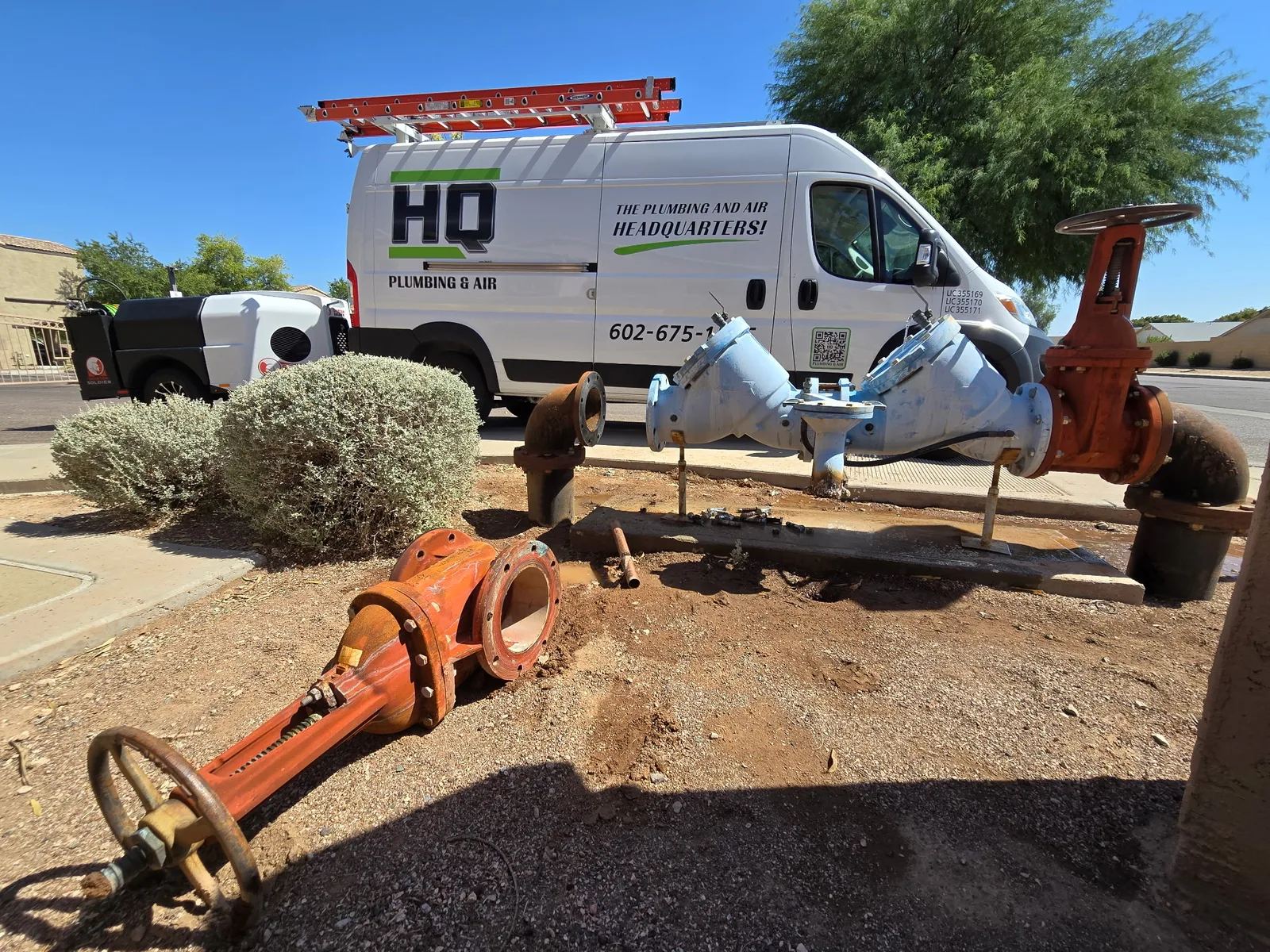
PhoenixIrrigation systems need a PVB, or an RP where there's chemical injection, multiple services, or elevated areas higher than six inches below the PVB. Every assembly is tested at least once a year, with records kept three years.
Source: Phoenix City Code 37-144, 37-143Separate landscape meter
PhoenixNew services established after January 1, 1990 need a separate water meter for landscape watering of any landscaped area over 10,000 square feet.
Source: Phoenix City Code 37-53Community pool fill lines
Maricopa CountyA pool run by a community association is semipublic. Potable make-up water enters only across an air gap, above a float-controlled feed tank, or through a submerged inlet with an approved backflow device.
Source: Maricopa County Environmental Health Code, Ch. VI, Sec. III, Reg. 21Shared sewer to the main
PhoenixThe owner maintains and repairs the building connection to the public sewer. The city fixes breaks in the right-of-way only for single-family and duplex properties; other owners repair off-property sections with a city permit.
Source: Phoenix City Code 28-5.1Condo or planned community: the statute decides the starting point
Board members and community managers get the same call over and over: a pipe broke, and nobody's sure whose pipe it is. In Arizona the answer starts with what kind of association you run.
In a condominium, A.R.S. 33-1247 makes the association responsible for maintaining, repairing and replacing the common elements, and each owner responsible for the unit, except where the declaration says otherwise. A.R.S. 33-1212 fills in the gray zone. When a chute, flue, duct, conduit or other fixture sits partly inside a unit, the part serving only that unit is a limited common element for that unit, and any part serving more than one unit is a common element. A shared drain stack running through several floors usually lands on the association's side of that line. See our page on A.R.S. 33-1247 condo plumbing responsibility.
In a planned community, owners hold their own lots, and the association owns and runs the common areas under its declaration. The plumbing serving one house is usually that owner's; irrigation, pools and other common-area systems are usually the association's. Our Planned Communities Act page walks through it.
Either way, read the declaration and the community's governing documents first. They often draw the line more precisely than the defaults.
Common-area irrigation and the yearly backflow test
Phoenix requires backflow protection on irrigation systems: a pressure vacuum breaker (PVB) where there's no backpressure, and a reduced pressure (RP) assembly where there's chemical injection, multiple services, or elevated areas higher than six inches below the PVB. Every assembly gets tested at least once a year by a certified tester, with records kept three years. A community with dozens of controllers can have dozens of assemblies, so put the due dates on one calendar. See backflow preventers for sprinklers and what to do after a failed test.
Newer communities often have a dedicated landscape meter. Phoenix City Code 37-53 requires a separate meter for landscape watering of areas over 10,000 square feet on services set up after January 1, 1990. When a common-area water bill jumps, that meter is the first place to look; a valve that won't close is a common cause. Here's why a sprinkler system won't shut off.
Pools and community water shutoffs
Maricopa County treats a pool run by a neighborhood or community association as a semipublic pool. Its Environmental Health Code bans cross connections between drinking water and the pool's recirculation system; fill water has to come in across an air gap, above a float-controlled feed tank, or through a submerged inlet with an approved backflow device. Auto-fill valves and pool equipment leaks are common trouble spots. See how to find a pool plumbing leak.
Shutting off water to a building or a whole community needs notice and a plan: a valve that's been exercised, a firm window, and a crew ready to restore service. Our commercial water shutoff guide covers the steps. When a main breaks overnight, the board doesn't have to wait. A.R.S. 33-1804 (planned communities) and 33-1248 (condos) let a board hold an emergency meeting for action that can't wait for 48 hours' notice, as long as the minutes record the reason. Fix first, document after. That's it.
How HQ works with HOAs and condo associations
We handle common-area repairs, shared drain and sewer line jetting, sewer camera inspection and repair, backflow assembly replacement (your certified tester handles the annual test), and water heater work in shared buildings. Managers get upfront pricing before work starts and free estimates for bigger projects, and emergency calls are answered 24/7.
Services and tools
Codes and permits
Questions we've answered
- In Phoenix, who is responsible for the sewer line to the city main?
- Utility easement vs right-of-way: who can dig to fix my sewer?
- How do I maintain my sewer line to prevent backups?
- Do I need a backflow preventer and annual test for my sprinklers in Arizona?
- My backflow assembly failed its test. What happens next?
- What happens if I miss my Phoenix backflow test deadline?
- Why won't my sprinkler system shut off?
- How do I find a leak in my pool's underground plumbing?
- How do I legally drain or backwash my pool in Phoenix?
- What size gas line does a pool heater need?
- How do I plan a water shutoff for my commercial building?
- Why is my water bill so high when I can't find a leak?
Sources
- A.R.S. 33-1247, upkeep of the condominium
- A.R.S. 33-1212, unit boundaries
- A.R.S. 33-1255, assessments for common expenses
- A.R.S. 33-1248, condominium open meetings and emergency meetings
- A.R.S. 33-1802, planned community definitions
- A.R.S. 33-1804, planned community open meetings and emergency meetings
- Phoenix City Code 28-5.1, sewer service line repair
- Phoenix City Code 37-53, separate water meters
- Phoenix City Code 37-143, customer backflow duties
- Phoenix City Code 37-144, backflow prevention methods
- Maricopa County Environmental Health Code (Ch. IV Sec. V condominiums; Ch. VI semipublic pools)
Other industries we serve
Grease interceptor rules by city, pumping schedules, health code plumbing and soda backflow, plus 24/7 kitchen drain service.
Arizona landlord plumbing duties, kitchen stack clogs, water heaters, planned shutoffs, backflow testing and sewer laterals.
Shared grease interceptors, strip center backflow, tenant improvement permits, vacant suite odors and the records cities ask for.
County hotel plumbing rules, pool and spa backflow, laundry lint interceptors and hot water for the morning rush, plus 24/7 repair.
Brewery backflow, sewer pH and temperature limits, carbonator RPs, bar floor sinks, glass washers and trench drain jetting.
EPA amalgam separator rules, Phoenix compliance reports, clinic backflow, sterilizer and vacuum plumbing, and tenant improvement permits.
Lab backflow, lead testing at fountains, cafeteria grease interceptors, worn restrooms and summer break maintenance for Valley campuses.
Dry traps, fellowship hall kitchen grease, restroom loads on event days and irrigation backflow for Valley houses of worship.
Locker room showers, hair-clogged drains, sewer smells from dry traps and pool and spa plumbing rules for Valley gyms.
State board hot water and drain rules, shampoo bowl clogs, hair interceptors, chemical dispenser backflow and salon water heaters.
Lint interceptor rules, city cleaning records, laundry backflow, water heaters sized for peak demand and sewer line care.
Sand and oil interceptor rules, 12-month pumping, three-year records, RP backflow and bay and reclaim line jetting.
RP backflow for multi-tenant shells, oil separators at truck bays, tempered eyewash water and industrial wastewater permits.
Plumbing Help for HOAs and Condo Associations
Talk to a real dispatcher who knows commercial work. Upfront pricing before work starts, 24/7 for emergencies.