
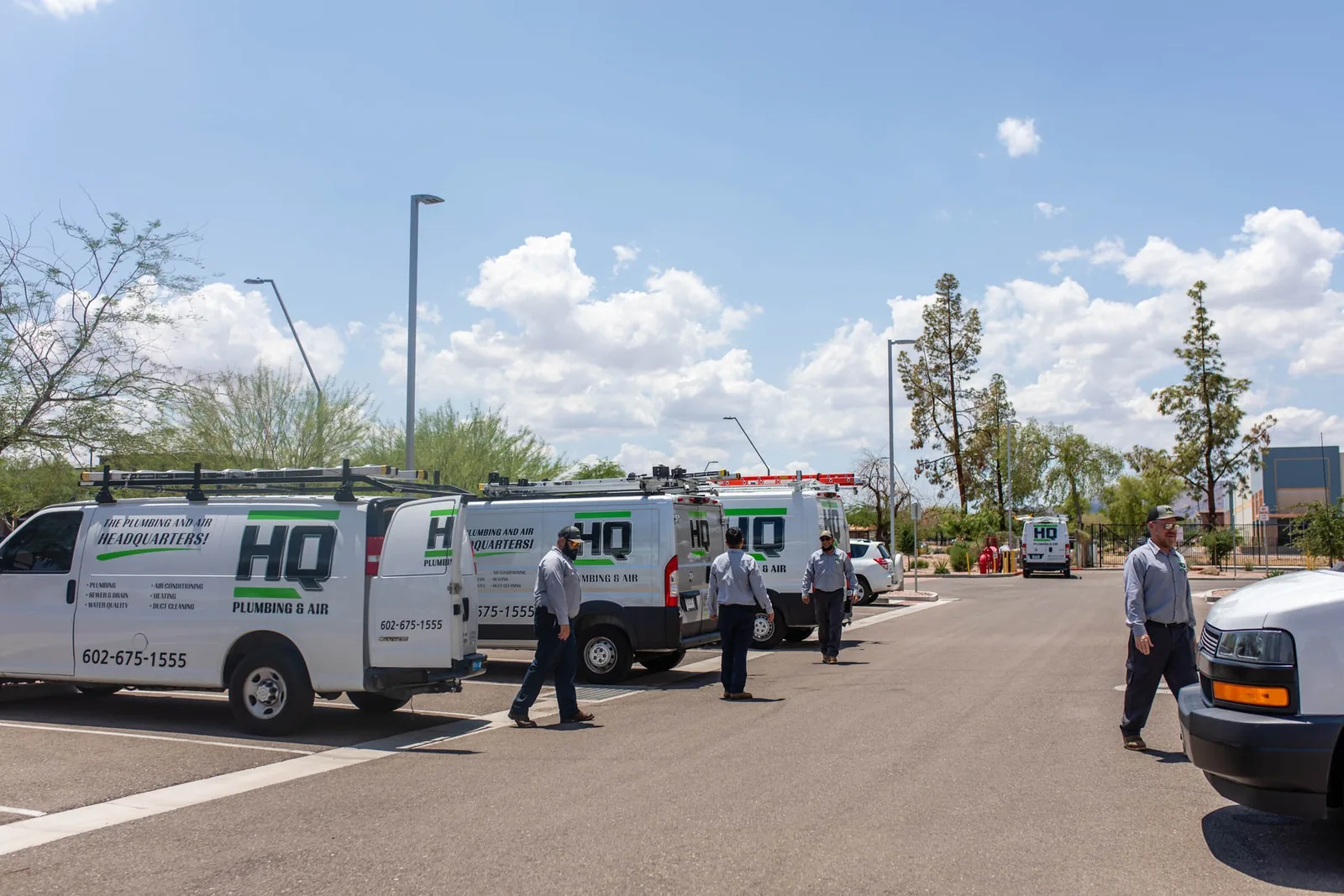
Plumber in Mesa
Licensed plumbers for Mesa, with a local read on two water zones, city permit rules and Mesa's own gas utility.
Plumbing in Mesa
Mesa has more than 517,000 residents and about 224,000 homes, and it's one of the few Valley cities where your address changes your water. The city splits into three water zones with different sources and different hardness. The median Mesa home was built in 1989, so a lot of the housing is now well past the age when first-generation water heaters, valves and fixtures wear out. HQ Plumbing & Air covers all of Mesa around the clock, with upfront pricing and free estimates.
- Water hardness
- 12 to 16 grains per gallon
- Median home built
- 1989
- Homes built before 1980
- About 27%
- Gas emergency line
- 480-644-4277
Two kinds of water in one city
Mesa's own water quality report divides the city into a City Zone, an Eastern Zone and a Southern Zone. In the City Zone, Salt and Verde river water from the Salt River Project is treated at the Val Vista plant, and the city says that source supplied about 40 percent of all the water it served in 2025. In the Eastern and Southern Zones, Colorado River water from the Central Arizona Project is treated at the Brown Road and Signal Butte plants and supplied about 52 percent. Deep wells supply about 4 percent in each area and are blended in.
That's why the numbers differ. The city says City Zone water averages about 12 grains per gallon of hardness, and Eastern and Southern Zone water averages 16. It recommends setting a water softener to 16 and adjusting from there. The USGS calls water above 180 milligrams per liter very hard, which is about 10.5 grains, so both zones are very hard, and the east side is harder.
Hardness leaves scale, and the USGS says scale can shorten equipment life, raise water heating costs and clog pipes. Mesa's report also clears up three things people call about. Cloudy water that clears from the bottom of a glass is just air. A sulfur or rotten egg smell can mean the water heater needs a flush. And warm tap water in summer, especially in east Mesa, can come from naturally warm groundwater rather than a problem in your house.
Mesa's homes: a big stock from the 1970s to the 1990s
Census figures put the median Mesa home at 1989. About 27 percent of homes, roughly 61,000, were built before 1980. Another 40 percent went up from 1980 through 1999, and about 32 percent have been built since 2000. Around 10,000 homes date from before 1960.
Those older homes are where we look for original galvanized supply lines and cast iron drains, but the build year alone doesn't tell us what's in your walls, so we check first. Homes from the 1980s and 1990s are past the point where the first water heater, angle stops, toilet fill valves and hose bibs are due. Newer areas like Eastmark, a master-planned community between Ellsworth and Signal Butte roads, south of Elliot Road, are a different job. The plumbing there is young, so hard water scale is the wear to plan for.
Water heater permits in Mesa: swap yes, tankless no
Mesa's rule is easy to state. According to the city's Residential Construction FAQ, no permit is required to replace a gas or electric water heater with a like-for-like model of equal or lesser rating. A permit is required to replace a storage gas water heater with a tankless or on-demand gas unit.
For any gas appliance, the city says to notify the serving gas utility before placing it into service. If an emergency repair would normally need a permit, submit the application by the next business day. Mesa Permit Services is at 55 N. Center St., open Monday to Thursday, 7 a.m. to 6 p.m., at 480-644-4273 or permitservices@mesaaz.gov.
Mesa adopted the 2024 International Code Council family of codes and the 2023 National Electrical Code, effective January 8, 2026. Permit rules are set city by city, so don't assume what holds in Mesa holds in the next town over.
Mesa has its own gas utility
The City of Mesa runs a natural gas utility that serves more than 82,000 homes and businesses in Mesa. Whether yours is one of them depends on your address, and your gas bill tells you who serves you.
If you smell rotten eggs, hear a hiss from a pipe, appliance or meter, or see dead plants or bubbling water over a gas line, the city says to leave the area immediately and go to a safe location. Then call 9-1-1 and the gas emergency line at 480-644-4277. Don't turn electrical switches on or off, ring a doorbell, smoke, or use matches or lighters near the smell, because a spark could ignite the gas.
Gas line repair and installation in Mesa
HQ Plumbing & Air repairs, replaces and installs gas lines in Mesa homes and businesses, from the meter to every gas appliance. That covers a leaking gas pipe, a corroded or damaged section, and a new line for an appliance you're adding. We pull the permit, do the work, test it and get it through the city inspection.
Whose pipe is it? The City of Mesa says it owns and maintains the gas piping up to and including the meter, and that piping from the meter to every gas appliance, indoors and out, belongs to the property owner. So a leak on your side of the meter is yours to have repaired, and the city tells owners to call a licensed professional when they suspect an unsafe condition. For questions about buried gas piping on your property, the city lists 480-644-4552.
To find a leak, we cap every gas fixture in the house at its flex line and pressurize the system at the meter for a gas pressure test. If the gauge drops, there's a leak, and we track it down section by section. Mesa's amendments to the 2024 fuel gas code set that test at no less than 10 psi, and 60 psi for welded pipe or gas delivered above 14 inches of water column.
Mesa City Code 4-1-4 requires a permit to install, alter, repair or replace a gas system, and Mesa added a rule that fuel isn't connected to a permitted system until the code official authorizes it. If the gas was shut off for a leak, the repair is how it comes back on: we pull the permit, fix the leak, run the pressure test and pass the city inspection, so the gas utility can restore service. For an emergency repair, Mesa asks for the permit application by the next business day, and it says to notify the serving gas utility before any gas appliance goes into service.
How Mesa grew
Mesa's first settlers arrived on February 14, 1878, and used an abandoned Hohokam canal for part of their first irrigation project. The town incorporated on July 15, 1883. The city says its population nearly doubled every decade from 1930 to 1990, from nearly 17,000 in 1950 to 288,000 in 1990. Growth that fast is why one city holds homes from every decade.
Mesa Areas We Cover
Our crews regularly work throughout Mesa, including Downtown Mesa, Eastmark and the surrounding areas. If you don't see your neighborhood listed, call us. Chances are we cover it.
We dispatch to Mesa around the clock. You get the price up front, before work starts, and the estimate is free.
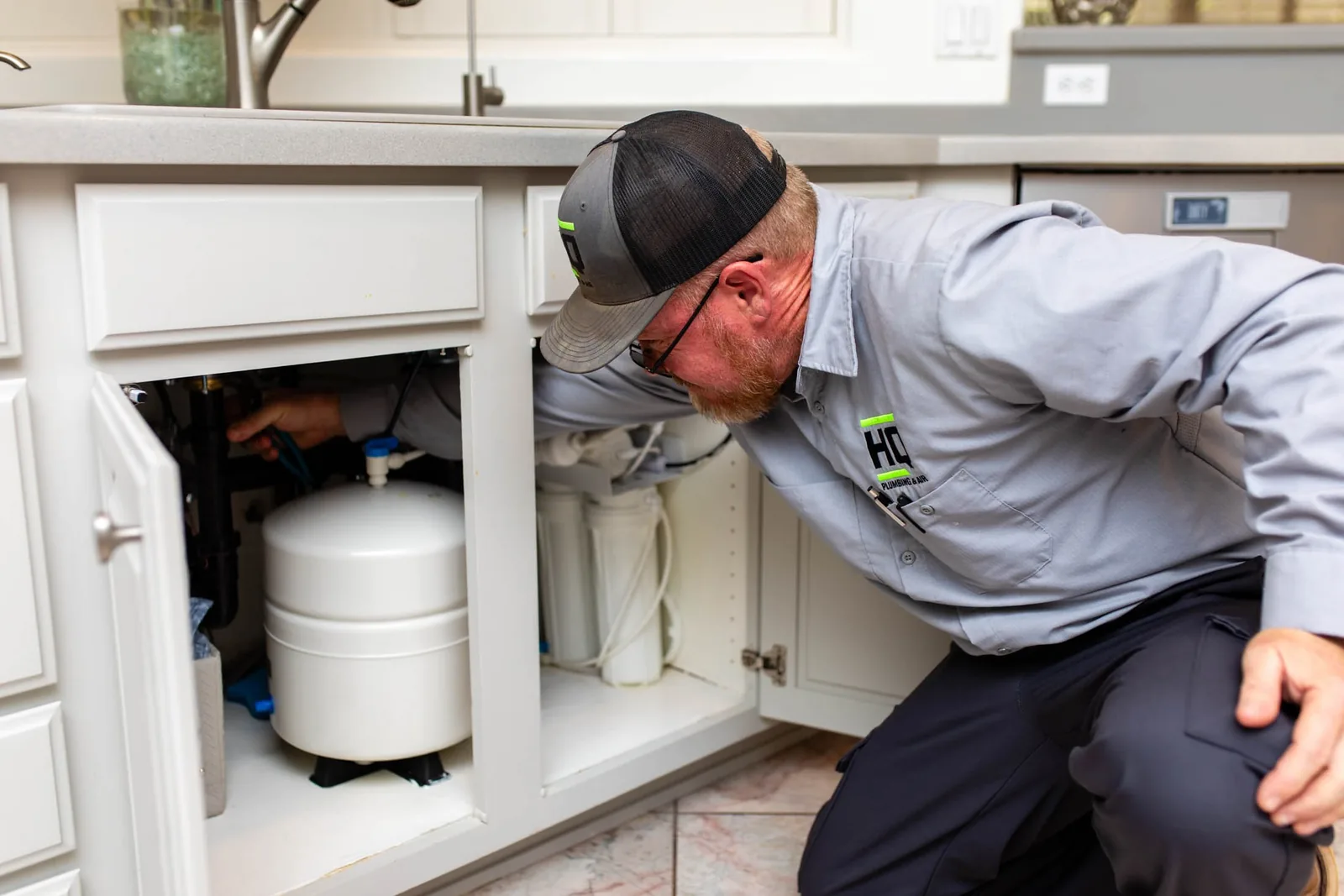
What We Do in Your Area
How hard is Mesa's water?
The City of Mesa says water in the City Zone averages about 12 grains per gallon, and water in the Eastern and Southern Zones averages 16. Both are very hard on the USGS scale, and the city recommends setting a softener to 16 grains to start.
Do I need a permit to replace my water heater in Mesa?
Not for a like-for-like gas or electric replacement of equal or lesser rating. You do need one to replace a storage gas water heater with a tankless gas unit. Call Mesa Permit Services at 480-644-4273 if you're unsure.
Why does my Mesa tap water smell like rotten eggs?
Mesa's water quality report says a sulfur or rotten egg smell can mean your water heater just needs to be flushed. It also suggests running the outside hose bib to see whether the smell comes from inside the house.
Who do I call for a gas leak in Mesa?
Leave the area and go somewhere safe, then call 9-1-1 and the gas emergency line at 480-644-4277, as the City of Mesa says. Don't touch light switches or use flames. Once the utility says it's safe, call us for the repair.
Who pays to fix a gas line leak in Mesa?
The City of Mesa owns the gas piping up to and including the meter. Piping from the meter to every gas appliance, indoors and out, belongs to the property owner, so a leak on that side is the owner's to have repaired by a licensed professional.
Do I need a permit for gas line work in Mesa?
For most of it. Mesa City Code 4-1-4 requires a permit to install, alter, repair or replace a gas system, and permitted work is pressure tested and inspected before the gas goes back on. We pull the permit and handle the inspection, and Mesa Permit Services at 480-644-4273 can confirm whether a small job needs one.
Can HQ install a new gas line in Mesa?
Yes. We install, repair and replace gas lines in Mesa homes and businesses, from the meter to the appliance, and we pull the permit and get the work through the city inspection.
What are the most common plumbing problems in Mesa homes?
Hard water scale is the big one: it wears out water heaters, valves and fixtures across Mesa. Homes from the 1980s and 1990s are due for their first water heater, angle stops and toilet fill valves, and homes built before 1980 can still have galvanized supply lines and cast iron drains. Gas leaks on the owner's side of the meter come up too.
Is HQ Plumbing & Air a licensed plumber in Mesa?
Yes. HQ Plumbing & Air is a licensed plumbing contractor and works throughout Mesa. Arizona licenses contractors through the Registrar of Contractors, and its contractor search lets you check any company's license before work starts.
Can I fix a Mesa plumbing emergency before a permit?
Yes, for repairs that need a permit. Mesa's code says that when equipment replacements and repairs requiring a permit must be done in an emergency, the permit application is due within the next working business day. Many small fixes, like stopping a leak or clearing a stoppage, need no permit at all.
Read full answer: Can I fix a Mesa plumbing emergency before a permit?How do I verify a plumber's license in Arizona?
Use the Arizona Registrar of Contractors free public license search at roc.az.gov/search. Look up the plumber by license number, business name, or qualifying-party name, then confirm the license is Active, the classification matches your job, the bond is current, and the complaint history is clean before you sign anything.
Read full answer: How do I verify a plumber's license in Arizona?Why are slab leaks so common in Arizona?
A slab leak can develop when a buried supply pipe corrodes, rubs against concrete or soil, or is stressed by ground movement, thermal expansion or excessive pressure. Water chemistry can contribute to copper pitting, but hardness alone does not identify the cause. Leaks beneath a slab can remain hidden.
Read full answer: Why are slab leaks so common in Arizona?Does HQ Plumbing & Air really answer 24/7?
Yes. A real Phoenix dispatcher answers the HQ line day or night, including weekends and holidays. No answering service, no offshore call center. For true emergencies we dispatch a licensed plumber same day across the Phoenix metro. Call (602) 675-1555 anytime.
Read full answer: Does HQ Plumbing & Air really answer 24/7?Sources for this page
- City of Mesa: 2025 Water Quality Consumer Confidence Report
- USGS: Hardness of Water
- City of Mesa: Residential Construction FAQ
- City of Mesa: Mesa Building Code
- City of Mesa: Natural Gas
- City of Mesa: Energy Safety and Education
- City of Mesa: Report a Utility Emergency
- Mesa City Code Sec. 4-1-4: Permits
- Mesa City Code Sec. 4-7-2: Amendments to the 2024 International Fuel Gas Code
- City of Mesa: A Brief History of Mesa
- City of Mesa: About Mesa
- City of Mesa: Eastmark Community Plan
- Census Reporter: Mesa, AZ (ACS 2024, tables B01003, B25034, B25035)
Need a Plumber in Mesa?
HQ Plumbing & Air dispatches licensed technicians to Mesa around the clock. Call now for upfront pricing and fast response.