
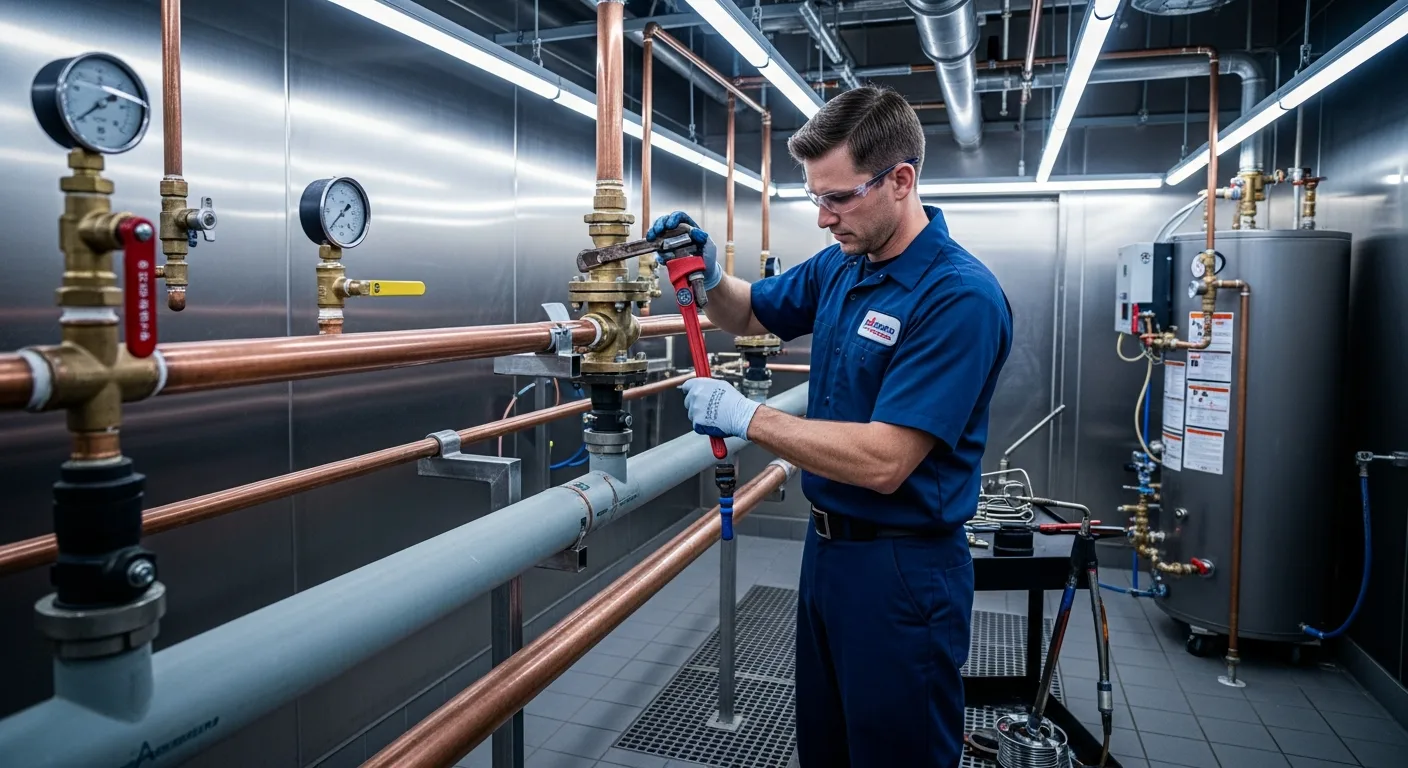
Commercial Water Shutoff Valve Replacement
A shutoff you cannot close is a flood waiting for a bad day. Replace it on your schedule, with notice to tenants, not during a break.
A commercial water shutoff valve should close fully and hold without weeping. When a main, tenant or riser valve sticks, leaks or will not turn, HQ replaces it after a planned shutdown, often with a full-port ball valve. If the building valve cannot be closed, Phoenix customer service can shut the water at the meter.
The rules that apply
Each rule links to the official text we read it from. Cities change these, so check the source before a big decision. Last checked 2026-10-04.
Where full-open valves are required
2024 IPCFull-open valves go on the building water service pipe near the curb, on the supply at the entrance into the structure, and on the discharge side of every water meter. They also go at the base of every water riser in most occupancies, at the top of every down-feed pipe, at the supply to every dwelling unit, and at every water heater and tank.
Source: 2024 IPC Sec. 606.1Tenants in a small multi-tenant building each get a main shutoff
2024 IPCIn multiple-tenant buildings three stories or less in height where a common supply pipe serves other than one- and two-family dwellings, a main shutoff valve is provided for each tenant.
Source: 2024 IPC Sec. 606.1, item 2.1Fixture and equipment shutoffs
2024 IPCShutoff valves are installed on the supply to each plumbing fixture (with exceptions for bathtubs and showers in dwellings), to each sill cock, and to each appliance or piece of mechanical equipment.
Source: 2024 IPC Sec. 606.2Valves must be reachable and labeled
2024 IPCAccess must be provided to all full-open and shutoff valves. Service and hose bibb valves are identified, and valves not adjacent to the fixture or appliance are identified to show what they serve.
Source: 2024 IPC Sec. 606.3 and 606.4Replacement valves for drinking water must be low-lead
2024 IPCValves used in the water supply system have not more than 8 percent lead, and valves that supply water for drinking or cooking comply with NSF 372 and have a weighted average lead content of 0.25 percent or less.
Source: 2024 IPC Sec. 605.2 and 605.2.1Phoenix: shut at the building, and test your valve
PhoenixThe city says to know where your shut-off valve is and test it regularly. It says not to shut water off at the meter, since that takes a special tool and the customer may be charged for meter damage. If you cannot find or operate the valve, call customer service at 602-262-6251 and a technician will shut the water off at the meter.
Source: Phoenix Water Services, Household Plumbing TipsAlso: Phoenix Water Services, General Service IssuesQuick-closing valves need water-hammer arrestors
2024 IPCFlow velocity must be controlled to reduce water hammer, and an ASSE 1010 arrestor is installed where quick-closing valves are used.
Source: 2024 IPC Sec. 604.9How do you know a shutoff valve needs replacing?
A valve needs replacing when it will not close, will not stay closed, or leaks while it is open. The signs are a handle that is frozen or turns without closing, water weeping at the stem or packing nut, a drip downstream after the valve is closed, or a valve that was never tested. An old multi-turn gate valve can fail to seat fully, and forcing one can snap the stem. Our guide to testing a main water shutoff valve shows how to check one without causing a leak: close it slowly, then check that water stops at a downstream fixture and the meter's low-flow indicator stands still.
Which valves does a commercial building have, and which one do you replace?
Most buildings have several, in layers. Under the 2024 IPC, full-open valves belong near the curb on the service line, at the entrance to the building, on the discharge side of every meter, at the base of risers, at the top of down-feed pipes, and at each water heater and tank. A multi-tenant building three stories or less also needs a main shutoff for each tenant. Shutoffs on every fixture and appliance make up the last layer. In an apartment or condo building, a valve at the entrance to every dwelling unit lets a unit be isolated without affecting its neighbors; see apartment buildings and unit shutoffs. The valve to replace is the one that fails the test, and that decides how big the shutdown is. Replacing a tenant valve affects one suite. Replacing the building main affects everyone.
How should the shutdown be planned?
Plan it like a small project: notice, window, upstream isolation and restart. Tenants and the property manager get a written notice with the date and hours, because the building's water is off while the valve is swapped. The window should avoid the busiest hours, and restaurants, clinics and salons need to know in advance. Isolation is the question: replacing a valve means shutting off the water upstream of it. If the building main valve is the one that has failed, the next valve upstream is the curb valve or the meter. In Phoenix, the city says not to operate the meter yourself and that its customer service can shut the water off at the meter for you, so call early rather than the morning of the job. Our commercial water shutoff planning guide covers notices, valves and restart, and temporary restrooms during a water shutdown helps when a suite must stay open.
Why upgrade to a ball valve?
A full-port ball valve closes with a quarter turn and has fewer parts to wear out. The code calls for full-open valves in the main locations, and a full-port ball valve keeps the same pipe size through the valve. Quarter-turn valves close fast, so operators should close them slowly. The code requires water-hammer arrestors where quick-closing valves are used, so a banging pipe after the upgrade is a reason to look at hammer control. Water hammer and banging pipes explains the symptoms. Valves that supply drinking or cooking water must meet the code's low-lead limit, and our guide to lead-free valves and NSF 61 versus 372 explains the marks to look for. Label the new valve and keep access clear, since the code requires both.
When a replacement is the wrong answer
A valve that only weeps at the stem may need a packing adjustment or repair, not replacement. A leaking fixture stop is a small repair on a single fixture; see replacing a toilet shutoff valve and angle stops that won't close. If the valve is fine and just hard to reach, the answer is access and labeling. If the building has no valves in the places the code lists, the answer is adding valves, which is a bigger job than a swap. And if the water is already flooding, see emergency commercial pipe burst response first.
How to book
HQ replaces commercial water shutoff valves, with free estimates, upfront pricing before work starts and 24/7 emergency service when a valve will not close during a leak. Tell us the valve location, pipe size, what the valve does and how many tenants it affects. Related: commercial plumbing, property management plumbing, multifamily plumbing and our emergency plumber service.
How do I test my main water shut-off valve?
To test your main water shut-off valve, open a cold faucet, then close the main valve: a quarter turn for a ball valve, or clockwise until it stops for a gate valve. The faucet should slow and stop. Check the valve for drips, reopen it all the way, and repeat the test a couple of times a year.
Read full answer: How do I test my main water shut-off valve?How do I plan a water shutoff for my commercial building?
Plan a commercial water shutoff by locating and labeling every valve first, then isolating only the affected zone so the rest of the building keeps service. Schedule it after hours, notify staff and tenants in writing, coordinate the fire line and equipment, relieve pressure, and verify backflow on restart.
Read full answer: How do I plan a water shutoff for my commercial building?Does an apartment need a water shutoff valve for each unit?
Usually yes. The International Plumbing Code calls for a full-open valve on the water supply pipe entering every dwelling unit, unless the pipe serves a single fixture with its own stops. Many multi-tenant buildings need a tenant main shutoff (three stories or less, 2024 code). Access and labels are required too. Cities adopt different code editions.
Read full answer: Does an apartment need a water shutoff valve for each unit?Can temporary restrooms keep a business operating during plumbing work?
Temporary restrooms may support an approved operating plan, but renting units does not automatically replace a commercial building’s required facilities. Check employee sanitation, customer access, accessible routes, handwashing, servicing and any food-establishment requirements with the responsible authorities. Describe the outage and proposed arrangement before relying on it; the permitted use and accepted plan determine what can continue.
Read full answer: Can temporary restrooms keep a business operating during plumbing work?Related commercial services
How a meter test, section-by-section pressure test and acoustic listening locate a leak, and who pays once it is found.
Repair in place, reroute or open the slab, what Phoenix says about permits for concealed pipe, and planning around tenants.
Gauge test, replacement, fail-open design, vacuum breakers and why exposed plastic pipe is banned outdoors in Phoenix.
Where owner responsibility starts, how a failed service line is repaired or replaced, and what comes before the excavator.
What HQ does and does not do on a fire line, the Phoenix certificate rule, and the owner's upkeep duties.
The first ten minutes, the valve Phoenix says to close, what to document, and the notification clock in Phoenix code.
Valve Stuck or Leaking?
Talk to a real dispatcher who knows commercial work. Upfront pricing before work starts, 24/7 for emergencies.