
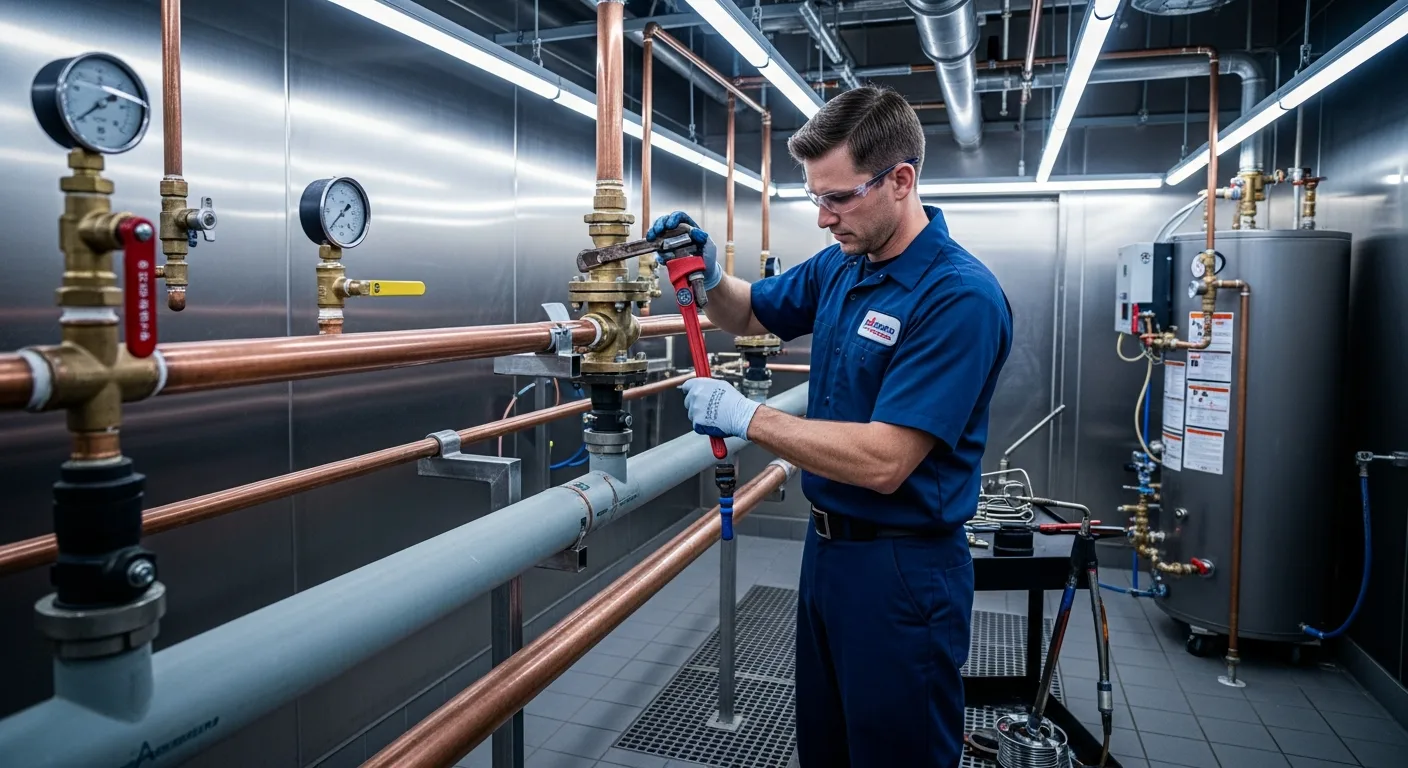
Plumbing Service for Property Managers in the Valley
One plumber for unit calls, common-area lines, backflow tests and drain stoppages, with who approves and who pays settled before the truck rolls.
A property manager's plumbing program covers unit calls, common-area water lines, backflow tests, hose bibs and drain stoppages with one team to call. Arizona makes the landlord responsible for keeping residential plumbing working, so tell us who approves and who pays before dispatch: the owner, the association or the tenant. That settles the bill before work starts, not after.
The rules that apply
Each rule links to the official text we read it from. Cities change these, so check the source before a big decision. Last checked 2026-10-04.
The landlord keeps residential plumbing in working order
ArizonaThe landlord must maintain in good and safe working order all electrical, plumbing and sanitary facilities supplied or required, keep common areas clean and safe, and supply running water and reasonable amounts of hot water at all times. Written agreements can shift only specified repairs to a tenant, and only in a separate signed writing.
Source: A.R.S. 33-1324Who is the water customer who gets the backflow notice
PhoenixThe customer is whoever has physical control, authority or responsibility for the water system. The customer tests all backflow assemblies at least once a year, repairs defective ones, files the results on city forms and keeps records three years.
Source: Phoenix City Code 37-143Master-metered properties are on the backflow list
PhoenixThe city's list requires backflow protection for shopping centers, strip malls and shell buildings where one service supplies more than one tenant (reduced pressure assembly), and for multi-story buildings with booster pumps or above-ground storage tanks (air gap, RP or double check).
Source: Phoenix City Code 37-144(b)Unit repairs rarely need a permit; backflow repairs need a report
PhoenixStopping leaks and clearing stoppages need no permit, and replacing valves or fixtures in place is exempt as long as nothing is relocated. Repair or replacement of an existing secondary backflow assembly of 2 inches or smaller is exempt, but a certified tester's report goes to the city.
Source: Phoenix 2024 IBC Chapter 1 amendments, Sec. 105.2 PlumbingOne dispatch line for the whole portfolio
A property-manager program means the person managing forty doors does not need forty vendor relationships. You call one number for a leaking valve in a unit, a stoppage in a common line, a hose bib that will not shut off or a backflow test notice. We dispatch same-day service, and after hours a night dispatcher takes the call and a supervisor follows up the next morning.
We handle plumbing only, so you will not get a call about equipment outside our trade. For calls that need other trades, we say so and let your other vendors take it.
What the work looks like
The calls property managers send us fall into a short list: kitchen and bath fixture leaks, toilet and flushometer repairs, drain stoppages in units and common lines, water-main and service-line leaks, hose bibs, pressure problems and backflow assemblies. For repeated stoppages in a building, we jet the line and bring a camera when the same drain keeps coming back. See sewer inspection for multifamily portfolios for how that goes.
For common-area water lines and slab or underground leaks, leak detection finds the line before anyone digs. If digging is needed, that is a separate estimate that you approve first.
Backflow: the notice with your name on it
Backflow is where property managers get surprised, because the city's notice goes to the water customer. Phoenix defines that as whoever has physical control, authority or responsibility for the water system, which usually means your management company or the owner. The customer tests every required assembly at least once a year and files the results.
Phoenix's list is clear that master-metered shopping centers and strip malls, and buildings with booster pumps or elevated tanks, need protection. The apartment guide for apartment complex backflow testing shows how many assemblies a typical complex has. We test and repair domestic assemblies and file results with the city. If your lease leaves it unclear who pays, see who pays for a backflow test.
Who approves and who pays
This is the part that goes wrong without a plan. A call from a condo or HOA can raise the question of who owes: the association, the owner or the tenant. Under A.R.S. 33-1324 a residential landlord must keep plumbing in working order, so the default for a failed supply line or common drain is the owner or association. Damage that a tenant caused, or equipment a tenant is responsible for under a signed agreement, may be billed differently, but that is a lease question, not ours.
So we do not guess. Tell us who approves and who pays before dispatch, property by property. If a call comes in from a tenant, we ask who is paying before we start, unless water is spreading and the first job is to stop it. Read commercial plumbing: tenant or landlord for the commercial side of that question.
Emergencies in a building with tenants
If a main breaks, close the building's main shutoff first, not the utility's meter. Then call us. Our guide on what a property manager does when the main line breaks covers notices to tenants and drying. We work with your tenant-notice process. If a repair needs water shut off to several units, we tell you how long, so you can notify residents before we start.
When this program is the wrong answer
If you manage a single small building with an on-site maintenance person who handles most calls, you may only need a plumber for the jobs beyond that person's license or tools. Arizona's licensing rules limit what an unlicensed handyman can take on, so bigger plumbing jobs belong with a licensed contractor. See licensed contractor versus handyman. And if your owner's agreement requires bids on every repair above a threshold, tell us. Estimates are free, so you can collect bids and run your process.
How to set it up
Send us your property list, the shutoff locations you know, access details and contacts, and who approves and who pays. We offer 24/7 emergency service, licensed and insured crews, free estimates and an upfront price before work starts. For related programs, see preventive plumbing maintenance, pool-area leaks for HOAs and apartments, and our pages for property management, multifamily and HOAs.
Services and tools
Do apartment complexes need annual backflow testing in Arizona?
Most do. Arizona's Valley cities require a backflow assembly on master-metered apartment complexes, tall buildings, buildings with booster pumps or tanks, and landscape irrigation, and every required assembly needs annual testing by a certified tester. A typical complex has several: the main service, irrigation, pools and fire sprinklers.
Read full answer: Do apartment complexes need annual backflow testing in Arizona?Who pays for backflow testing: landlord or tenant?
The lease decides who pays for backflow testing. City codes don't pick landlord or tenant. They hold the water customer responsible, meaning whoever controls the water system or holds the water account, and the city sends notices and penalties to that party. Your lease then decides who books the test and who covers the cost.
Read full answer: Who pays for backflow testing: landlord or tenant?What should a property manager do when a main water line breaks in an apartment building?
Close the building's main shut-off valve, not the utility's meter. Then call the water utility if the break is on its side of the meter, or a plumber if it is on yours. Warn tenants, start drying within 24 to 48 hours, photograph everything for the insurer, and flush lines when water returns.
Read full answer: What should a property manager do when a main water line breaks in an apartment building?How do I plan sewer inspections across many buildings?
Inventory every building's lateral, rank them by age, pipe material and backup history, and inspect the highest-risk ones first with the same written scope everywhere: complete coded runs, footage counters, locating and video. Then use the worst grade in each report to sort repairs, cleaning and re-inspection dates across the portfolio.
Read full answer: How do I plan sewer inspections across many buildings?Related commercial services
How chain and franchise operators get consistent plumbing service across Valley cities, and why backflow and permit rules change at every city line.
What happens when a facility manager calls at night, what counts as an emergency, and the short list of details that speeds up dispatch.
What a recurring plumbing maintenance visit actually covers for restaurants, shopping centers and apartments, and what gets written down.
Which leaks near an apartment or HOA pool are domestic plumbing, which belong to a pool specialist, and how a buried leak is usually narrowed down.
What a multi-unit restaurant operator should standardize across kitchens: jetting cadence, grease records, hand sinks and after-hours coverage.
Need a Plumber Your Owners Trust?
Talk to a real dispatcher who knows commercial work. Upfront pricing before work starts, 24/7 for emergencies.