
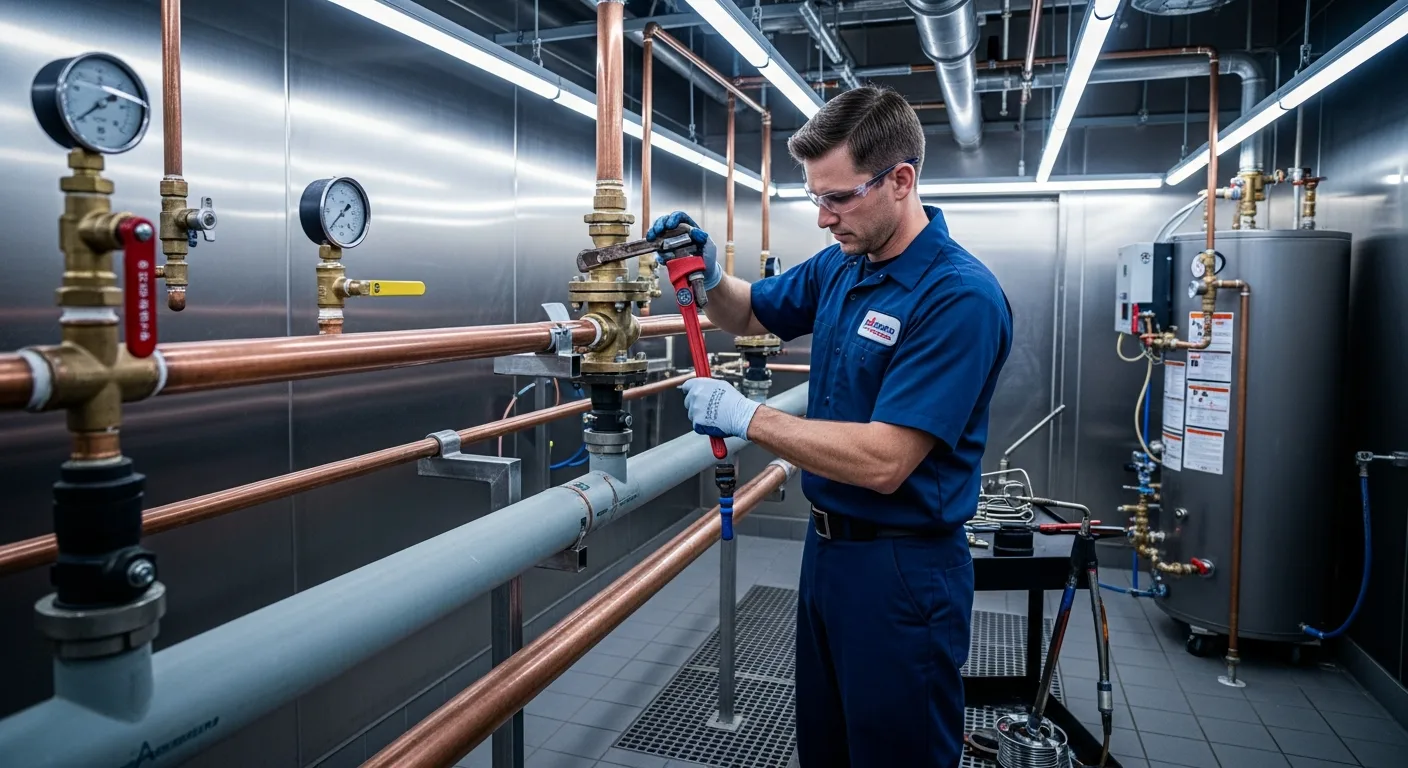
Flushometer Valve Repair in Phoenix
Most flushometer calls are a worn kit, a plugged bypass or low pressure. Find out which before replacing the valve.
A flushometer valve that runs on, flushes weakly, leaks or will not fire usually needs a matched repair kit, not a new valve. HQ rebuilds diaphragm kits, replaces vacuum breakers and handles, and diagnoses sensor valves. Supply pressure and the kit's flush volume are checked first, because both cause the same symptoms.
The rules that apply
Each rule links to the official text we read it from. Cities change these, so check the source before a big decision. Last checked 2026-10-04.
What the plumbing code requires of a flushometer
2024 IPCFlushometer valves comply with ASSE 1037, and their vacuum breakers with ASSE 1001. Access must be provided to the vacuum breakers. The valve is the water-conservation type, may not be used where pressure is below the minimum for normal operation, and has a means of regulating flow.
Source: 2024 IPC Sec. 415.2Phoenix flush volumes
PhoenixPhoenix's amended table sets water closets at 1.28 gallons per flush and urinals at 0.5 gallon. Service sinks are exempt, and certain building types, such as care facilities and buildings over six stories, keep the 1.6 and 1.0 gallon limits.
Source: Phoenix amendment to 2024 IPC Sec. 604.4Low-flush fixtures need running pressure at the valve
Manufacturer manualZurn's Aquaflush manual gives a recommended supply range of 10 to 100 psi, and says most low-consumption fixtures (1.28 and 1.6 gallon) require a minimum of 25 psi running pressure through the valve to evacuate properly.
Source: Zurn Aquaflush Z6000 installation and maintenance manualA short or long flush traces to the kit, orifice or pressure
Manufacturer manualThe manual lists a punctured diaphragm or enlarged bypass orifice for a valve that shuts off too quickly, a diaphragm kit not matched to the fixture for a short flush, and a plugged bypass orifice, debris at the trip mechanism or low line pressure for a valve that runs too long. Its fix for the first two is a replacement kit.
Source: Zurn Aquaflush Z6000 troubleshooting tableSensor valves need a live power supply
Manufacturer manualFor Zurn's hardwired AquaSense ZEMS-IS valve, a valve that does not activate after a user leaves is reset by shutting off the 6 VDC supply for 2 minutes and recalibrating the sensor. The guide asks for 6 to 9 VDC at the escutcheon and says a leaking sensor assembly may only need tightening.
Source: Zurn AquaVantage ZEMS-IS troubleshooting guideThe flush control has to be usable
Federal (ADA)Flush controls are hand operated or automatic. Hand-operated controls need one hand, no tight grasping, pinching or twisting, and no more than 5 pounds of force, and at a water closet they are on the open side.
Source: 2010 ADA Standards, Sec. 604.6, 605.4 and 309.4What types of flushometer valves are there, and how do they fail?
Most commercial toilets and urinals use a flushometer: a valve that releases a measured burst of line water instead of a tank. The valve may be manual, with a handle, or sensor operated, with a battery or a hardwired supply. Inside, a rubber diaphragm and a small bypass orifice control how long the valve stays open, and a vacuum breaker prevents siphoning dirty water back into the supply. Some designs use a piston instead of a diaphragm, and the parts differ, so identify the model before ordering anything.
The failures are consistent. Diaphragms tear or harden, bypass orifices clog with scale or grit, handle seals leak, vacuum breakers crack, and sensor valves lose power or calibration. Zurn's manual ties a short flush to a punctured diaphragm, an enlarged bypass or a kit that does not match the fixture, and a valve that will not shut off to a plugged bypass, debris at the trip mechanism, a cracked cover or low line pressure. Our guides to Sloan-style valves that keep running and a toilet that will not flush fully cover the symptoms by fixture.
When is a repair kit enough, and when do you replace the valve?
A kit is enough when the body is sound. A matched diaphragm or piston kit, a new handle assembly or a vacuum breaker repair kit renews the wearing parts without disturbing the rough-in, so the stop, the tailpiece and the wall stay as they are. Replace the valve when the body is cracked or pitted, the threads are damaged, the finish is gone and the chrome is peeling, or the valve is the wrong flush volume for the fixture and cannot be fixed with a kit. Replace it also when the model is obsolete and kits are no longer made. The kit must match the fixture's flush volume: Zurn's kits are sold by closet or urinal volume, including a 0.125 gallon urinal kit, and an unmatched one causes the short flush it was meant to cure.
A valve that needs a new kit every few months is a sign that the supply is the problem, not the valve.
Why do sensor flushometers stop flushing?
Usually power, calibration or a dirty sensor, not the valve body. Zurn's hardwired guide says to shut off the 6 VDC supply for 2 minutes and recalibrate the sensor if a valve will not activate, and to confirm 6 to 9 VDC at the escutcheon. Battery units need a fresh battery. Check the sensor window for scale or tape, and the solenoid for debris. Our pages on sensor flushometers that will not activate and urinal flush valves and vacuum breakers list more causes.
How do pressure and water-use limits affect a repair?
They decide whether a repair holds. Zurn says most 1.28 and 1.6 gallon fixtures need at least 25 psi running pressure at the valve, so a weak flush can mean a failing regulator or a partly closed stop, not a bad kit. The 2024 IPC also says a flushometer may not be used where pressure is below the minimum for normal operation. Phoenix set water closets at 1.28 gallons and urinals at 0.5 gallon in covered work, so a valve and fixture have to be matched, and a kit installed in the wrong volume causes problems. See commercial restroom water use measurement to check what your fixtures actually use. If the pressure is the issue, pressure regulator and hose bib repair covers the supply side.
When a flushometer repair is the wrong answer
If the fixture will not clear because the drain is slow, a new kit makes it worse. A urinal line clogged with scale needs cleaning; see urinal line uric scale clogs. If the problem is a loose or cracked bowl, a leaking floor flange or a seat, the valve is fine; our commercial toilet and urinal repair page covers those. And if several valves in the building misbehave at once, the cause is shared: water pressure, hammer or a failing regulator. A building with old fixtures in constant use may be better served by replacing the fixtures as part of a restroom remodel.
How to book
HQ repairs commercial flushometers with free estimates and upfront pricing before work starts, and handles emergency calls 24/7 when a valve will not shut off. Give us the brand and model if you can read it on the valve, the fixture type and what the valve is doing. Related: our toilet repair service, commercial plumbing and schools plumbing.
Why does my Sloan flushometer keep running?
A Sloan flushometer that keeps running almost always has a dirty diaphragm. A clogged bypass orifice, a relief valve that will not seat, or a worn diaphragm stops the valve from resealing. Shut the control stop, clean the parts under running water, and install the rebuild kit that matches the fixture's gallons per flush.
Read full answer: Why does my Sloan flushometer keep running?Why does a commercial flushometer toilet not flush fully?
A flushometer toilet that flushes weakly is usually short on pressure or flow, or its valve is out of adjustment or worn. Check the control stop first, then the diaphragm or piston and its bypass, then the bowl's rim holes and the drain. Zurn lists 25 psi running pressure for its valves, and some fixtures need more.
Read full answer: Why does a commercial flushometer toilet not flush fully?Why won't a sensor-operated commercial toilet flush?
A sensor-operated toilet that never starts a flush needs activation, power and water-supply conditions separated before a diaphragm is replaced. Identify the exact controller, record indicators and whether its intended manual control works, and follow its troubleshooting table. A dirty lens, recognition fault, disrupted power or closed supply can have different remedies; internal electrical and valve work needs qualified service.
Read full answer: Why won't a sensor-operated commercial toilet flush?Do urinal flush valves need a vacuum breaker?
Yes. A urinal flush valve, or flushometer, needs a vacuum breaker, because the valve pipes clean water straight into the fixture. The 2024 IPC requires flushometer vacuum breakers to meet ASSE 1001 and to be accessible, and the vacuum breaker's critical level must sit at least 6 inches above the urinal's flood rim.
Read full answer: Do urinal flush valves need a vacuum breaker?Sources
Related commercial services
How a meter test, section-by-section pressure test and acoustic listening locate a leak, and who pays once it is found.
Repair in place, reroute or open the slab, what Phoenix says about permits for concealed pipe, and planning around tenants.
Gauge test, replacement, fail-open design, vacuum breakers and why exposed plastic pipe is banned outdoors in Phoenix.
Where owner responsibility starts, how a failed service line is repaired or replaced, and what comes before the excavator.
What HQ does and does not do on a fire line, the Phoenix certificate rule, and the owner's upkeep duties.
The first ten minutes, the valve Phoenix says to close, what to document, and the notification clock in Phoenix code.
Valve Won't Shut Off?
Talk to a real dispatcher who knows commercial work. Upfront pricing before work starts, 24/7 for emergencies.