
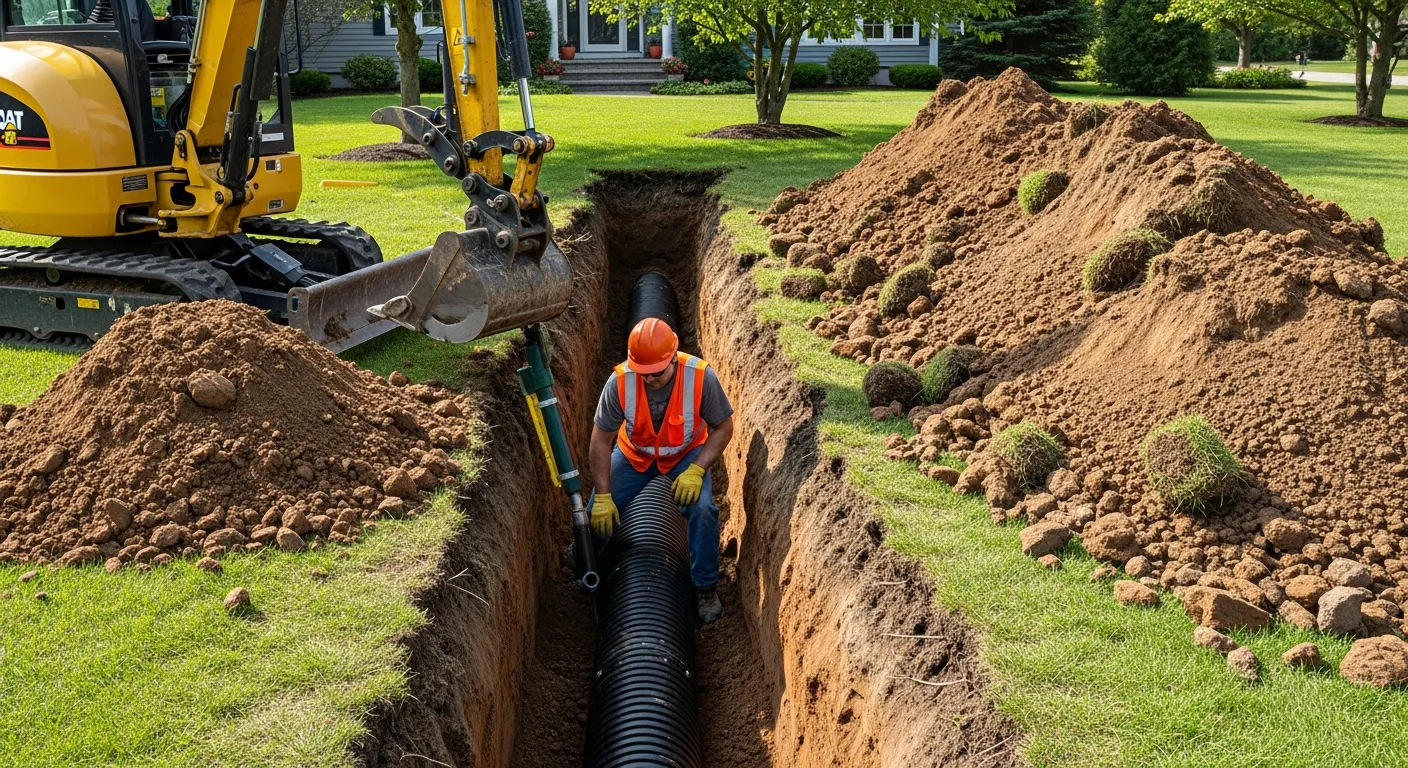
Commercial Sewer Lateral Repair in Phoenix
The line from your building to the city main is usually yours, but the piece under the street sometimes is not. Check before you bid.
A commercial sewer lateral repair fixes the pipe between a building and the public sewer main. HQ finds the failure with a camera and locate, then repairs the section, usually by open-cut excavation. Who pays depends on the city: Scottsdale puts the whole lateral on the commercial owner, while Glendale has the city dig the street.
The rules that apply
Each rule links to the official text we read it from. Cities change these, so check the source before a big decision. Last checked 2026-10-04.
Scottsdale: private up to the main
ScottsdaleBuilding sewers and laterals are private up to and including the tap on the public sewer. For commercial, industrial and non-residential properties, the owner, account holder or property management association is responsible for cleaning, unstopping, repair and replacement up to and including the connection to the public main, and for the costs.
Source: Scottsdale City Code 49-127(c)Chandler: owner to the tap, with a residential exception
ChandlerThe building service line is all piping on the owner's property and in the city right-of-way down to the tap on the city main, and the owner repairs it. Only for a single-family or duplex property does the city repair a broken section inside a street or alley, up to the owner's property line.
Source: Chandler City Code 51-6Glendale: the city digs the street
GlendaleThe property owner is responsible for cleaning, repair and replacement of sewers and connections to the public sewer, except when the work requires excavating a public street, public right-of-way or sidewalk, in which case the city does the work at no cost to the owner.
Source: Glendale City Code 33-217Surprise: contractor pulls two permits
SurpriseUsers other than single-family and duplex are responsible for the building sewer, lateral and tap from the building drain to the public sewer. When damage needs off-property excavation, the contractor obtains a permit to perform the repair and an encroachment permit to work in the right-of-way.
Source: Surprise City Code 58-312(b)Mesa: owner, except the off-property piece in a street or alley
MesaThe property owner is responsible for cleaning, maintenance and repair of the building connection from the building to the public sewer. Where correcting a stoppage requires repairing a broken section located off-property in a street or alley, the Water Resources Department makes the repair.
Source: Mesa City Code 8-4-8(E) and (F)No dig without a locate
ArizonaExcavating in a public street, alley, right-of-way or utility easement requires first determining where underground facilities are. Markings are valid for fifteen working days.
Source: A.R.S. 40-360.22Trenches need a protective system
Federal (OSHA)Employees in an excavation are protected from cave-ins by an adequate protective system, except in stable rock or where the excavation is under 5 feet deep and a competent person finds no indication of cave-in.
Source: OSHA 29 CFR 1926.652(a)(1)A repaired lateral gets a water test
2024 IPCA gravity sewer test plugs the building sewer at its connection to the public sewer, fills it, and holds a 10-foot head of water for 15 minutes.
Source: 2024 IPC Sec. 312.7What is a sewer lateral, and how do you know it has failed?
A lateral is the pipe that carries a building's waste from the building drain to the public sewer main. When it fails, the warning is repeated stoppages that jetting fixes for a short time, slow drains on every fixture at once, sewage backing up at the lowest drain, a sewer smell, or a wet or sunken spot over the line. A camera inspection settles the cause: roots in a joint, a crack, a belly that holds water, a collapse, or a disconnected fitting. Our pages on sewer camera inspection and how to find and read a commercial camera report explain what the footage shows. Do not buy a replacement before the camera shows where the break is.
Who owns the lateral in the Valley?
It varies by city, and the difference can decide the whole bid. Scottsdale's code says the lateral is private up to and including the tap on the public main, and for commercial and non-residential properties the owner or property management association pays for cleaning, repair and replacement all the way to that connection. Chandler is similar: the owner repairs everything down to the city tap, including pipe under the city right-of-way, and only a single-family or duplex property gets a city repair in a street or alley. Glendale and Mesa split it differently. In Glendale, if the repair requires excavating a street, right-of-way or sidewalk, the city does that work at no cost. In Mesa, the Water Resources Department repairs a broken section off-property in a street or alley when it is needed to correct a stoppage. Surprise puts it on the user and requires the contractor to pull a repair permit and an encroachment permit.
Phoenix's published lateral ownership section addresses single-family and duplex properties, so a commercial owner in Phoenix should get the city's answer in writing before assuming; see Phoenix sewer line ownership and our comparison of sewer line ownership by city. When you manage a multifamily building or an HOA, remember the code speaks of the account holder or management association, not the individual tenant.
Should the lateral be dug up, burst or lined?
The camera and locate decide, and the answer is not always a trench. Open-cut excavation works on every pipe: the crew digs, removes the failed section, sets new pipe on a proper bed, backfills and restores the surface. It is the right method for a collapse, an offset joint or a short repair. Trenchless methods work through small pits instead of one long trench. EPA's fact sheet says pipe bursting replaces the old pipe in place, can up-size it, and has limits: expansive soils, nearby service lines and a collapsed pipe can cause difficulty. Lining suits a pipe that is still mostly intact. See pipe bursting versus pipe lining and relining the whole line, part of it or nothing. Older materials have their own issues; see Orangeburg pipe on camera.
What permits, locates and safety steps come first?
A locate, then the permits, then a protected trench. Arizona law requires determining where underground facilities are before excavating in a street, alley or easement, and the markings last fifteen working days. In the right-of-way, expect an encroachment or right-of-way permit; Surprise's code says so directly. Under OSHA's excavation rule, workers in a trench need a protective system unless the trench is in stable rock or under 5 feet with no sign of cave-in, so ask the contractor how the trench will be shielded. Keep occupants and parked cars away from the trench; our guide to trench safety coordination for property owners lists what to settle first. After the repair, the new section is tested, and the city inspects where required.
When digging up the lateral is the wrong answer
If the problem is a clog or grease, cleaning is the answer, not excavation; see commercial drain cleaning. If the camera shows the line is sound but the main in the street is surcharging, the problem is the city's, and a backwater valve is the owner's protection. If the damage is in the street and your city handles that piece, call the city rather than hiring a repair. And if you are buying or leasing the property, a camera run before closing is a better deal than finding the break afterward; see camera inspection before buying or leasing.
How to book
HQ repairs and replaces commercial sewer laterals, with free estimates, upfront pricing before work starts and 24/7 emergency service for backups. Send us the address, the city, any camera video and the as-built drawings. Related: sewer repair, commercial plumbing and property management plumbing.
Services and tools
What should a commercial sewer camera report include?
A usable report has the full video, a written log of every defect with its distance from the start of the pipe, the pipe material and size, and a severity rating for each finding. It should say whether the line was cleaned first, and where and why the camera stopped.
Read full answer: What should a commercial sewer camera report include?Pipe bursting vs pipe lining: which sewer repair do I need?
Choose pipe lining (CIPP) when the old sewer pipe is still mostly intact, since a resin liner cures inside it to form a new pipe. Choose pipe bursting when the pipe is collapsed, badly broken, or needs upsizing. A camera inspection decides which fits.
Read full answer: Pipe bursting vs pipe lining: which sewer repair do I need?What should a property owner coordinate before sewer or water-line trenching?
Before sewer or water-line trenching, agree on utility locating, permits, site access, barriers and the contractor’s excavation-safety responsibilities. The employer’s competent person evaluates excavation hazards and required protective measures. Owners should keep occupants away and report changing conditions, not enter the trench or prescribe a shoring design. A locate ticket does not establish that a trench is safe.
Read full answer: What should a property owner coordinate before sewer or water-line trenching?Sewer backup in a multi-tenant building: what first?
First keep people away from the sewage and stop water use in the building so the backup stops growing. Then call a commercial plumber to find the blockage, notify the city if it is coming from the public main, and tell tenants in writing. Photograph everything before cleanup starts.
Read full answer: Sewer backup in a multi-tenant building: what first?Sources
- Scottsdale City Code Sec. 49-127, Building sewers and sewer laterals
- Chandler City Code Sec. 51-6, Owner responsibility for building service line
- Glendale City Code Sec. 33-217, Responsibility for cleaning, repair and replacement of sewers
- Surprise City Code Sec. 58-312, User's responsibility
- Mesa City Code Sec. 8-4-8, Building connections
- A.R.S. 40-360.22, Excavations; locating underground facilities
- OSHA 29 CFR 1926.652, Requirements for protective systems
- 2024 International Plumbing Code, Chapter 3 (Sec. 312.7)
- EPA Water Technology Fact Sheet: Pipe Bursting
Related commercial services
How a meter test, section-by-section pressure test and acoustic listening locate a leak, and who pays once it is found.
Repair in place, reroute or open the slab, what Phoenix says about permits for concealed pipe, and planning around tenants.
Gauge test, replacement, fail-open design, vacuum breakers and why exposed plastic pipe is banned outdoors in Phoenix.
Where owner responsibility starts, how a failed service line is repaired or replaced, and what comes before the excavator.
What HQ does and does not do on a fire line, the Phoenix certificate rule, and the owner's upkeep duties.
The first ten minutes, the valve Phoenix says to close, what to document, and the notification clock in Phoenix code.
Lateral Failing?
Talk to a real dispatcher who knows commercial work. Upfront pricing before work starts, 24/7 for emergencies.