
Grease Interceptor Replacement for Valley Restaurants
Rotted walls, a cracked floor or a tank that was never big enough. How the decision gets made, and how each city wants the paperwork before anyone digs.
Replace a grease interceptor when the tank walls or floor have failed, when it is too small for the kitchen, or when a city inspector requires it. Phoenix, Mesa, Chandler and Scottsdale all review the plans before anyone digs. HQ inspects the emptied tank, writes up whether repair or replacement is honest, and gives a free estimate.
The rules that apply
Each rule links to the official text we read it from. Cities change these, so check the source before a big decision. Last checked 2026-10-04.
Every replacement goes through plan review
PhoenixAll grease interceptors installed and replaced in Phoenix go through plan review. Only like-for-like hydromechanical swaps can go over the counter. A new gravity interceptor goes through electronic review, and a certificate of occupancy is required.
Source: Phoenix FOG BMP Manual, installation and Appendix BApproved models and minimum build
PhoenixGravity interceptors must come from the city's approved list. The smallest allowed is a 2-compartment, 2-man-way, 500 gallon unit. At 750 gallons and up there are at least three man-ways. Man-ways are at least 20 inches inside diameter, and the interceptor goes outside unless the city approves otherwise.
Source: Phoenix 2024 IPC amendments, Sec. 1003.3.7 (Ord. G-7397)Also: Phoenix FOG BMP Manual, Appendix AApproval before installation, then build rules
MesaInterceptors are of a type and capacity approved by the City Manager or Water Resources Director. Size runs 500 to 2,500 gallons, with at least two chambers, three at 750 gallons or more, and a two-way cleanout within 5 feet before and after the tank.
Source: Mesa City Code 8-4-22(B) and (E)Fixture count and plumbing plan with the permit
ChandlerYour plumber provides a fixture count and a plumbing plan to Development Services when applying for the plumbing permit. The number of fixtures draining to the device sets its size.
Source: Chandler food service establishments pageNever installed at risk
ScottsdaleInterceptors may not be installed at risk. Plans may need an Arizona registrant's stamp. A gravity unit needs site and civil drawings showing setbacks and public utility easements. Interceptors are single-user, and all work is by a licensed plumbing contractor per ROC requirements.
Source: Scottsdale grease interceptor guidelinesRotted tanks are replaced, not patched
PhoenixPhoenix inspectors check whether the interceptor has rotted out and needs to be replaced, and an inspector can issue a requirement to replace with a deadline.
Source: Phoenix FOG BMP Manual, routine inspectionsWhen replacement is the honest answer
Replace the tank when the structure is the problem, not a part inside it. That means walls that have lost their surface, a cracked floor, a tank that leaks, or one that is simply too small for the kitchen it serves. Phoenix puts it directly: inspectors check whether the interceptor has rotted out and needs to be replaced. A baffle or a tee can be repaired. A tank that is dissolving cannot.
Other triggers are not about damage. A restaurant that added a dishwasher or more floor drains may have outgrown its tank, since Phoenix, Chandler and Scottsdale size the device from the fixture count. An inspector can also write a requirement to install a bigger device. And a space that used to be retail may have no grease line at all, which is its own project. See a new grease interceptor for a former retail space.
How we decide, and why we look first
We do not quote a replacement from the lid. A licensed hauler pumps the tank, and HQ does not pump, then our three-person confined-space crew inspects it from inside. If the baffles and fittings are the only failed parts, the answer is interceptor repair. If the walls and floor are failing, you get that in writing, with what we saw, so the replacement estimate rests on facts. The inspection is covered on our interceptor inspection page.
What each Valley city wants before anyone digs
Plan first, dig second. The cities differ on the details.
Phoenix. All installs and replacements go through plan review with Planning and Development. A like-for-like trap swap can be done over the counter. A new gravity tank goes through electronic review, with a plumbing floor plan, and an isometric if any fixture is re-piped. The submittal lists every grease-bearing fixture, the device make and model, and, if an inspector required the work, a copy of the inspection report. The city has an approved list, and the minimum gravity size is a 500 gallon unit with two compartments and two man-ways.
Mesa. Every interceptor must be of a type and capacity approved by the City Manager or Water Resources Director. Mesa sizes from drainage fixture units, with a 500 to 2,500 gallon range, at least two chambers, and a traffic-rated cover that carries no wording saying the city owns it.
Chandler. The plumber supplies a fixture count and a plumbing plan to Development Services with the permit application. Chandler's own sizing method applies.
Scottsdale. No at-risk installs. Plans can need an Arizona registrant's stamp, and a gravity tank needs site and civil drawings with setbacks and easements. Scottsdale also notes that standard pumping trucks have a 2,500 gallon limit, so a tank beyond that needs larger trucks at every pump-out.
For the full city-by-city table, see permits for replacing a grease interceptor in the Valley and the Phoenix plan review page.
What the installation involves
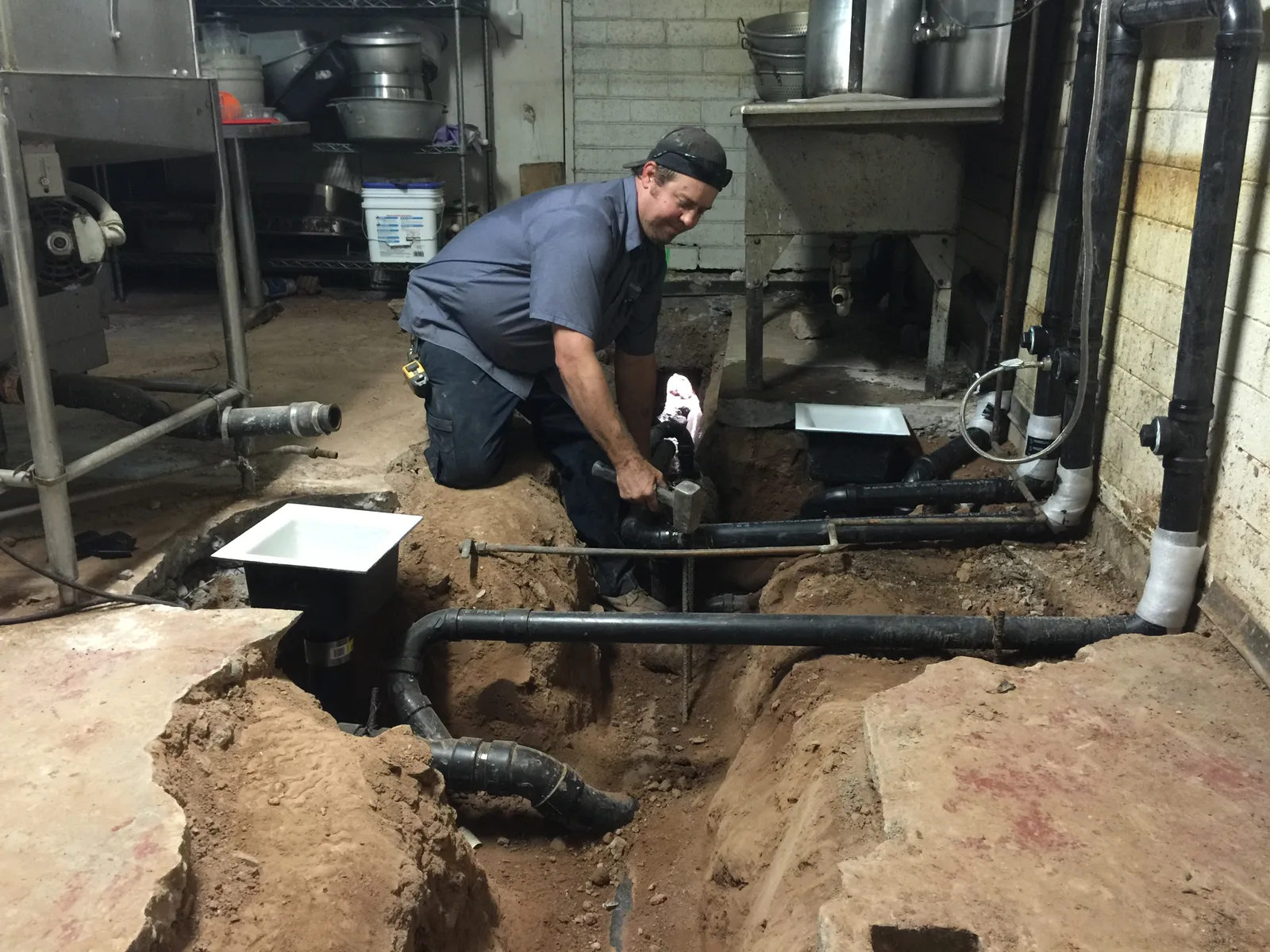
Once plans are approved, the job runs in a set order: excavate, set the tank on a prepared base, connect the inlet and outlet, add the cleanouts, set the risers and covers, inspect, then bring the tank into service. Several details come straight from the codes. Phoenix requires the drain piping upstream of the tank to slope at least 1/4 inch per foot. Mesa requires a two-way cleanout within 5 feet on each side. Phoenix requires the risers to be grouted with shrink-proof grout. The tank maker's instructions govern the rest. Our installation steps page walks the sequence, and the sizing calculator shows how fixture count becomes gallons.
Because a new tank often sits under a parking lot or drive lane, location and access come first. See lids and risers and where a grease interceptor can go.
When this is the wrong answer
Replacement is the wrong answer when one part failed in a sound tank, when the real cause is a full tank or a bypassed fixture, or when the only issue is a lid. It is also the wrong answer if you are a tenant and the tank is shared. A shared strip-center tank has an owner and several users, and the landlord is part of the decision. See shared grease interceptors in strip centers.
Next step
Call us with your city, the tank's size if you know it, and what the pumper or inspector said. We offer free estimates and an upfront price before work starts, and 24/7 emergency service if a kitchen is backing up. Related: grease trap and interceptor service, restaurant plumbing and sewer repair.
Services and tools
Do you need a permit to replace or add a grease interceptor?
Yes. To replace or add one, Phoenix says every grease interceptor installed or replaced goes through plan review, and Scottsdale bars installing one at risk. Mesa says interceptors must be reviewed and approved before installation. Chandler wants a fixture count and plumbing plan with the permit application. Tempe wants plans accepted before construction.
Read full answer: Do you need a permit to replace or add a grease interceptor?What is involved in installing a grease interceptor?
Installing a restaurant grease interceptor means counting the grease fixtures, sizing the tank, getting an approved model through city plan review, then having a licensed plumbing contractor set it outside and pipe every grease fixture to it. In Phoenix, plan review comes before any digging.
Read full answer: What is involved in installing a grease interceptor?Why do concrete grease interceptors corrode?
Decaying grease and food solids release hydrogen sulfide gas. Above the waterline, bacteria turn it into sulfuric acid, which eats the concrete until aggregate and rebar show. Light damage and broken baffles can often be repaired or coated, but an interceptor that has rotted through usually gets replaced, and in Phoenix that means plan review.
Read full answer: Why do concrete grease interceptors corrode?When must a grease trap be replaced by an interceptor?
A restaurant has to move from an indoor grease trap to an outdoor interceptor when the kitchen outgrows what a trap may serve: more than four fixtures or any commercial dishwasher. Phoenix adds garbage disposals. Scottsdale and Gilbert can also require the change after a remodel, an addition or a grease blockage.
Read full answer: When must a grease trap be replaced by an interceptor?Sources
- City of Phoenix: FOG Best Management Practices for Food Service Establishments (June 2024)
- City of Phoenix: Amendments to the 2024 International Plumbing Code (Ord. G-7397)
- Mesa City Code Sec. 8-4-22, Interceptors
- City of Chandler: Food Service Establishments
- City of Scottsdale: Grease Interceptor Guidelines
Related commercial services
Baffle, tee and standpipe repairs inside the tank, what inspectors cite, and how the pumper and repair crew are sequenced.
How a failed baffle shows up, how it gets repaired, and the point where the honest answer is a new tank.
Which fitting does what, what Mesa's code says about down spout length, and how a missing tee gets replaced.
What an inside inspection covers, why hardened grease on the pass-over baffle matters, and how to be ready for a city inspector.
Flow control, gaskets and lids on indoor traps, cleaning versus replacing, and the four-fixture rule that decides what you may install.
Traffic-rated covers, risers, manway sizes and access rules, and the signs a lid needs attention now.
Is It Time for a New Tank?
Talk to a real dispatcher who knows commercial work. Upfront pricing before work starts, 24/7 for emergencies.