
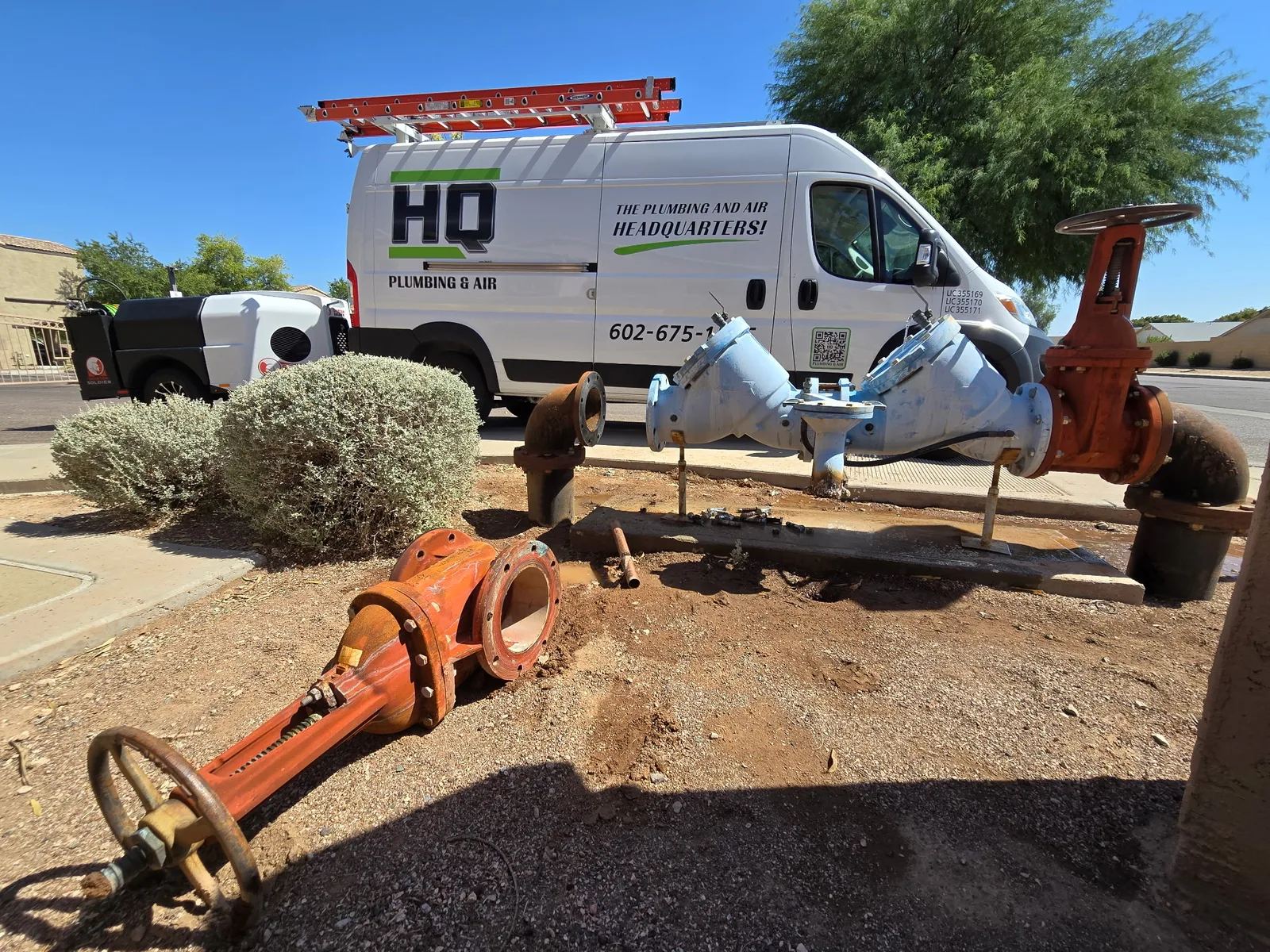
Backflow Assembly Repair in Phoenix
Check valves, relief valves, springs, seats and shutoffs rebuilt on failed or leaking domestic assemblies, then retested by a certified tester.
A backflow assembly that fails its test or leaks is usually rebuilt, not replaced. A certified repairer cleans or replaces the check valves, springs, seats or relief valve parts, then a certified tester retests it and files a passing report. Phoenix requires repairers certified to ASSE 5130, and Mesa wants the retest within 24 hours.
The rules that apply
Each rule links to the official text we read it from. Cities change these, so check the source before a big decision. Last checked 2026-10-04.
Who may repair
PhoenixAssembly repair must be performed by a certified repairer following ASSE Series 5000 Standard No. 5130. Testing is a separate certification.
Source: Phoenix City Code 37-143Who may repair
ScottsdaleInstallation, testing, maintenance, repair and replacement of backflow assemblies may only be done by an individual certified and approved by an agency the city recognizes.
Source: Scottsdale Revised Code 49-65(d)Repair deadline after a failed test
ScottsdaleA defective assembly must be returned to satisfactory condition within 45 days after the date of the city's notice.
Source: Scottsdale Revised Code 49-65(b)Repair and retest clocks
MesaRepairs found at the annual test are done by the compliance due date. A defect found between tests is fixed within 15 calendar days. After any repair, a recognized tester retests within 24 hours.
Source: Mesa City Code 8-1-11(G), (H), (I)What the failed report records
PhoenixReplaced parts are listed with part numbers. A failed assembly's report shows the date of failure, date of repair and date it passed.
Source: Phoenix TRT 00335Inspection after repair
TempeAfter repair, repiping, overhaul or relocation, the user has the assembly inspected by the department and tested by a certified tester. Records list the materials or replacement parts used.
Source: Tempe City Code 33-107(a), (e)No permit for small secondary assemblies
PhoenixRepair or replacement of an existing secondary assembly 2 inches or smaller is exempt from a permit, but a certified tester's report goes to the city at the time of the repair.
Source: Phoenix Building Construction Code 105.2, plumbing item 6What a failed test actually means
A failed test means one part of the assembly didn't hold the number the procedure requires. It rarely means the whole assembly is junk. The tester's gauge readings point to the part:
- A check valve that won't hold. On a double check, Watts' service manual for its large assemblies lists the causes as debris on the seat, a damaged seat, a damaged clapper or a broken spring.
- An RP relief valve that dumps water. The same manual's troubleshooting table starts with a fouled first check, then a leak in the second check, fluctuating inlet pressure, or a relief valve with a damaged diaphragm or weak spring.
- A shutoff valve that won't close tight. The test needs tight shutoffs to read the checks, so a leaking shutoff can fail a test that the checks would have passed.
The gauge readings narrow it down. Watts' RP guide reads a steady 4 to 7 psid across the first check as a relief valve problem, 2 to 3 psid as a leaking check, and a fluctuating reading as unstable inlet pressure. That's why we read the numbers before we open anything. If your RP is discharging between tests, see why an RPZ spits water.
Who is allowed to repair it
Valley cities are strict about who touches the inside of an assembly.
- Phoenix requires a certified repairer working to ASSE Standard 5130 (City Code 37-143). Phoenix also asks test companies on its list to file both a tester certificate and a repairer certificate.
- Scottsdale limits installation, testing, maintenance, repair and replacement to individuals certified and approved by an agency the city recognizes (Revised Code 49-65(d)).
- Mesa says anyone doing backflow maintenance and testing in the city must be a recognized tester (City Code 8-1-12).
A handyman with a repair kit doesn't meet any of those. Neither does a tester who isn't on that city's list.
The clock in each city
| City | Deadline to repair | Retest and report |
|---|---|---|
| Phoenix | To the city's satisfaction, by the date it sets | Report shows date of failure, repair and pass, with part numbers |
| Mesa | By the compliance due date; 15 days if found between tests | Retest within 24 hours; record within 7 days |
| Scottsdale | 45 days after the city's notice | Records within 7 days |
| Tempe | Before the due date in the overdue notice | Department inspection plus a certified test |
| Chandler | By the compliance date | Water is shut off the next working day without a passing report |
Late is expensive. Phoenix can add a civil penalty of up to 1,000 percent of water charges per billing period under City Code 37-146, and shut water off after ten days' written notice. Our FAQ on a failed backflow test covers the notices step by step.
Repair or replace
Repair is the default. Check rubber, springs, seats and relief valve parts are all serviceable on most commercial assemblies, and the Watts manual walks through replacing seats and relief valve parts in the field. Replacement makes sense when parts for an old model aren't available, the body is damaged, or the assembly is the wrong type for the hazard. Then it's a backflow assembly replacement.
The permit question differs by city. Phoenix's building code exempts repair or replacement of existing secondary assemblies 2 inches and smaller from a permit, as long as a certified tester's report goes to the city at the time of the work. Gilbert requires a permit when a failed assembly can't be repaired and is replaced. So a repair usually skips the permit counter. A replacement often doesn't.
What HQ does
HQ repairs leaking and failed domestic backflow assemblies, retests them and files the passing report with the city. A failed test followed by a repair and retest is cheapest in downtime when it happens on one visit, so tell us the shutoff limits ahead of time. Phoenix's form asks for the part numbers on the report. Fire backflow assemblies and fire sprinkler work are outside what HQ does.
If the city's deadline is close, tell us the date when you call. We offer 24/7 emergency service for an assembly that's flooding the planter, and an upfront price before work starts. Related: commercial backflow testing, commercial plumbing, emergency plumber and property management plumbing.
Services and tools
My backflow assembly failed its test. What happens next?
The assembly has to be repaired or replaced, retested by a certified tester, and a passing report filed with your water provider by its deadline. Most failures are fixed by cleaning or rebuilding the check valves or relief valve. Mesa wants repairs done by the compliance date, and Scottsdale gives 45 days after its notice.
Read full answer: My backflow assembly failed its test. What happens next?Why is my RPZ backflow preventer spitting water?
An RPZ spits from its relief valve when pressure between its two check valves gets too close to the supply pressure. A short spit when street pressure dips can be normal. Steady or repeated discharge usually means a fouled first check, a leaking second check with backpressure, or a worn relief valve. It needs a test and repair.
Read full answer: Why is my RPZ backflow preventer spitting water?What happens if I miss my Phoenix backflow test deadline?
Under City Code 37-146, Phoenix can shut off your water after 10 days written notice, or right away if your system could be a health hazard. It can also add up to 1,000 percent to your water charges per billing period. Service comes back only after the test is done and you pay the city's costs and penalties.
Read full answer: What happens if I miss my Phoenix backflow test deadline?How do I read a backflow test report and its numbers?
A backflow test report gives each valve a psid reading and a closed tight or leaked mark, then the tester marks pass or fail. Published test procedures set common minimums: an RP relief valve opens at 2.0 psid or more, and DC check valves and vacuum breakers hold 1.0 psid or more. The certified tester decides.
Read full answer: How do I read a backflow test report and its numbers?Sources
- Phoenix City Code 37-143, Responsibility for backflow prevention control
- Phoenix City Code 37-146, Remedies
- City of Phoenix TRT 00335: Backflow Assembly Test Report Instructions
- Phoenix Building Construction Code amendments to IBC Chapter 1, Section 105.2
- Mesa City Code Title 8 Chapter 1, Backflow Prevention (2025)
- Scottsdale Revised Code 49-65, Inspections; maintenance; records
- Tempe City Code 33-107, Maintenance, testing and records
- City of Tempe: Backflow Prevention Program
- City of Chandler: Backflow Testing and Maintenance Process
- Town of Gilbert: Backflow FAQ
- Watts (Ames) 2000DCA, 3000DCDC, 4000RP, 5000RPDA installation and maintenance manual
Related commercial services
Who may test, what the report must show, how long the water is off, and where each Valley city wants the results.
Which kitchen and bar connections carry a testable assembly, which cities require one at the meter, and how to test without losing a service.
Master meter rules by city, the assemblies a typical complex carries, who the city holds responsible, and how to batch the yearly tests.
When a PVB is allowed on landscape water, when the city requires an RP instead, and what fails most on irrigation assemblies.
Repair or replace, picking the assembly type the hazard calls for, and how permits differ for a replacement across the Valley.
What to do in the first hour after a theft, why nobody may pipe across the gap, and how the replacement and retest go.
Assembly Failed Its Test?
Talk to a real dispatcher who knows commercial work. Upfront pricing before work starts, 24/7 for emergencies.