
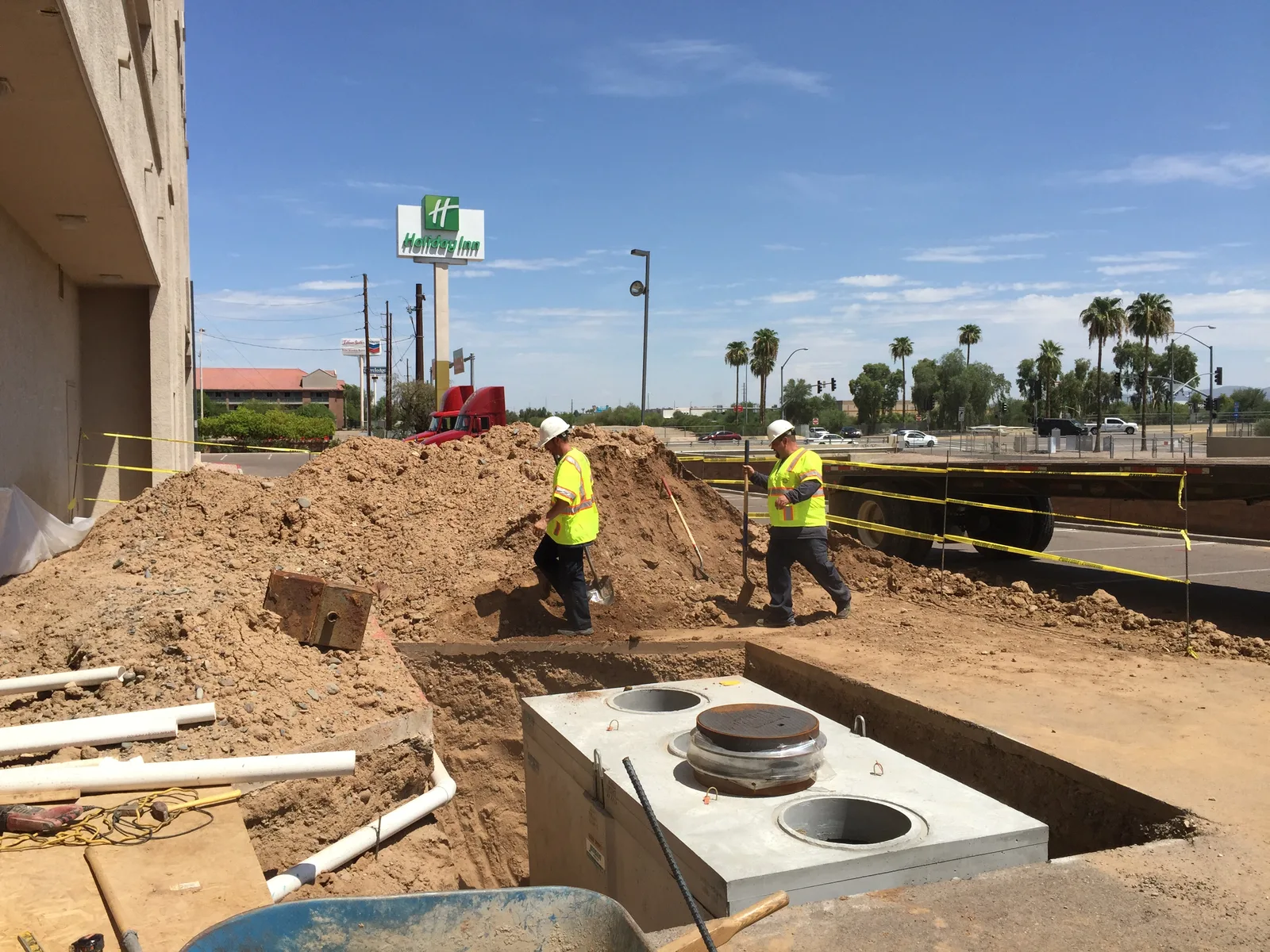
Grease Trap Service in Phoenix
Cleaning, repair, replacement and installation for restaurants and commercial kitchens, built around your city's grease rules. 24/7 emergency service.
What You Need To Keep a Kitchen Legal and Flowing
A grease trap or interceptor has to be cleaned on the schedule your city sets (in many cities, before it reaches 25 percent full), kept in working order, and documented, because your city inspects it. That is the job. We service, repair, replace and install traps and interceptors for restaurants and commercial kitchens across the Valley, and we work from your city's actual rules, not a generic checklist.
A licensed and insured plumber looks at the device and the lines, and you get a free estimate and an upfront price before any work starts. If your kitchen is backing up now, we offer 24/7 emergency service.
Which One Does Your Kitchen Need?
| Device | What it is | Usually fits |
|---|---|---|
| Grease trap | Small unit near the fixtures, often indoors | Small kitchens with few grease fixtures and no commercial dishwasher, where the city allows one |
| Grease interceptor | Large tank, often a gravity interceptor buried outside | Bigger kitchens, kitchens with a commercial dishwasher, and cities that require one |
The line between them is set by your city. Phoenix, Mesa, Scottsdale and Tempe allow an indoor trap only when a kitchen has four or fewer fixtures and no dishwasher. Compare all of them in the Valley grease trap and interceptor rules by city. Sizing questions are covered in what size grease interceptor a restaurant needs and whether a commercial dishwasher can drain to a grease trap.
Cleaning Schedules and the 25 Percent Rule
A common rule in Valley programs: clean the device before fats, oils, grease and solids reach 25 percent of its capacity. Chandler states it exactly that way, though not every city uses that rule. Past that point the device stops catching grease and starts passing it to the sewer.
The required schedule is different in every city. Some set a calendar, and the intervals in the Valley range from every 30 days for small traps to every six months for some interceptors. Others go by the 25 percent rule. Start with how often to pump a grease trap, then look up your city: Phoenix, Tempe, Scottsdale and Chandler.
Additives do not change the schedule. Chandler prohibits adding enzymes and bacterial products to a grease device to reduce cleaning or pumping, and the same is true in other cities. See whether enzyme grease treatments are allowed in Phoenix.
Grease Trap and Interceptor Services
- Cleaning and maintenance. We clean the unit and check the baffles, tees, lids and connections. Where your city requires a licensed hauler for the contents, we tell you how that is handled on your job. Some cities, Chandler among them, let kitchens clean their own devices.
- Repair. Broken baffles or tees, leaking tanks, damaged lids and bad connections.
- Replacement. Failed or undersized traps and interceptors. Cities can require plan review for a replacement. See plan review for replacing a grease interceptor in Phoenix.
- New installation. Sizing, placement and connection to your city's requirements, for new restaurants and remodels.
- Line jetting. Grease builds up in the lines leading to and from the device. Our hydro jetting and commercial drain cleaning clear them.
Signs Your Grease Device Needs Attention
Records the Inspector Will Ask For
Every Valley program we checked expects a log. Chandler requires pumping, cleaning, maintenance and repair records to be kept on site for three years, showing the date, who did the work, what was done, how much was removed and where it went. Scottsdale also requires written logs kept for at least three years and handed over on request.
Keep the log where the manager can find it in a minute. Ask whoever services your device for a written record every time, and if a record is missing, fix that first. Related: the records Chandler restaurants keep on site and Scottsdale's interceptor record rules.
What Affects the Cost of Grease Trap Service
We do not post prices because the device and the job decide them. These are the factors:
- Size and type. A small trap and a large buried interceptor are different jobs.
- Condition and access. How full it is, and whether the lid and lines are easy to reach.
- Line condition. Whether the lines also need jetting or a camera check.
- Repair, replace or install. Each has its own materials, labor and permits.
- Timing. An after-hours emergency is a different visit from a scheduled one.
The way to get an exact number is the free estimate. You get the price up front, before any work starts. Backed up right now? Read what to do when a commercial kitchen drain overflows.
Serving The Entire Phoenix Metro
Our crews deliver grease trap & interceptor service across Phoenix and the surrounding Valley. Find your city below:
Explore More Services
Kitchen Backing Up?
Call HQ for a free estimate and an upfront price. We offer 24/7 emergency service.