
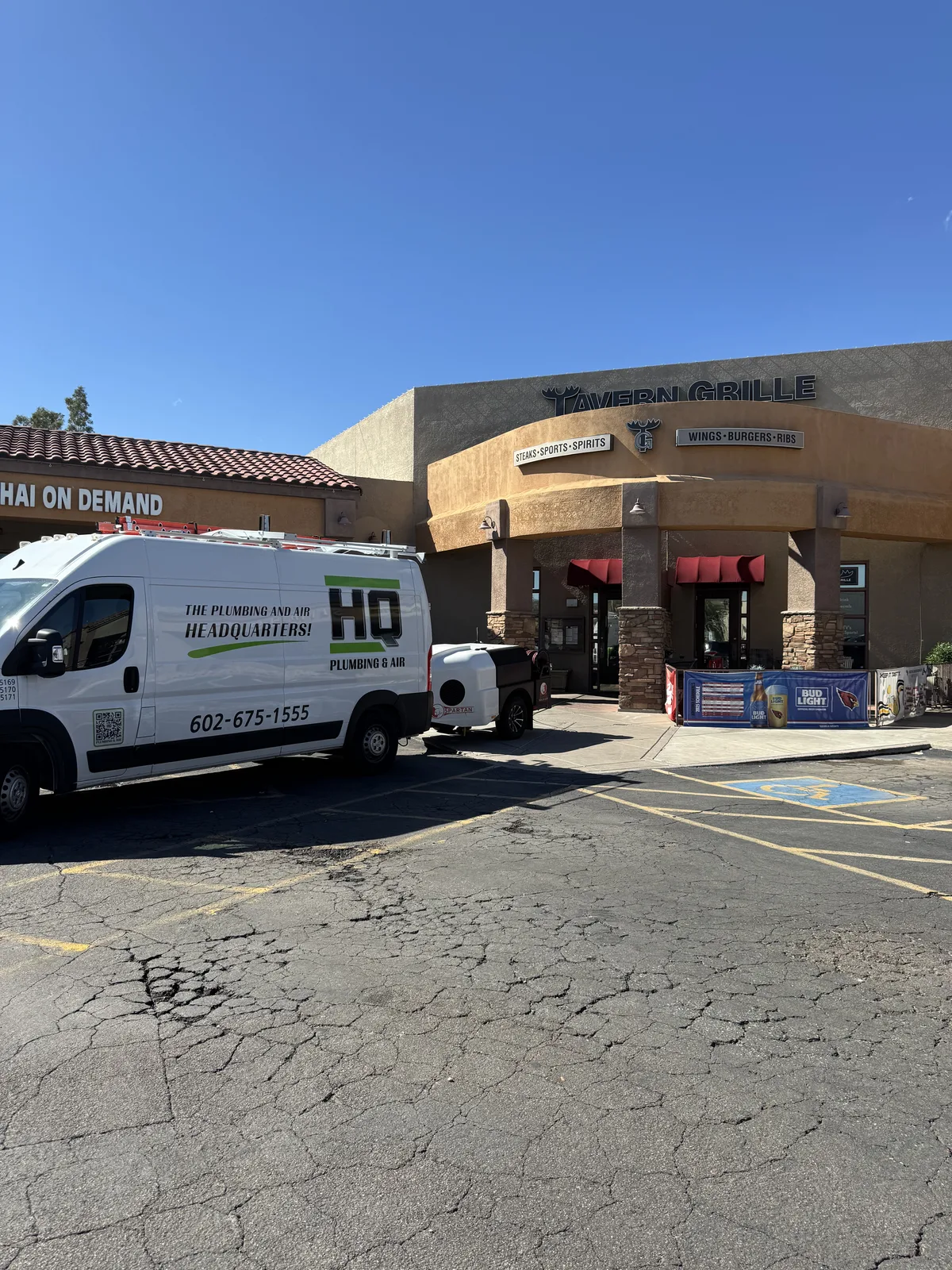
Restaurant Kitchen Drain Cleaning in Phoenix
Floor sinks, prep sinks, three-compartment sinks and dish machine drains cleared from inside the kitchen, timed so your next service starts on a working line.
A clogged kitchen drain is cleared from the fixture side. HQ pulls the strainer, clears the floor sink or receptor trap, then cables or jets the line behind it with a small hose, and tests it with the dish machine running. The work usually takes one to two hours, before opening or after close.
The rules that apply
Each rule links to the official text we read it from. Cities change these, so check the source before a big decision. Last checked 2026-10-04.
Sink wells drain through an air gap, one receptor per well
Phoenix (IPC 802.1.1)Equipment and fixtures used for food storage, preparation and handling discharge through an indirect waste pipe by means of an air gap, and each well of a multiple-compartment sink discharges independently to a waste receptor. That is why the water you see is in a floor sink, not in the sink.
Source: 2024 IPC Chapter 8 as adopted by Phoenix, Section 802.1.1Dish machines and pot sinks
Phoenix (IPC 802.1.6 and 802.1.7)A commercial dishwashing machine discharges through an air gap or air break into a waste receptor, and sinks used to wash, rinse or sanitize utensils, dishes, pots and pans discharge indirectly the same way.
Source: 2024 IPC Chapter 8, Sections 802.1.6 and 802.1.7Receptors need a removable strainer and ready access
Phoenix (IPC 802.4)A removable strainer or basket covers the outlet of a waste receptor, receptors cannot sit in concealed spaces, and ready access must be provided. Standpipes must have access for rodding.
Source: 2024 IPC Chapter 8, Sections 802.4 and 802.4.3Floor drains must be cleanable
Phoenix (IPC 413.2)Floor drains have removable strainers, are built so the drain can be cleaned, and have ready access. A floor drain you cannot reach is a code problem as well as a clog problem.
Source: 2024 IPC Chapter 4, Section 413.2Which kitchen fixtures the city counts as grease-bearing
PhoenixFloor sinks, floor drains, mop sinks, trough sinks and drains, pre-wash sinks, prep sinks, pot sinks, can wash sinks, dishwashers and garbage disposals in the kitchen prep or wash area are all grease-bearing fixtures. Hand sinks are not.
Source: Phoenix FOG BMP Manual, grease-bearing fixturesNo chemical or enzyme shortcut
PhoenixUsing chemicals, enzymes, proteins, bacteria, grease solvents or emulsifiers to temporarily dissolve fats, oils and grease is prohibited under the city's interceptor maintenance rules. Dissolved grease cools and coagulates farther down the sewer.
Source: Phoenix FOG BMP Manual, interceptor cleaningAlso: Phoenix Water Services sewer cleaning FAQs, question 4Steeper slope on lines that feed an interceptor
Phoenix (amended IPC 704.1)Drainage piping upstream of a grease interceptor must slope at least 1/4 inch per foot, a steeper minimum than the base code gives for 3 to 6 inch pipe. A kitchen line that holds water after cleaning may have a sag a camera can find.
Source: 2024 IPC Chapter 7 as adopted by Phoenix, Section 704.1Also: Phoenix amendments to the 2024 IPC, Section 704.1Which kitchen drains clog first
Floor sinks and the dish machine receptor clog first, because they take grease, starch and food solids from several fixtures at once. Phoenix's FOG manual counts floor sinks, floor drains, prep sinks, pot sinks, mop sinks and dishwashers as grease-bearing fixtures, which is a fair map of where a kitchen's slime comes from.
The plumbing code adds a wrinkle that confuses a lot of kitchens. Under the 2024 IPC as Phoenix adopts it, food prep sinks, pot sinks and dish machines discharge through an air gap into a waste receptor, and each well of a three-compartment sink gets its own. So the standing water you see in a floor sink under a sink is not a sink clog. It is the receptor's trap and the line behind it.
That gives you a simple field test. If a sink holds water but the floor sink next to it is empty, the clog is in that sink's own tailpiece or trap. If the floor sink fills and drains slowly every time the dish machine dumps, the clog is downstream of the receptor. Tell us which one you are seeing when you call, and we arrive with the right tools.
What we do inside the kitchen
We clear kitchen drains from the fixture side and leave the line open end to end. A typical visit goes like this:
- 1We confirm which fixtures are affected and which are fine, since the pattern points to the clogged section.
- 2We lift the strainer basket and clear the receptor trap by hand. Many "clogs" end here.
- 3We run a cable or a small-hose jet from the receptor or the nearest cleanout, working in the direction of flow.
- 4We flush the line, then run the dish machine and the sinks to confirm that it drains fast and holds no water.
- 5We pull a camera through the run if the same fixture has clogged before.
The work is scheduled before opening or after close, and the inside portion usually takes one to two hours. We give you the price before work starts, and the estimate is free. If we find something that needs a separate fix, such as a sagging line, we tell you before touching it.
When we jet and when a cable is enough
A cable is enough when one hard obstruction sits close to the fixture. A jet is the better tool when the pipe wall is coated with grease or starch, because a cable punches a hole through that coating and leaves the rest of it behind. The hole closes within weeks, and the same floor sink backs up again.
Manufacturers match hose to pipe. RIDGID's operator manual pairs 2 to 3 inch kitchen sink, laundry and stack lines with a 3/16 inch jetter hose, and floor drains, lateral lines and grease traps in the 3 to 4 inch range with a 1/4 inch hose. That is why interior line work uses small equipment. Our page on restaurant lateral line jetting covers the lines past the fixtures, and the main line has its own page at restaurant main line jetting.
Why chemicals and enzymes are not the shortcut
A bottle of drain opener or an enzyme treatment is tempting at 11 p.m. It rarely works in a kitchen line, and in Phoenix it is on the wrong side of the rules. The city's FOG manual prohibits using chemicals, enzymes, proteins, bacteria, grease solvents or emulsifiers to temporarily dissolve fats, oils and grease. The city's own sewer FAQ explains the problem: grease cools as it enters the sewer and coagulates, causing a blockage. Dissolving it only moves it downstream. Mechanical cleaning removes it.
When this is the wrong answer
Kitchen drain cleaning is not the fix for every backup, and we will say so.
- Every fixture backs up together. That points to the main line or a full interceptor, not the fixture lines. See restaurant main line jetting. If the interceptor is full, a licensed hauler pumps it. We do not pump, but our grease trap service covers the repair and inspection side.
- The dish machine overflows its receptor only at full dump. Check that the strainer basket is in place and clean. The code requires a removable strainer so your crew can empty it daily.
- Water stands in the line after we clear it. That is a sag or a broken section, not a clog. Jetting more will not fix it, and the next step is a camera inspection.
You can handle a slow hand sink or a single fruit-fly floor drain yourself with a brush and hot water. Anything that smells of sewage or fills the floor needs a plumber.
How to book
Call with the fixtures affected, how long it has been going on, whether the dish machine is involved, and when the interceptor was last pumped. Our 24/7 emergency line takes after-hours calls, and routine kitchen drain work is booked around your doors. For a recurring problem, see scheduled drain maintenance, and for the full picture of how we serve kitchens, see restaurant plumbing and our commercial drain cleaning and hydro jetting services.
Services and tools
Codes and permits
Why does my commercial kitchen drain keep overflowing?
Grease is the usual cause. Fats, oils, and grease wash down warm, then cool and harden on the pipe walls until the line chokes. The EPA found grease causes 47 percent of sewer blockages. A full grease trap, food solids, or a clog in the main line make it worse. The fix is hydro jetting plus regular interceptor service.
Read full answer: Why does my commercial kitchen drain keep overflowing?When is a floor sink required in a commercial kitchen?
A commercial kitchen needs an approved waste receptor where equipment must drain indirectly, often a floor sink. Food prep equipment needs an air gap; other connections may allow an air break. A floor sink must be trapped, vented and accessible. The adopted code and county-approved plans determine the layout.
Read full answer: When is a floor sink required in a commercial kitchen?Do commercial sinks need an air gap or indirect waste?
Yes, for food sinks. The plumbing code has sinks used to wash utensils, pots and dishes drain indirectly through an air gap or air break, and Maricopa County wants a three-compartment sink drained with at least a 1-inch air gap. Each sink compartment drains on its own into a trapped receptor such as a floor sink.
Read full answer: Do commercial sinks need an air gap or indirect waste?Why is my grease trap backing up into the floor sinks?
Wastewater is taking the easiest way out. The usual causes are a trap or interceptor past its cleaning date, grease coating the line downstream, or a blockage in the sewer line. Stop water use, get the device pumped, then have the line jetted and camera-checked before the next dinner rush.
Read full answer: Why is my grease trap backing up into the floor sinks?Sources
- 2024 International Plumbing Code as adopted by Phoenix, Chapter 8 (Indirect/Special Waste)
- 2024 International Plumbing Code as adopted by Phoenix, Chapter 4, Section 413
- 2024 International Plumbing Code as adopted by Phoenix, Chapter 7, Section 704
- City of Phoenix: FOG Best Management Practices for Food Service Establishments (June 2024)
- City of Phoenix: Amendments to the 2024 International Plumbing Code
- City of Phoenix Water Services: Sewer Cleaning FAQs (May 2026)
- RIDGID KJ-1350 and KJ-1750 Water Jetter Operator Manual, hose selection chart
Related commercial services
Why interior branch lines need a small hose, what a cable leaves behind, and how the job is paired with a main line pass.
Where the private main ends and the city sewer begins, why a cleanout decides the job, and why the main and the branches get jetted as a pair.
Why soda and ice well drains stink, what Maricopa County and the plumbing code say about their air gaps, and what a cleaning visit does.
How interior drain work is scheduled around service, what the window looks like, and what happens when a stoppage hits at night.
How to tell a fixture problem from a line problem, why a cable alone keeps failing, and what the repeat call sequence looks like.
Why floor drains back up or stink in the Valley, what a trap primer does, and what a cleaning visit includes.
Kitchen Drain Backing Up?
Talk to a real dispatcher who knows commercial work. Upfront pricing before work starts, 24/7 for emergencies.