
Commercial Gas Line Pressure Testing
The test your city inspector reads before gas goes in: the right pressure for your city, appliances capped off, and the gauge left on until sign-off.
A commercial gas pressure test seals new or repaired piping, fills it with air or nitrogen above working pressure and watches a gauge for any drop. Phoenix uses at least 1.5 times working pressure, never under 3 psig. Mesa and Gilbert require at least 10 psi. The test stays on until the city inspector sees it.
The rules that apply
Each rule links to the official text we read it from. Cities change these, so check the source before a big decision. Last checked 2026-10-04.
Base test pressure and duration
Phoenix (2024 IFGC, not locally amended)Test at not less than 1.5 times the proposed maximum working pressure and not less than 3 psig, for at least half an hour per 500 cubic feet of pipe volume. Systems under 10 cubic feet test for at least 10 minutes; no test has to exceed 24 hours.
Source: IFGC 406.4.1 and 406.4.2Also: Phoenix 2024 IFGC amendments (Ord. G-7397)Higher test pressure
MesaAt least 10 psi gauge, or 6 inches of mercury where the building official approves. Welded piping and gas above 14 inches water column test at 60 psi or more. Gauges read in 0.1 psi steps for tests of 10 psi or less and top out at no more than twice the test pressure.
Source: Mesa City Code 4-7-2, IFGC 406.4.1, 406.4.3Two inspections and a 15-minute hold
GilbertInspected after piping is installed and before concealment, and again after concealment before appliances are attached. Air, CO2 or nitrogen at 10 psi or more, held at least 15 minutes with no perceptible drop; 60 psi for at least 30 minutes on welded or elevated-pressure piping. The permit holder furnishes the test apparatus.
Source: Gilbert Town Code 10-35-2, IFGC 406.4 as amendedClearance needs a test even with no new work
Maricopa County (unincorporated, 2018 IFGC)The county enforces the 2018 IFGC with its own amendments. Gas cannot be introduced into piping or appliances without first being tested, inspected and approved, and a permit and pressure test are needed for a utility clearance even if no new work was performed.
Source: Maricopa County Inspection Services Guide, Gas Line InspectionsAlso: Maricopa County adopted codes (2018 IFGC)Appliances come off before the test
Phoenix (2024 IFGC)Appliances designed for less than the test pressure are disconnected and the outlets capped. Appliances rated at or above it are isolated by closing their shutoff valves.
Source: IFGC 406.3.3 and 406.3.4What counts as a failed test
Phoenix (2024 IFGC)Any reduction in test pressure on the gauge is deemed a leak unless another cause is readily apparent. Leaks are located with a listed combustible gas detector or leak detection fluid, then repaired and retested.
Source: IFGC 406.5 to 406.5.2When a business needs a gas pressure test
A pressure test isn't a yearly checkup. It's required at specific moments, and the city or the gas company is usually the one asking:
- New piping before it is covered or put in service, which is every restaurant build-out and every new branch.
- Repairs and alterations to existing piping, at least for the part that was opened up.
- Getting gas back on after Southwest Gas locked the meter for a leak on your side, which in Phoenix means a permit, inspection and city clearance.
- A clearance with no new work in unincorporated Maricopa County, which still needs a permit and a pressure test.
- When Southwest Gas asks for proof. Its Arizona tariff lets it refuse service until a certificate is issued by an authorized public official or a licensed plumber.
If what you need is a written inspection report or a certification letter for a health department, landlord or insurer, that's our gas leak inspection and certification service. This page is the test that goes with permits and clearances.
How the test actually works
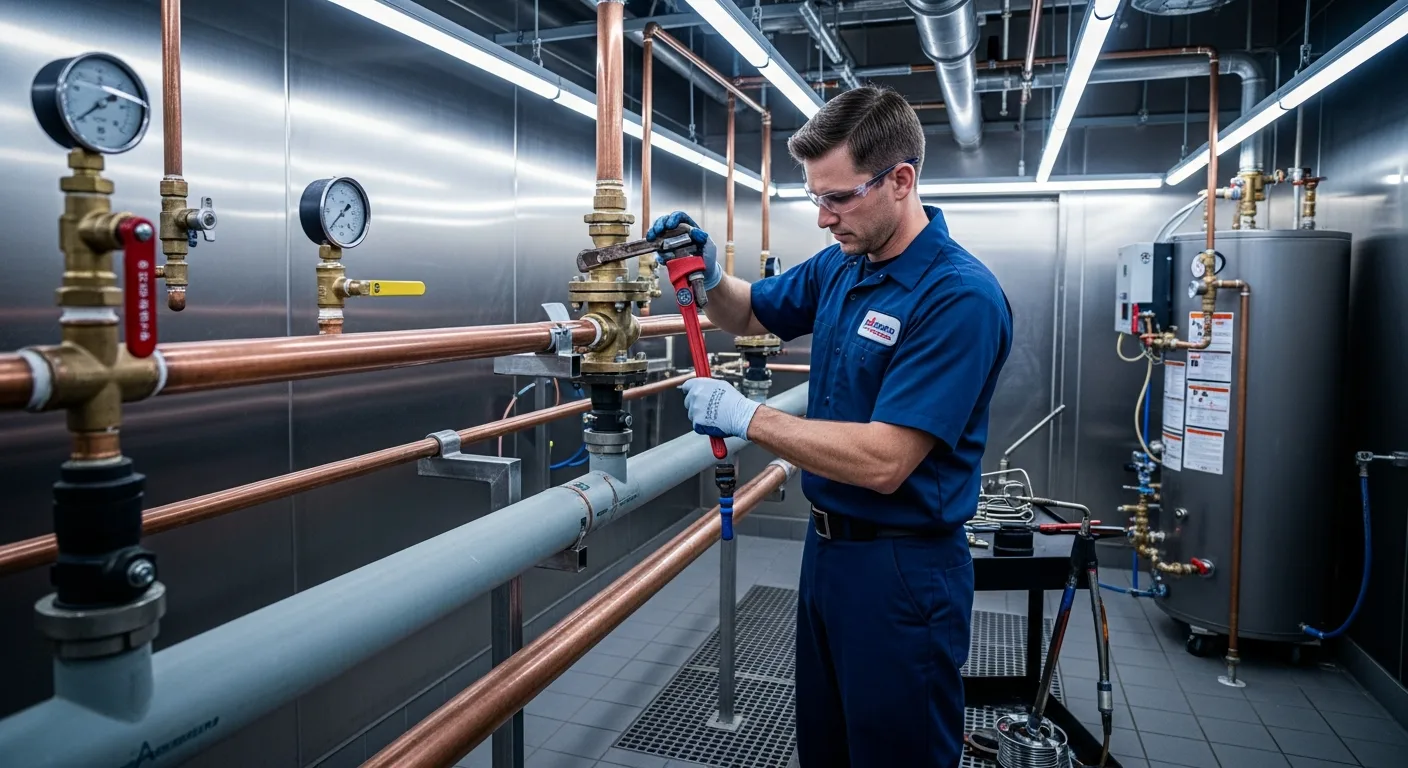
We isolate the piping, take the appliances off it, pressurize with air or nitrogen and leave a gauge on it.
Prep. Section 406.3.3 says appliances designed for less than the test pressure are disconnected and their outlets capped. On a commercial cooking line that's nearly everything, since appliance controls and connectors are built for low pressure. Joints stay exposed so a leak can be found.
Medium. Section 406.2 allows air, nitrogen, carbon dioxide or an inert gas. Oxygen is never used.
Gauge. Section 406.4 calls for a manometer or a gauge calibrated to show a loss from leakage. A mechanical gauge's full scale can be no more than five times the test pressure, so a 3 psig test doesn't go on a 100 psi gauge. Mesa tightens that to twice the test pressure with 0.1 psi markings.
Hold. The base code sets half an hour per 500 cubic feet of pipe volume. Gilbert sets a 15-minute minimum at 10 psi.
Read. Section 406.5 is strict: any drop is a leak unless something else clearly explains it, such as a big temperature swing on a rooftop run in July. We'd rather find the leak than argue the gauge.
Test pressure by Valley city
The number on the gauge depends on where the building is. These are the rules we've checked against each city's code text:
| Jurisdiction | Test pressure | Minimum hold |
|---|---|---|
| Phoenix | 1.5 x working pressure, not under 3 psig | Half hour per 500 cubic feet |
| Mesa | 10 psi; 60 psi welded or above 14 in. w.c. | Base code duration |
| Gilbert | 10 psi; 60 psi welded or above 14 in. w.c. | 15 minutes; 30 at 60 psi |
| Chandler | 1.5 x working pressure, not under 3 psig | 10 minutes (residential manual) |
| Maricopa County | Per the 2018 IFGC, kept on through the inspection | Until inspected |
Chandler's 10-minute figure comes from its residential homeowner permit manual, which says most systems test at 3 psig unless they're above 2 psi. For a commercial job, confirm the hold time with Chandler's inspector. For every city on one page, see our gas pressure test rules by city.
Who witnesses it
The city inspector does. In Phoenix it's commercial inspection 235, gas piping. Maricopa County's inspection guide says interior gas piping should be on its required pressure test when the inspector arrives at rough-in, and Gilbert inspects twice: before the piping is concealed and again after, before appliances go on. So the test isn't a five-minute check we run and remove. It stays on, gauge visible, until the inspector reads it.
After the inspection passes, the city sends the clearance to Southwest Gas. When gas is turned on, Section 406.6.3 requires an immediate leak check, and Southwest Gas runs its own at turn-on. Our page on how a gas line pressure test works covers the same steps for a home.
When the gauge drops
A drop means finding the leak. We work along the exposed joints with a combustible gas detector and leak-detecting fluid, the methods Section 406.5.1 names, repair or replace what's leaking, and put the test back on. Section 406.5.2 requires the retest. On a failed test of old piping, sometimes the honest answer is that the run needs replacing, and we'll tell you that with a price before doing it. See commercial gas line repair.
Can you test it yourself?
No, and don't try. Over-pressurizing a line with appliances still connected can damage their controls, and a test that hasn't been witnessed doesn't satisfy the city or Southwest Gas. A property manager can do one useful thing in advance: confirm the permit number and inspection window, and make sure the meter area and the piping are accessible on test day.
What HQ does
We isolate and cap the appliances, run the test at the pressure your city requires, keep it on for the inspection, fix anything that drops, and get the clearance to Southwest Gas. When gas goes back on, we leak-check, purge and relight. We're licensed and insured, with free estimates and an upfront price. Related: commercial gas line service, restaurant gas line installation, property management plumbing and restaurant plumbing.
Services and tools
How does a gas line pressure test work?
A gas line pressure test checks isolated piping for evidence of leaks under specified test conditions. Phoenix requires at least 1.5 times the proposed maximum working pressure, never below 3 psig, held for at least 10 minutes in a single-family home. A gauge drop indicates a leak unless it can be readily traced to another cause.
Read full answer: How does a gas line pressure test work?What is a gas meter piping pressure test verification form?
It's an affidavit a licensed plumber signs stating that gas piping at the meter passed a leakage test, with the test pressure, hours and date. Con Edison uses this form in New York. In the Phoenix area the same proof comes through a city permit, inspection and gas clearance before Southwest Gas turns gas on.
Read full answer: What is a gas meter piping pressure test verification form?What is a gas leak inspection and certification?
A gas leak inspection checks accessible natural gas piping and appliance connections and may include a pressure test of specified piping. Written findings document the scope, conditions, and results. Southwest Gas may require a certificate from a licensed plumber or public official; confirm what the requesting utility or city accepts.
Read full answer: What is a gas leak inspection and certification?What does a Southwest Gas red tag mean?
A red tag means a gas technician found an unsafe condition and shut off gas to an appliance or to the whole meter. Do not relight it or turn the valve back on yourself. Have a licensed plumber fix the problem, get a city permit and clearance if the leak was on your piping, then Southwest Gas restores service.
Read full answer: What does a Southwest Gas red tag mean?Sources
- Phoenix Fuel Gas Code 2024 (IFGC 2024), Chapter 4, Section 406
- City of Phoenix: 2024 International Fuel Gas Code amendments (Ordinance G-7397)
- City of Phoenix: Commercial inspections (inspection 235, gas piping)
- Mesa City Code Sec. 4-7-2, Amendments to the 2024 IFGC
- Town of Gilbert: Technical Codes, Town Code 10-35 (IFGC 406.4 as amended)
- City of Chandler: Homeowner Building Permit Manual, Gas Permits
- Maricopa County Planning and Development: Inspection Services Guide
- Maricopa County: Ordinances, Regulations and Codes (2018 IFGC adoption)
- Southwest Gas Arizona Gas Tariff No. 7 (Rule No. 7 A.4)
Related commercial services
New kitchen gas piping from load list to meter set, with Southwest Gas lead times, city test rules and the hood shutoff tie-in.
Leak repair on your side of the meter, what a red tag means for permits, and how service gets restored in Phoenix.
The valve, hose, restraint and pressure checks behind every appliance on the line, and when a swap needs a permit.
Whether your pipe, meter and pressure can take another gas appliance, and what upsizing involves when they can't.
Buried gas lines you own past the meter: locating them, Arizona dig rules, burial depth by city and repair versus replace.
Need a Gas Test for Your Permit?
Talk to a real dispatcher who knows commercial work. Upfront pricing before work starts, 24/7 for emergencies.