
Commercial Floor Drain Cleaning in Phoenix
Strainer, trap, trap primer and the line behind it. A floor drain that smells or backs up usually has one of those four problems, and each fix is different.
A commercial floor drain that backs up or smells has one of four problems: a packed strainer, a dried-out trap, a clogged line behind it, or backflow from a blocked main. HQ cleans the strainer and trap, clears the line, checks the trap primer, and tells you which of the four it was.
The rules that apply
Each rule links to the official text we read it from. Cities change these, so check the source before a big decision. Last checked 2026-10-04.
Floor drains must come apart and be reachable
Phoenix (IPC 413.2 and 413.3)Floor drains have removable strainers, are built so the drain can be cleaned, and have ready access, with a drain outlet not less than 2 inches in diameter. If the strainer is welded, grouted or buried under equipment, cleaning is harder than it should be.
Source: 2024 IPC Chapter 4 as adopted by Phoenix, Sections 413.2 and 413.3How deep the trap seal must be
Phoenix (IPC 1002.4)Each fixture trap must hold a liquid seal of not less than 2 inches and not more than 4 inches. A floor drain whose seal has evaporated gives sewer gas a straight path into the room.
Source: 2024 IPC Chapter 10 as adopted by Phoenix, Section 1002.4Seals that evaporate need protection
Phoenix (IPC 1002.4.1)Trap seals subject to evaporation, and emergency floor drain traps, must be protected by one of five methods: a potable water-supplied primer valve (ASSE 1018), a reclaimed-water-supplied primer, a wastewater-supplied primer (ASSE 1044), a barrier-type device (ASSE 1072), or a drain from a lavatory, hand sink or drinking fountain in the same room.
Source: 2024 IPC Chapter 10, Sections 1002.4.1.1 through 1002.4.1.5Also: Phoenix amendments to the 2024 IPC (no change to Chapter 10 trap seal sections)Floor drains in walk-in coolers drain indirectly
Phoenix (IPC 802.1.2)Floor drains inside walk-in refrigerators and freezers in food establishments are indirectly connected to the sanitary drainage system by an air gap, and where freezing is possible the waste line is not trapped and discharges to a receptor outside the cold space.
Source: 2024 IPC Chapter 8, Section 802.1.2Also: FDA Food Code 2017, Section 5-402.11(B)Kitchen floor drains count as grease-bearing
PhoenixFloor drains in a kitchen prep or wash area are grease-bearing fixtures, and Phoenix counts each toward the drainage fixture units used to size the interceptor. Their lines drain to the grease interceptor, so a clog there can be a sign the interceptor is full.
Source: Phoenix FOG BMP Manual, grease-bearing fixturesSewer gas is more than an odor
Federal (OSHA)Hydrogen sulfide, also called sewer gas, smells of rotten eggs at low levels, builds up in low, enclosed spaces and can overcome the sense of smell at higher levels, so no smell does not mean no gas.
Source: OSHA: Hydrogen SulfideThe four reasons a floor drain misbehaves
Almost every floor drain problem is one of four, and each looks a little different.
- A packed strainer. Water drains slowly right at the grate, and you can see debris. This is the simplest fix, and the code requires strainers that come out so it can be done.
- A dry trap. The drain drains fine, but the room smells like sewage. No water in the trap means nothing blocks sewer air.
- A clogged line. Water stands in the drain, rises slowly and drains slowly, but only this drain is affected.
- A backup from the main. Water or sewage comes up in several drains at once, usually the lowest ones in the building.
The first two are cleaned from the top in minutes. The last two take a cable or a jet. Telling us which one you see, and whether it is one drain or several, saves a trip.
The trap and the primer
A floor drain holds a plug of water in its trap that blocks sewer air. The 2024 plumbing code, as Phoenix adopts it, requires that seal to be between 2 and 4 inches deep. A drain that sees water only now and then loses that seal to evaporation, and in Valley heat that does not take long.
The code answers with trap primers. A water-supplied valve tops up the trap on a schedule. A wastewater-supplied device does it from a nearby fixture's drain. A barrier-type device, built to a different standard, blocks the air without needing water. A lavatory, hand sink or drinking fountain draining in the same room can also serve as the primer.
If your drain has a primer and still smells, the primer may be the broken part: a valve that no longer opens, a feed line that has clogged, or a connection that was cut. We trace it and test it. If the drain has no primer, pouring water in restores the seal for a while, and a primer or barrier device is the permanent answer. See our guides to whether commercial floor drains need a trap primer and why dry floor drains smell in Arizona.
A caution about the smell itself. OSHA notes that hydrogen sulfide, which is sewer gas, smells like rotten eggs at low levels but can overcome your sense of smell at higher ones. If the odor is strong, comes with headaches or dizziness, or is worse in a closed room, leave the room and call us.
What we do on a floor drain visit
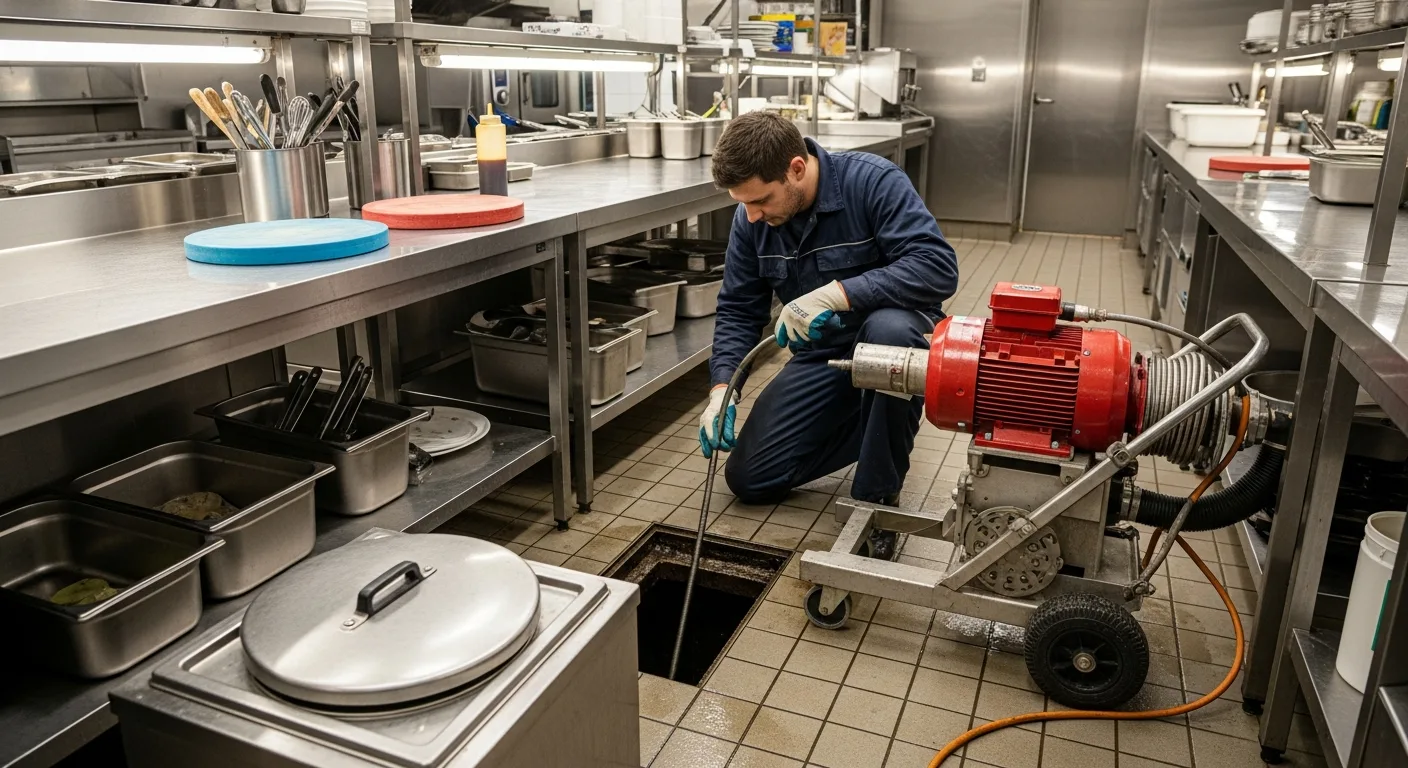
We clear the drain from the top first, then the line, then confirm the seal.
- 1We lift the strainer and clean out the bucket and the trap by hand.
- 2We run a cable or a small-bore jet through the line to the first cleanout, working with the flow.
- 3We check the trap primer: where it is fed, whether it opens, and whether the trap seal refills.
- 4We run water into the drain to confirm that it drains fast and that the seal stays.
- 5If this drain has backed up before, we run a camera down the line to look for a sag, roots or a break.
Walk-in cooler drains are different, and we leave them that way. Under the code, they drain indirectly, through an air gap, into a receptor outside the cold space. We clean that line and do not connect it directly to the sewer.
Why a kitchen floor drain deserves a second look
Kitchen floor drains are grease-bearing, and their lines feed the interceptor. When one backs up soon after your last pump-out, the cause may be the interceptor or a downstream line, not the drain. Our page on grease trap backing up into floor sinks walks through that, and a licensed hauler handles pumping. Trench-style drains, common in dish rooms, have their own page at trench drain cleaning.
When cleaning will not fix it
- The smell is real but the drain is wet. If the trap holds water and the room still smells, the source is elsewhere: a cracked line, a dry fixture trap, or a vent. A smoke test traces it.
- Several drains back up together. This is a main line problem. Jetting one drain will not help, and our page on restaurant main line jetting explains the next step.
- Water stands only after heavy rain. A floor drain tied to storm drainage is a different system, and its fix is not a sanitary cleaning.
You can pour a gallon of water into a rarely used drain yourself and see if the smell goes away. If it does, put the drain on a reminder, or have a primer installed.
What to have ready when you call
Call with where the drain is, whether it smells, drains slowly or fills, and how many drains are affected. We offer 24/7 emergency service, free estimates and an upfront price before work starts. Related: commercial drain cleaning, hydro jetting, and property management for buildings with many drains.
Services and tools
Codes and permits
Why is my floor drain backing up?
Your floor drain backs up because it usually sits at the lowest point in your home's drain system. When the main sewer line or a shared branch clogs, wastewater has nowhere to go and surfaces there first. A blocked or dried-out drain trap is the other common cause.
Read full answer: Why is my floor drain backing up?Why do commercial floor drains need a trap primer?
A floor drain that rarely gets water lets its trap seal evaporate, and then sewer gas comes up into the room. The plumbing code requires trap seals that can dry out to be protected, and a trap primer is the usual fix. It feeds the trap a little water automatically so the seal never disappears.
Read full answer: Why do commercial floor drains need a trap primer?Why do floor drains dry out so fast in Arizona?
Seldom-used floor-drain traps can lose water by evaporation, especially without a working primer or suitable trap-seal protection. A lost seal can admit sewer gas. Check the drain’s existing protection and condition; refilling or a properly selected protection device may be needed.
Read full answer: Why do floor drains dry out so fast in Arizona?Floor drain vs trench drain vs area drain: what differs?
A floor drain takes water from inside a building and belongs on the sanitary side. An area drain collects rain from open paved ground and belongs on the storm side. A trench drain is a long, narrow channel that can do either job. Its pipe decides which, and the code bars floor drains from storm drains.
Read full answer: Floor drain vs trench drain vs area drain: what differs?Sources
- 2024 International Plumbing Code as adopted by Phoenix, Chapter 4, Section 413
- 2024 International Plumbing Code as adopted by Phoenix, Chapter 10, Section 1002 (Traps)
- 2024 International Plumbing Code as adopted by Phoenix, Chapter 8, Section 802
- City of Phoenix: Amendments to the 2024 International Plumbing Code
- FDA Food Code 2017, Section 5-402.11
- City of Phoenix: FOG Best Management Practices for Food Service Establishments (June 2024)
- OSHA: Hydrogen Sulfide
Related commercial services
Which kitchen drains clog first, how they are cleared from the fixture side, and what the air gap rules mean for the fix.
Why interior branch lines need a small hose, what a cable leaves behind, and how the job is paired with a main line pass.
Where the private main ends and the city sewer begins, why a cleanout decides the job, and why the main and the branches get jetted as a pair.
Why soda and ice well drains stink, what Maricopa County and the plumbing code say about their air gaps, and what a cleaning visit does.
How interior drain work is scheduled around service, what the window looks like, and what happens when a stoppage hits at night.
How to tell a fixture problem from a line problem, why a cable alone keeps failing, and what the repeat call sequence looks like.
Floor Drain Backing Up or Smelling?
Talk to a real dispatcher who knows commercial work. Upfront pricing before work starts, 24/7 for emergencies.