
Restaurant Grease Line Jetting in Phoenix
When grease gets past the interceptor it coats the lateral and comes back as a backup. Fix the tank, then clean the pipe, then look at it.
When grease gets past an interceptor, it coats the line downstream and returns as a backup. HQ hydro-jets that line, but only after the tank and its parts are checked, so the grease does not simply come back. We schedule before opening or after close and run a camera pass afterward to show the wall is clean.
The rules that apply
Each rule links to the official text we read it from. Cities change these, so check the source before a big decision. Last checked 2026-10-04.
Grease in the sewer is prohibited
PhoenixIt is unlawful to discharge solid or viscous pollutants or FOG that can cause obstruction to the flow in sewers. Phoenix says FOG hardens and builds up until it blocks the city sewer or your own line.
Source: Phoenix City Code 28-8 (printed in the FOG manual)Downstream jetting is a cost of letting grease through
PhoenixPhoenix says keeping FOG out of the plumbing reduces the likelihood of a blockage in or downstream from your facility, the need for routine jetting of sewer lines, and the chance of causing damage downstream that you could be back billed to fix.
Source: Phoenix FOG BMP Manual, kitchen BMPsCleanout on the discharge side of a trap
PhoenixA two-way cleanout goes on the discharge side of every hydromechanical grease interceptor, to give an entry point to clean the line downstream of the device and back to it.
Source: Phoenix 2024 IPC amendments, Sec. 1003.3.5.3 (Ord. G-7397)Cleanouts around the tank
MesaA two-way cleanout is installed within 5 feet before and 5 feet after the interceptor, which is where a jetter hose gets into the line on either side.
Source: Mesa City Code 8-4-22(E)(3)(e)Grease leaving the device means act on the device
ChandlerIf FOG is witnessed leaving a treatment device, the cleaning frequency must increase. Enzyme and bacterial products only emulsify FOG temporarily until it re-congeals farther down the pipe, generally in the city sewer, and are prohibited under City Code 51-24.
Source: Chandler food service establishments pageKeep the line between kitchen and tank clean
Industry guidelineThe precast industry's maintenance guidance says routine cleaning of the sewer line between the establishment and the interceptor prevents it from plugging, and that records of maintenance must be kept.
Source: NPCA gravity grease interceptor guidelinesTwo lines, two jobs
A restaurant has two grease-carrying lines, and jetting means something different on each. The line from the kitchen to the interceptor carries fresh grease and food solids toward the tank. The line downstream of the interceptor, the lateral that runs to the city sewer, is supposed to carry only treated water. When grease shows up there, the interceptor has let something through.
This page is about the second case. The kitchen-side line has its own page on commercial drain cleaning. The downstream line is where grease turns into a blockage that is yours, and sometimes the city's, to fix.
Fix the tank first, then jet
Jetting a lateral clean while the tank is still passing grease buys you a few weeks. Grease gets past an interceptor for a handful of reasons: the tank is overdue, a baffle or tee is broken, an additive is pushing grease through, a fixture bypasses the tank, or the water is too hot. Our page on grease in the sewer line after an interceptor walks through each.
So the order of work matters.
- 1Pump the tank. A licensed hauler does it. HQ does not pump.
- 2Check the inside. Our crew looks for the failed part, as described on grease interceptor repair.
- 3Jet the line. Once the cause is handled, the pipe gets cleaned.
- 4Camera the line. The pass afterward shows what is left.
Chandler says grease witnessed leaving a device means the cleaning schedule goes up. That is true when the tank is simply overdue. When a part has failed, the schedule is not the problem.
What the jetting involves
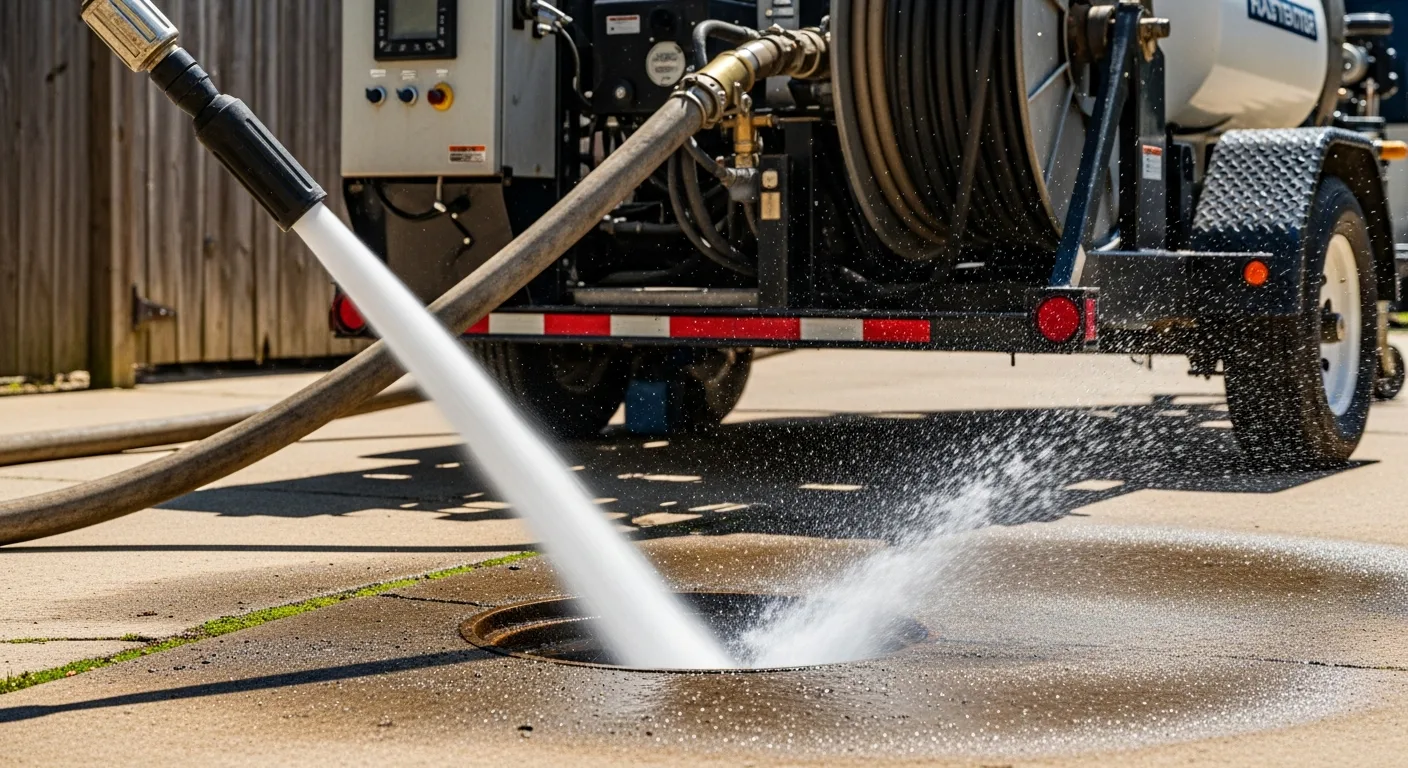
Hydro jetting uses high-pressure water through a hose and a nozzle to scour the pipe wall rather than punch a hole through the middle of the blockage. For a grease coating, that difference is everything. A cable opens a channel and leaves the coating, which is why a line cleared with a cable can back up again within weeks. See jetting versus snaking a commercial main line and what hydro jetting is.
We jet the restaurant lateral from inside the building with a small hose, and jet the main out to the city sewer when the stoppage reaches that far. Work is scheduled before opening or after close, usually one to two hours inside. We go in through the cleanouts the code puts around the tank. Mesa requires a two-way cleanout within 5 feet before and after the interceptor, and Phoenix requires one on the discharge side of a trap. If a line has no usable access, that gets sorted first. See hydro jetting without an accessible cleanout.
The camera pass afterward
We camera the line after the jetting to see whether the wall is actually clean. Flow at a cleanout shows that something moved. It does not show that the coating is gone, or that the pipe is sound. The camera can also show a belly, a cracked joint or roots that the grease was hiding. A defect is a repair question, not a cleaning one, and it moves the conversation to sewer camera inspection and sewer repair. Our page on why to camera the line after jetting covers what the video can and cannot prove.
Keep the video with your records. Next time, you can see how fast the line fills.
Keeping it clean: scheduled jetting
For restaurants with a history of grease in the line, we keep jetting on a schedule and log the dates against your account. A line that needs jetting twice a year is a different problem from one that needs it twice a month, and the log tells you which you have. The Phoenix manual says keeping grease out of the pipes reduces the need for routine jetting. Practice and a healthy tank are what stretch the interval.
When this is the wrong answer
Jetting is the wrong answer when the cause is still active. Do not jet, and do not buy more enzymes. Phoenix prohibits chemicals and enzymes that dissolve grease for a while, and Chandler explains that they re-congeal further down the pipe. Do not jet when the pipe is fragile and a camera has not looked first, either. For old cast iron or clay, see whether hydro jetting can damage old pipe.
And if the backup is happening right now, call for a same-day visit. We start with a cable and keep a jetter on standby. A jetting proposal follows for the permanent fix.
Booking
Tell us the city, whether there is a gravity interceptor or a trap, and when grease was last seen downstream. We offer 24/7 emergency service, free estimates and an upfront price before work starts. Related: hydro jetting, grease trap service and restaurant plumbing.
Services and tools
Why is there grease in my sewer line after the interceptor?
Grease gets past an interceptor when it is overdue for cleaning, a baffle or part is missing, hot water or emulsifiers push grease through, or a fixture bypasses the device. Phoenix and Chandler both name these problems. Fix the device first, then jet the line to remove what already coated it.
Read full answer: Why is there grease in my sewer line after the interceptor?Does hot water jetting clear grease lines better?
Hot water jetting usually clears grease lines better. Heat softens and melts grease so the jet can strip it off the pipe wall and flush it out, where cold water tends to push it downstream. The water still has to be sized to the line, the pipe has to tolerate the heat, and the grease needs somewhere safe to land.
Read full answer: Does hot water jetting clear grease lines better?Why camera the line after hydro jetting?
A camera pass after jetting documents visible cleaning results and defects that buildup may have hidden. Ask for the video and any limits from access, standing water or visibility. It does not prove every branch is clean, measure remaining wall thickness or guarantee the pipe is structurally sound.
Read full answer: Why camera the line after hydro jetting?In Phoenix, who is responsible for the sewer line to the city main?
You are. In Phoenix, the property owner is responsible for the sewer line from the house to the public main, under City Code Chapter 28. The one exception: for single-family and duplex homes, the city repairs broken sewer piping in the public right-of-way. A clog in your line is always your cost.
Read full answer: In Phoenix, who is responsible for the sewer line to the city main?Sources
- City of Phoenix: FOG Best Management Practices for Food Service Establishments (June 2024)
- City of Phoenix: Amendments to the 2024 International Plumbing Code (Ord. G-7397)
- Mesa City Code Sec. 8-4-22, Interceptors
- City of Chandler: Food Service Establishments
- National Precast Concrete Association: Gravity Grease Interceptor guidelines
Related commercial services
Baffle, tee and standpipe repairs inside the tank, what inspectors cite, and how the pumper and repair crew are sequenced.
How a failed baffle shows up, how it gets repaired, and the point where the honest answer is a new tank.
Which fitting does what, what Mesa's code says about down spout length, and how a missing tee gets replaced.
What an inside inspection covers, why hardened grease on the pass-over baffle matters, and how to be ready for a city inspector.
Flow control, gaskets and lids on indoor traps, cleaning versus replacing, and the four-fixture rule that decides what you may install.
The signs a tank is past repair, what plan review wants in Phoenix, Mesa, Chandler and Scottsdale, and what installation involves.
Grease in the Lateral?
Talk to a real dispatcher who knows commercial work. Upfront pricing before work starts, 24/7 for emergencies.