
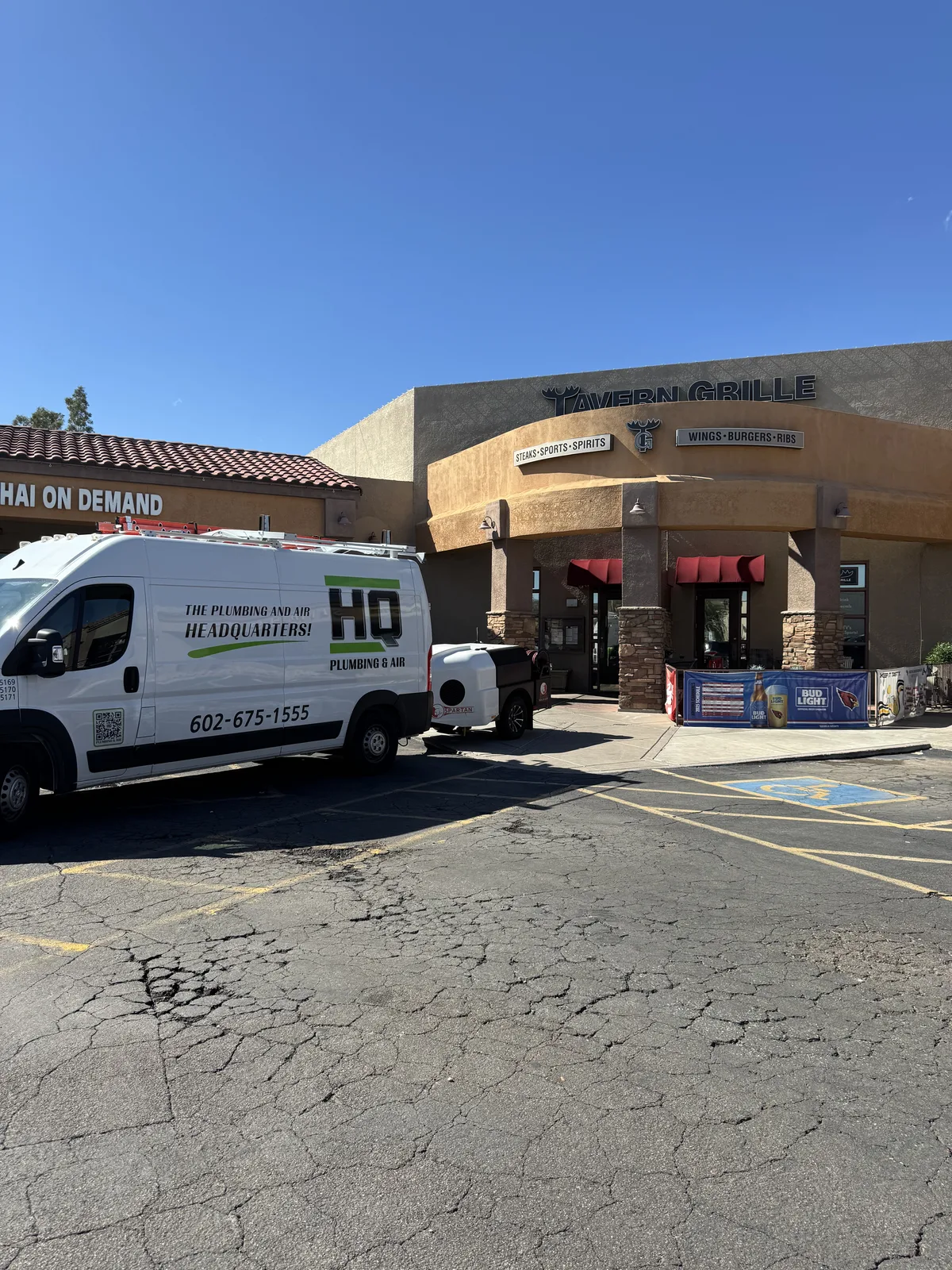
Pump-Out and Repair, Scheduled as One Job
A licensed hauler empties the tank. HQ repairs it right after. Done in the right order, the kitchen loses one early morning, not two.
A licensed hauler pumps the interceptor first, and HQ's repair crew arrives right after, while the tank is empty. HQ never pumps. For early-morning jobs the truck comes around 3 or 4 a.m. and our crew follows, so the kitchen is back before the first fryer lights. We can bundle both on one invoice.
The rules that apply
Each rule links to the official text we read it from. Cities change these, so check the source before a big decision. Last checked 2026-10-04.
Only a licensed pumper cleans it, and leaves it empty
PhoenixCleaning must be performed by a licensed pumper. The interceptor must be left completely empty on completion, and the pumper may not return the removed water or material to the interceptor or the sewer.
Source: Phoenix FOG BMP Manual, maintenance of grease interceptorsSchedules the repair can ride on
PhoenixGravity interceptors are fully pumped and cleaned at least every 3 months, and hydromechanical traps every 30 days with no more than 90 days between, unless the Director grants a variance.
Source: Phoenix FOG BMP Manual, how often to pumpThe truck must be permitted
Maricopa CountyNo person may remove, store, transport or dispose of non-hazardous liquid waste, which includes grease trap waste, without a permit. The vehicle is inspected and permitted, permits last one year, and tanks hold at least 750 gallons.
Source: Maricopa County: Non-Hazardous Liquid Waste transportation FAQHaulers and quarterly service
TempeGrease interceptors are serviced by a non-hazardous liquid waste hauler quarterly or more often, and traps monthly. Pump-out service records stay on site for inspection.
Source: Tempe FOG program pageBoth visits go in the log
ChandlerRecords of pumping, cleaning, maintenance and repairs stay on site for 3 years, with the date, the servicer, the nature of service (pumped, repaired, inspected, replaced baffle) and the quantity removed.
Source: Chandler food service establishments pageRepair and cleaning are both the owner's duty
MesaThe owner maintains the interceptor at the owner's expense and keeps written records of all cleaning, repair, calibration and maintenance for at least three years.
Source: Mesa City Code 8-4-22(D)Who does what, in what order
The hauler pumps, then HQ repairs. That order is not negotiable, because nobody repairs inside a tank that is full of grease and water. A licensed pumper empties and cleans the tank, and our three-person confined-space crew arrives right behind the truck to inspect and fix what is broken. HQ does not pump grease interceptors and does not offer to.
Two different companies are involved because two different permissions are. Maricopa County permits the trucks that haul grease trap waste, and Phoenix says cleaning must be done by a licensed pumper. Repairs are a plumbing job. Splitting the work this way means each side does only what it is licensed and equipped for.
The early-morning schedule
Most restaurants cannot lose the kitchen at lunch. So the visits go early. The pump truck comes around 3 or 4 a.m., and our crew arrives shortly after, typically in time to finish before the day's cooking starts. A job like that costs the kitchen one early morning instead of two.
Here is how the morning tends to run.
- 1The kitchen stops sending grease-bearing wastewater to the tank for the work window. Plan prep and cleanup around that.
- 2The hauler pumps and cleans the tank to empty. Phoenix says the tank must be left completely empty.
- 3We enter, inspect and repair. The entry procedure is on our confined-space entry page.
- 4We write down what was found and done, and the hauler leaves their ticket. Both go in the log.
- 5The tank goes back into service and the kitchen opens as usual.
Tell us the window you need, and we tell you before we start whether the repair fits it. If the tank turns out to need more than the window allows, we say so before the lid is open, not after.
One invoice, if you want it
You can deal with the hauler directly, or you can let us coordinate and put it on one invoice. The pumping charge passes through from the hauler. Either way, you still keep the hauler's ticket for your records, since Chandler asks for the servicer and the quantity removed, and Phoenix wants invoices from third-party contractors available on site.
Use a pump-out you already owe
Do not pay for a special pump-out when a scheduled one is coming. Phoenix requires gravity interceptors to be pumped at least every three months, and Tempe sets quarterly service. If your next routine pump-out is close, book the repair for that morning. If a city notice or a failing part cannot wait, move up the pump-out and keep the ticket. Our page on how often a Phoenix restaurant must pump its interceptor sets out the schedule.
What to tell the hauler
A short call saves a lot of trouble. Tell the pumper:
- A repair crew is following the truck, so the tank must be left empty and not refilled.
- Which parts you suspect, or what the inspector wrote.
- Where the lids are, and that nothing sits on them. See lid and riser repair.
- To note any broken or missing part they see, and tell you before they leave. Phoenix calls witnessing the cleaning a good time to spot damaged or missing parts.
Look for the county permit number on the truck, and see who can haul grease trap waste in Maricopa County.
When this is the wrong answer
You do not need a coordinated visit if all you need is routine pumping, or if the problem is not inside the tank. A routine pump-out is the hauler's job alone. If grease is showing up in the line and you have not checked the tank's parts, an inside inspection comes first, and pumping more often will not fix a failed part.
If the tank is clearly beyond repair, the visit turns into replacement planning, where plan review comes before any digging.
Booking
Give us your city, the tank size, your hauler if you have one, and the date of the next pump-out. If you do not have a hauler, we can coordinate the visit. We offer 24/7 emergency service, free estimates and an upfront price before work starts. Related: grease trap and interceptor service, restaurant plumbing and breweries and bars.
Services and tools
Who can haul grease trap waste in Maricopa County?
Only a hauler with a Maricopa County Environmental Services permit. County code bars anyone from removing, transporting or disposing of nonhazardous liquid waste, which the county says includes grease trap waste, without one. The truck is inspected, numbered and permitted for one year at a time.
Read full answer: Who can haul grease trap waste in Maricopa County?What happens during a commercial grease trap cleaning?
A licensed pumper opens the trap or interceptor, removes the grease layer, liquids, solids and the buildup scraped off the walls, and leaves it empty. The waste goes to a licensed disposal site. It cannot be poured back in or into the sewer. You get a record to keep on site.
Read full answer: What happens during a commercial grease trap cleaning?How often must a Phoenix restaurant pump its interceptor?
Phoenix City Code 28-15 requires gravity interceptors at food service establishments to be fully pumped out and cleaned at least every three months. Hydromechanical units (grease traps) must be cleaned at least every 30 days and never go past 90 days. In every case, grease and solids must stay under 25 percent of capacity.
Read full answer: How often must a Phoenix restaurant pump its interceptor?What should a restaurant grease trap log record?
Record the service date, who did it (hauler name and address), what was done, how much material was removed, and where it was disposed of. Keep the log and invoices on site for three years in Phoenix, Chandler, Mesa, Scottsdale and Surprise, and have them ready when the city asks.
Read full answer: What should a restaurant grease trap log record?Related commercial services
Baffle, tee and standpipe repairs inside the tank, what inspectors cite, and how the pumper and repair crew are sequenced.
How a failed baffle shows up, how it gets repaired, and the point where the honest answer is a new tank.
Which fitting does what, what Mesa's code says about down spout length, and how a missing tee gets replaced.
What an inside inspection covers, why hardened grease on the pass-over baffle matters, and how to be ready for a city inspector.
Flow control, gaskets and lids on indoor traps, cleaning versus replacing, and the four-fixture rule that decides what you may install.
The signs a tank is past repair, what plan review wants in Phoenix, Mesa, Chandler and Scottsdale, and what installation involves.
Want Both Visits Lined Up?
Talk to a real dispatcher who knows commercial work. Upfront pricing before work starts, 24/7 for emergencies.