
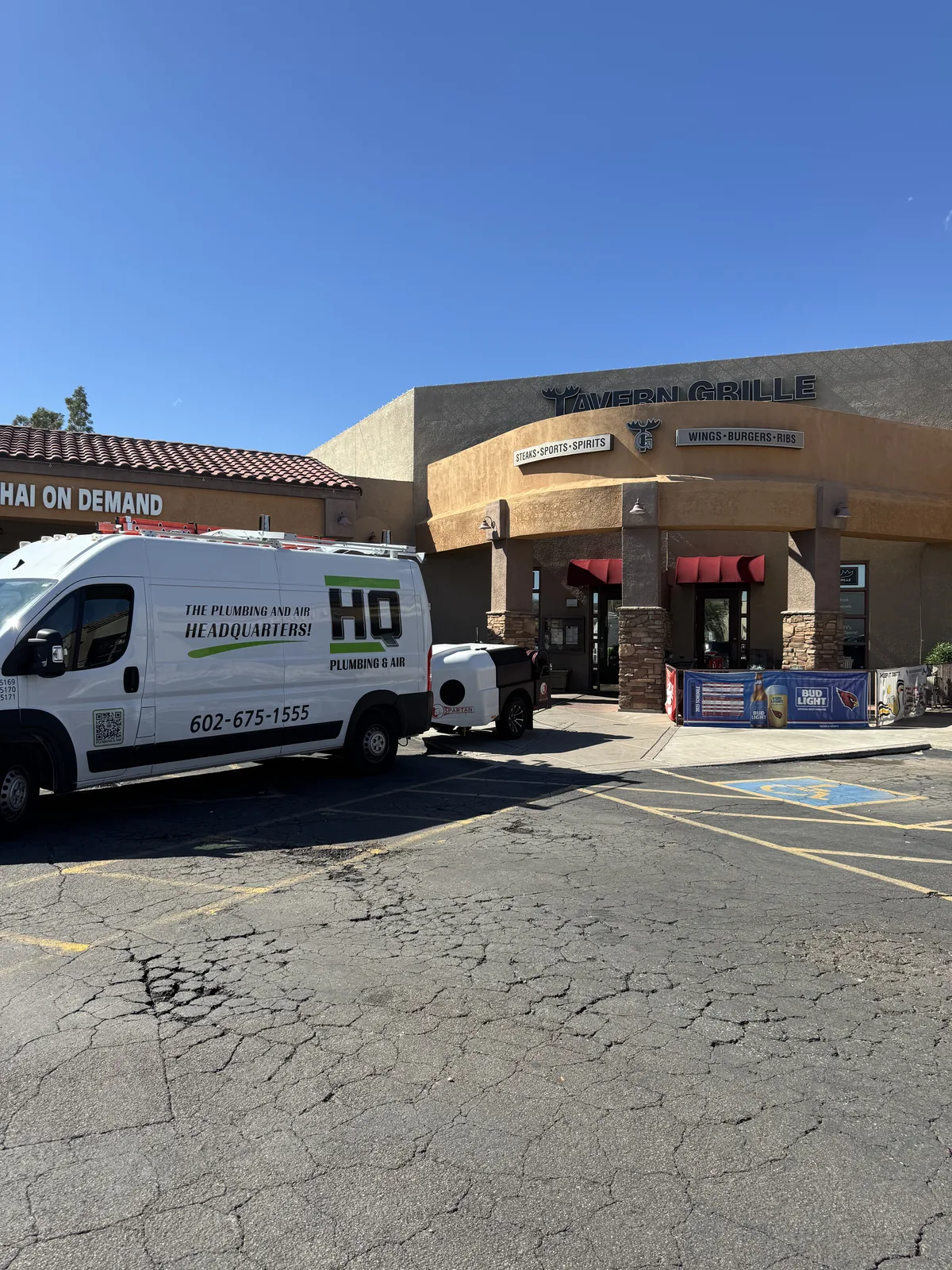
Grease Interceptor and Trap Repair in Chandler
Grease traps and gravity interceptors put back to code for Chandler kitchens, sequenced behind your licensed hauler, with the lines in and out jetted and camera-checked.
Chandler requires every kitchen that prepares or packages food or drinks for sale to have a grease trap or interceptor, kept below 25 percent full of grease and solids, with three years of service records on site. HQ repairs and replaces traps and interceptors after your hauler pumps them, and jets and camera-checks the lines in and out.
The rules that apply
Each rule links to the official text we read it from. Cities change these, so check the source before a big decision. Last checked 2026-10-21.
Every food service establishment needs a FOG device
ChandlerFood service establishments that prepare or package food or beverages for sale or consumption must install a fats, oils and grease (FOG) treatment device, with a fixture count and plumbing plan submitted to Development Services with the plumbing permit.
Source: City of Chandler: Food Service EstablishmentsGravity interceptors sized by Chandler's own chart
ChandlerChandler replaces the first sentence of IPC 1003.3.7 with its DFU conversion chart: 750 gallons for 0 to 21 drainage fixture units, 1,000 for 22 to 35, 1,250 for 36 to 90, up to 3,000 gallons at 308 to 342. Above 342, an Arizona registered professional engineer designs it.
Source: Chandler City Code 29-4.4 (amends 2024 IPC 1003.3.7)Clean at 25 percent
ChandlerCombined fats, oils, grease and solids should not exceed 25 percent of the device's total capacity. If grease is seen leaving the device, clean it more often.
Source: City of Chandler: Food Service EstablishmentsRecords and haulers
ChandlerPumping, cleaning, maintenance and repair records should be kept on site for 3 years. A hauler must be a Maricopa County Environmental Services licensed non-hazardous liquid waste hauler.
Source: City of Chandler: Food Service EstablishmentsNo disposers, no enzymes
ChandlerA food waste disposer or grinder cannot discharge to a FOG treatment device. Chemicals and other additives put in to reduce cleaning or pumping are prohibited and must be removed at the owner's expense.
Source: City of Chandler: Food Service Establishments (City Code 51-24)Grease limit at the sewer
ChandlerFats, oils and grease of vegetable or petroleum origin, emulsified or not, above 100 mg/L must not be discharged to the city's treatment works. The pretreatment program inspects grease traps and interceptors at food service facilities.
Source: Chandler Industrial Pretreatment ProgramWhat Chandler expects from your grease trap or interceptor
Chandler keeps the rule short. Any business that prepares or packages food or drinks for sale needs a fats, oils and grease (FOG) treatment device, which covers both the small hydromechanical trap under a sink and the big gravity interceptor in the ground. The owner of the device pays for its cleaning, maintenance and repairs.
Three things decide whether you pass. The device has to be the right size for the fixtures that drain to it. It has to be cleaned before grease and solids pass 25 percent of its capacity. And you need three years of service records on site showing it was. Under City Code 51-25 the building official enforces the plumbing code's interceptor rules, so size and installation are settled at plan review and inspection, and the city's pretreatment program inspects the devices once the kitchen is open. More detail is on our page about Chandler's food service grease rules.
Chandler sizes interceptors from a chart, not a formula
This is where Chandler parts ways with Phoenix. Phoenix sizes a gravity interceptor with a flow formula. Chandler's City Code 29-4.4 replaces that with a chart based on drainage fixture units (DFU), the number the plumbing code gives each fixture for how much it can drain:
| Fixture units draining to the interceptor | Size Chandler requires |
|---|---|
| 0 to 21 | 750 gallons |
| 22 to 35 | 1,000 gallons |
| 36 to 90 | 1,250 gallons |
| 91 to 172 | 1,500 gallons |
| 173 to 216 | 2,000 gallons |
| 217 to 307 | 2,500 gallons |
| 308 to 342 | 3,000 gallons |
Above 342 fixture units, an Arizona registered professional engineer designs it. The city's worksheet (Form UDM-062) counts each fixture by drain size, and a commercial dishwasher at 2 fixture units for every gallon per minute it is rated for. One added sink can push a kitchen from 750 to 1,000 gallons, which is why the count comes before the layout is final. The full chart and examples are on our Chandler interceptor sizing page.
That matters most in a tenant improvement. A retail center space that comes with a 500-gallon interceptor from the last tenant is already below Chandler's smallest size, so a new restaurant there may be looking at a replacement, not a repair. Whether an existing tank can stay is decided at plan review. See grease interceptor replacement.
What we repair, and the order of work
Most of our grease work starts when something inside the unit has failed: a baffle has broken off, an inlet or outlet tee has rotted, a lid or riser has cracked, or the line between the kitchen and the interceptor keeps stopping up. Here's how a repair goes:
- 1Your hauler pumps it first. HQ does not pump interceptors. Chandler wants a Maricopa County licensed non-hazardous liquid waste hauler if anyone other than your own staff cleans it, and the tank has to be emptied of all contents before anyone goes in. We schedule our crew right behind the truck. See pump and repair coordination.
- 2We go in as a confined space. A gravity interceptor can hold a hazardous atmosphere, so we treat entry as permit-required confined space work under OSHA 29 CFR 1910.146: air tested before entry, an attendant outside and retrieval gear rigged. HQ sends a three-person crew for interceptor entry. More on that in confined space interceptor entry.
- 3We put the parts back to code. Broken or missing baffles are reinstalled, failed tees and standpipes replaced, and damaged lids and risers repaired. See baffle repair.
- 4We clear and check the lines. The line from the kitchen into the interceptor and the line out to the city sewer are hydro jetted, then camera-inspected to confirm no grease is left in either. That's the fix. See restaurant grease line jetting.
You get a written record of what was done, ready for the three-year file the city expects.
Mistakes that make a Chandler grease system fail
No calendar, just the 25 percent rule. Phoenix and Gilbert set pumping intervals. Chandler doesn't. It asks you to clean before grease and solids reach a quarter of the capacity, and more often if grease is seen leaving the device. A busy fryer line can hit that mark long before a slow cafe does, so the right interval is the one your pumping records support. Our 25 percent rule page explains how to measure it.
Enzymes and additives. Chandler City Code 51-24 prohibits adding chemicals, enzymes or bacteria to a grease device to put off pumping. A dosing system found in place has to come out at the owner's cost, and citations and fines can follow. See enzyme grease treatments.
A disposer on the grease line. The city says a food waste disposer or grinder can't discharge to a FOG device. If a remodel added one at the prep sink and tied it into the interceptor, it needs its own drainage or it comes out.
Grease past the device. Chandler's limit for fats, oils and grease at the sewer is 100 mg/L, emulsified or not. When grease keeps showing up in the lateral even with a good pumping schedule, a missing baffle or a failed outlet tee is the usual cause, and it's what we look for first. The city's discharge limits are on our code library page.
Repair or replace?
Repair fits when the tank is the right type and size and a part has failed. Replacement is the answer when the concrete or steel has corroded through, when the kitchen has outgrown the unit under Chandler's chart, or when an indoor trap is being asked to take a dishwasher or disposer it can't. Replacements go through Chandler Development Services with a fixture count and plumbing plan, the same as a new install. Our repair or replace guide walks through the call.
How to book in Chandler
Call with the type of unit, any notice from the city and your last few pumping records. We offer 24/7 emergency service, free estimates and an upfront price before work starts, and Chandler is in our regular dispatch area. Related: grease interceptor repair, grease trap service, restaurant plumbing and our Chandler service area page.
Services and tools
What is the 25 percent rule for grease traps?
The 25 percent rule says a grease trap or interceptor stops working well once fats, oils and solids fill a quarter of its capacity. Phoenix requires a full cleaning at that point. Chandler calls it a rule of thumb and says to clean more often if grease is seen leaving the device.
Read full answer: What is the 25 percent rule for grease traps?Grease trap pumping vs cleaning vs jetting: which is which?
Pumping and cleaning are one job on the grease device: remove everything inside, scrape the walls, leave it empty. Jetting is a different job on the pipes: high-pressure water scrubs grease off the drain and sewer lines downstream. Neither replaces the other.
Read full answer: Grease trap pumping vs cleaning vs jetting: which is which?What happens when a grease interceptor baffle or tee breaks?
A broken baffle or outlet tee lets grease and solids slip past the tank, so an interceptor can pass grease toward the sewer even when it is not full. Have a pumper empty it, inspect every internal part, repair or replace what failed, log the work, and ask your city whether the fix needs a permit.
Read full answer: What happens when a grease interceptor baffle or tee breaks?Can a commercial dishwasher drain into a grease trap?
Usually not in the Valley. Tempe, Scottsdale and Mesa each require a full grease interceptor, not a small grease trap, for any facility installing a commercial dishwasher. Traps are limited to kitchens with four or fewer food prep fixtures, and dishwashers push the requirement up to a gravity interceptor.
Read full answer: Can a commercial dishwasher drain into a grease trap?What should a restaurant grease trap log record?
Record the service date, who did it (hauler name and address), what was done, how much material was removed, and where it was disposed of. Keep the log and invoices on site for three years in Phoenix, Chandler, Mesa, Scottsdale and Surprise, and have them ready when the city asks.
Read full answer: What should a restaurant grease trap log record?Sources
- City of Chandler: Food Service Establishments (Industrial Pretreatment Program)
- City of Chandler: Industrial Pretreatment Program
- Chandler City Code 29-4, International Plumbing Code adopted, with local amendments (Municode)
- Chandler City Code 51-25, enforcement of interceptor requirements (Municode)
- City of Chandler: Gravity Grease Interceptor Requirements worksheet (Form UDM-062)
- OSHA 29 CFR 1910.146, Permit-required confined spaces
Related commercial services
How a Phoenix leak gets found and fixed, who owns which side of the meter, and how a January leak raises a year of sewer bills.
How a slab leak gets found without guessing, when to repair in place or reroute overhead, the Phoenix permit line, and who pays.
What a camera run proves under Phoenix City Code 28-5, which repairs need a permit and inspection, and when to skip the camera.
Where the city's pipe ends, the galvanized replacement program, Phoenix's pressure and pipe rules, and how a repair gets permitted.
When to replace instead of repair, tank or tankless, the Phoenix permit rule for in-kind swaps, and what a code-correct install includes.
Who clears what in Phoenix, why grease and roots cause most backups here, and how to stop paying for the same clog twice.
Grease Trap Trouble in Chandler?
Talk to a real dispatcher who knows commercial work. Upfront pricing before work starts, 24/7 for emergencies.