
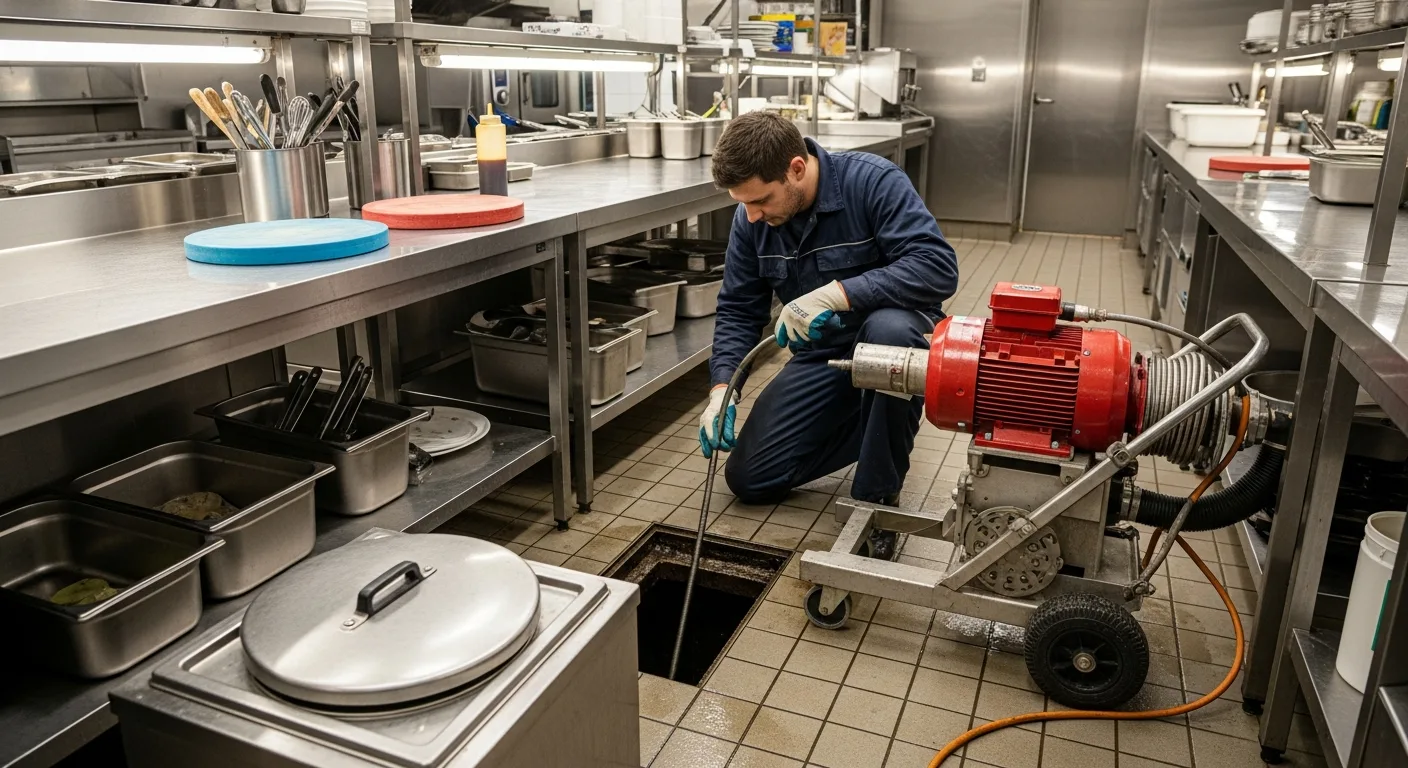
Indoor Grease Trap Repair in Phoenix
Small indoor units fail in small ways: a dead gasket, a clogged flow control, a warped lid. Here is when a repair is enough and when the unit is done.
An indoor grease trap, called a hydromechanical interceptor, can often be fixed with a new gasket, lid or flow control. Replace it when the body is cracked or corroded, or when it is the wrong size. In Phoenix a trap is only allowed for up to four fixtures and no dishwasher or disposal.
The rules that apply
Each rule links to the official text we read it from. Cities change these, so check the source before a big decision. Last checked 2026-10-04.
Four-fixture limit
PhoenixHydromechanical interceptors are approved for food service establishments with up to four plumbing fixtures. No garbage disposal or dishwasher can discharge to one. Those need an outdoor gravity interceptor.
Source: Phoenix FOG BMP Manual, hydromechanical grease interceptorsSize is set by fixture count
PhoenixPhoenix's amended plumbing code sizes the trap by fixtures connected: one fixture needs 20 gpm and 40 lb of grease retention, two need 25 gpm and 50 lb, three need 35 gpm and 70 lb, and four need 50 gpm and 100 lb.
Source: Phoenix 2024 IPC amendments, Table 1003.3.5.1 (Ord. G-7397)Flow control and cleanout
PhoenixThe trap must have a flow-control device so water cannot exceed the rated flow, vented and terminating at least 6 inches above the flood rim unless the manufacturer's instructions say otherwise. A two-way cleanout goes on the discharge side.
Source: Phoenix 2024 IPC amendments, Sec. 1003.3.5.2 and 1003.3.5.3Cleaning frequency and material
PhoenixA trap must be fully pumped out and cleaned every 30 days unless the Director grants a variance, and never go more than 90 days. Approved traps are stainless steel or polymer and PDI certified or UPC/IAPMO certified.
Source: Phoenix FOG BMP ManualLike-for-like swaps can go over the counter
PhoenixLike for like replacements of hydromechanical interceptors can be submitted over the counter. Anything that changes the type or needs re-piping goes through full plan review.
Source: Phoenix FOG BMP Manual, installation and replacement, Appendix BOne size only, and the valve must be reachable
ScottsdaleTraps are allowed only with four or fewer food-prep fixtures, and the only size is 50 gal/100 lb. A flow restriction valve goes upstream, vented, and must be inspectable if the trap is below floor level. Dishwashers need a gravity interceptor.
Source: Scottsdale grease interceptor guidelines, Sec. 1003.3.5.1Mesa and Tempe
Mesa and TempeMesa sizes traps at a minimum of 50 gpm and 100 lb with the flow control valve installed so it can be reached at all times. Tempe allows a trap with four or fewer kitchen fixtures and requires monthly service by a permitted hauler.
Source: Mesa City Code 8-4-22(E)Also: Tempe FOG program pageWhat usually fails on an indoor trap
Most trap problems are small parts, not the whole box. A hydromechanical trap is a compact unit under or near the three-compartment sink. It uses air entrapment, buoyancy and interior baffling to separate grease, and it depends on a flow-control device to keep water from rushing through faster than the unit is rated for.
The parts we see cause trouble:
- The lid gasket. A dried or flattened gasket lets odor into the kitchen.
- The lid itself. Warped or cracked, it will not seal.
- The flow control. Phoenix's code requires one, vented, and Mesa and Scottsdale want it reachable. When it is blocked or missing, the trap overflows or passes grease.
- Interior baffling and the body. Stainless corrodes and polymer cracks. Phoenix approves only those two materials.
A smell, a slow sink or a leak at the lid is usually the first sign, and a trap that overflows right after a pump-out points at a part rather than at grease. For odor causes, see controlling odor from a grease trap or interceptor.
Repair, clean or replace
Repair when the body is sound and the problem is a lid, gasket, fitting or flow control. Clean when it is simply full. Replace when the body is cracked, corroded through, undersized or the wrong type.
Cleaning is its own step. Phoenix requires a full pump-out every 30 days, and no more than 90, by a licensed pumper. HQ does not pump. If your trap smells or backs up and the last pump-out was more than 30 days ago, call your hauler first. Our page on grease trap pumping versus cleaning versus jetting explains the differences.
The four-fixture rule decides what you can install
In Phoenix, a trap is for up to four fixtures, and a dishwasher or garbage disposal rules a trap out entirely. A typical layout is a three-compartment sink, a prep sink and a mop sink. Scottsdale counts a three-compartment sink as one unit, and Tempe uses the same four-fixture line.
That has a practical side. If you added a fifth drain, put a dishwasher in, or took over a kitchen with more equipment than the last tenant, a repaired trap may no longer be legal for the kitchen. The answer then is an outdoor gravity interceptor, covered on our indoor trap to outdoor interceptor upgrade page and the Phoenix fixture count page.
Replacing a trap
If the trap is the right type but worn out, a like-for-like replacement is the simple case. In Phoenix those can go over the counter, and the manual asks you to call at least 24 hours ahead so a city inspector can be on hand. Appendix B asks for the manufacturer and model, a plumbing floor plan, and, if the pipes are not changing, nothing more. Re-piping, such as rerouting a fixture or adding one, needs drawings, including an isometric that shows pipe size and venting.
Size has to match the fixtures. Phoenix's table steps up with each fixture. Scottsdale allows only the 50/100 size, and Mesa's minimum is the same. So the replacement is picked by the city, not by what fit the old cabinet. The unit also has to be PDI or UPC/IAPMO certified in Phoenix.
HQ replaces the trap and its connections: the flow control, the vent, the discharge cleanout. We confirm the rules for your city before ordering.
When this is the wrong answer
Do not pay for a new trap if the problem is a full one. Do not pay for a repair if the trap is under a kitchen that now has a dishwasher. And do not use an enzyme or additive to cover a smell, since Phoenix prohibits chemicals, enzymes and emulsifiers meant to dissolve grease. If the trap is sound and the drain still overflows, the cause may be the line beyond it. See why a kitchen drain keeps overflowing and restaurant grease line jetting.
Booking
Tell us the city, the make if you know it, how many fixtures drain to the trap, and what you see. We offer free estimates, an upfront price before work starts, and 24/7 emergency service when a kitchen is backing up. Related: grease trap service, commercial drain cleaning and restaurant plumbing.
Services and tools
Grease trap vs grease interceptor: what's the difference?
A grease trap is a small hydromechanical unit, usually inside the kitchen, for kitchens with up to four grease-bearing fixtures. A grease interceptor is a large underground tank outside, at least 500 gallons in Phoenix, Tempe and Mesa. A commercial dishwasher pushes a kitchen from a trap up to an interceptor.
Read full answer: Grease trap vs grease interceptor: what's the difference?When must a grease trap be replaced by an interceptor?
A restaurant has to move from an indoor grease trap to an outdoor interceptor when the kitchen outgrows what a trap may serve: more than four fixtures or any commercial dishwasher. Phoenix adds garbage disposals. Scottsdale and Gilbert can also require the change after a remodel, an addition or a grease blockage.
Read full answer: When must a grease trap be replaced by an interceptor?Can a commercial dishwasher drain into a grease trap?
Usually not in the Valley. Tempe, Scottsdale and Mesa each require a full grease interceptor, not a small grease trap, for any facility installing a commercial dishwasher. Traps are limited to kitchens with four or fewer food prep fixtures, and dishwashers push the requirement up to a gravity interceptor.
Read full answer: Can a commercial dishwasher drain into a grease trap?How do I control odor from a grease trap or interceptor?
To control odor from a grease trap or interceptor, clean it on schedule, keep lids and gaskets sealed, keep the building vent working, and keep grease and scraps out. Skip enzyme and bacteria additives, which Phoenix and Chandler prohibit. A strong rotten-egg smell can be hydrogen sulfide, so stay out of the tank.
Read full answer: How do I control odor from a grease trap or interceptor?Related commercial services
Baffle, tee and standpipe repairs inside the tank, what inspectors cite, and how the pumper and repair crew are sequenced.
How a failed baffle shows up, how it gets repaired, and the point where the honest answer is a new tank.
Which fitting does what, what Mesa's code says about down spout length, and how a missing tee gets replaced.
What an inside inspection covers, why hardened grease on the pass-over baffle matters, and how to be ready for a city inspector.
The signs a tank is past repair, what plan review wants in Phoenix, Mesa, Chandler and Scottsdale, and what installation involves.
Traffic-rated covers, risers, manway sizes and access rules, and the signs a lid needs attention now.
Grease Trap Acting Up?
Talk to a real dispatcher who knows commercial work. Upfront pricing before work starts, 24/7 for emergencies.