
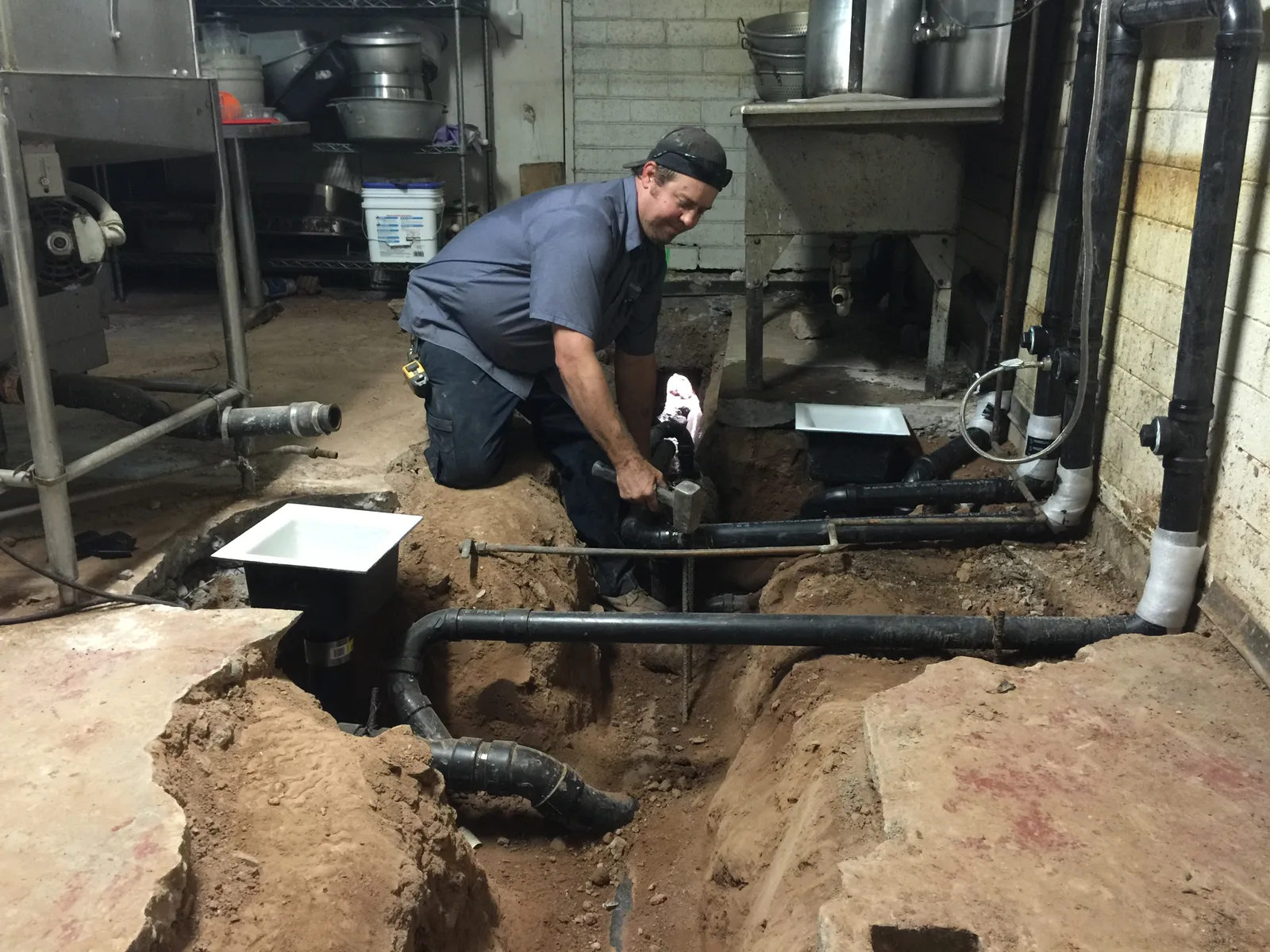
Grease Interceptor Lid and Riser Repair
If the pumper cannot open it, nobody can service it. Covers, grade rings and risers are the part of the tank cars drive over every day.
A grease interceptor lid and its risers must stay clear, reachable and able to carry the traffic above them. HQ repairs cracked or rocking covers, sunken grade rings and buried access so your pumper and the city inspector can open every manway. Mesa requires a traffic rated cover, and Phoenix sets 20 inch minimum man-ways.
The rules that apply
Each rule links to the official text we read it from. Cities change these, so check the source before a big decision. Last checked 2026-10-04.
Free from obstructions, easy to reach
PhoenixInterceptors must be located free from obstructions and readily and easily accessible for cleaning and inspection. If one sits in a hazardous spot such as active traffic, the Director can temporarily close the area to traffic to inspect it.
Source: Phoenix City Code 28-13 (printed in the FOG manual)Man-way size and grade rings
PhoenixAll man-ways have a minimum 20 inch inside diameter. A 500 gallon interceptor has two man-ways and a 750 gallon or larger one has three. The grade rings (risers) are grouted with shrink-proof grout.
Source: Phoenix 2024 IPC amendments, Sec. 1003.3.7 (Ord. G-7397)Traffic rated cover, no city wording
MesaThe interceptor is constructed with the appropriate traffic rated cover, and the cover must not carry wording indicating it is owned by the City of Mesa.
Source: Mesa City Code 8-4-22(E)(3)(f)Easily removable, and gastight if bolted
MesaInterceptors are equipped with easily removable covers. Where bolted covers are required they must be gastight and watertight. All interceptors must be readily accessible for cleaning and inspection.
Source: Mesa City Code 8-4-22(B) and (C)Access is a plumbing code duty
ScottsdaleAccess shall be provided to each interceptor for service and maintenance, and the interceptor is maintained by periodic removal of accumulated grease and solids.
Source: Scottsdale guidelines, IPC 1003.10Design for traffic
Industry guidelineThe precast industry says all interceptors should be designed for traffic loading, at minimum to the loads in ASTM C890, and should provide easy access for maintenance.
Source: NPCA gravity grease interceptor guidelinesWhat the lid and riser have to do
The lid has to open for every pump-out and carry whatever drives over it. That sounds basic, and it is where tanks get neglected, because a lid is the one part everybody can see and nobody inspects. Between the tank and the cover, risers made of stacked grade rings bring the access up to grade. If the cover or rings fail, the tank fails its access duty even when everything inside is perfect.
The codes are clear on both halves. Phoenix wants interceptors free from obstructions and readily accessible. Scottsdale quotes the plumbing code: access shall be provided to each interceptor for service and maintenance. Mesa wants easily removable covers, and traffic rated ones.
Signs a lid or riser needs attention now
These are the ones we see, roughly in order of urgency.
- A cracked or chipped cover in a drive lane or parking stall. Traffic makes it worse every day.
- A cover that rocks or is not seated after the pump truck leaves. A loose cover is a hazard for cars and people, and it lets debris and water in.
- A sunken ring or settled pavement around the lid. Gaps open up at the joints.
- A lid you cannot find. Paved over, striped over, or buried under a dumpster pad or planter. If a pumper cannot open it, it will not get pumped.
- Odor around the lid. Mesa requires bolted covers to be gastight and watertight.
- A man-way that is too small to enter, which matters because Phoenix sets 20 inches inside diameter as the minimum.
If you suspect the damage extends inside, the next step is an inside inspection. Water and grit that reach the tank through a broken lid are not good for it either.
What we repair
HQ looks at the covers, the grade rings and the access path as part of any interceptor visit. Depending on what we find, the work is one or more of these.
- 1Cover replacement with a unit that matches the traffic above it, per the tank maker's specs and your city's wording rules.
- 2Resetting or replacing grade rings that have shifted, with shrink-proof grout in the joints, which is what Phoenix's code requires.
- 3Adding or adjusting a riser to bring a deep or buried lid to grade, so the pumper can reach it. See when a riser or extension collar is needed.
- 4Clearing the access. We tell you what is on top of the lid, and you or your landlord move it.
Paving, saw-cutting and heavy slab work around a lid can need other trades or a right-of-way permit if it reaches the street. We tell you that up front, in the estimate.
Traffic rated is something you can check
The word on a plan does not carry the load. The rating is cast into the cover and frame, and the tank's slab and risers have to match it. The precast industry says all interceptors should be designed for traffic loading, at minimum to ASTM C890. So ask for the rating by standard name from the maker's submittal, ask the tank maker what the slab and risers are rated for in that spot, and ask the city whether it expects a specific rating. Our page on whether a grease interceptor lid needs to be traffic rated explains the terms.
Mesa adds a rule that catches people: its covers must not be marked as owned by the City of Mesa. Check that on the order before the casting is made.
When this is the wrong answer
Do not pay for a new cover if the old one is sound and just needs to be seated, cleaned and unblocked. Do not pay for riser work if the real problem is a dumpster parked on the lid. And do not use a lid fix to answer a grease problem: lids and risers do not stop grease from leaving the tank. For that, see baffle repair and tee and standpipe repair.
If the tank is under a lot that is about to be repaved or restriped, tell us before the crew arrives. It is easier to raise or protect a lid before the asphalt goes down than after.
Booking
Tell us the city, where the tank sits and what you see on the lid. We offer free estimates, an upfront price before work starts and 24/7 emergency service. Related: grease trap and interceptor service, restaurant plumbing and property management plumbing.
Services and tools
Does a grease interceptor lid need to be traffic rated?
Where cars or trucks can reach it, yes. Mesa's code requires a traffic rated cover and Surprise lists traffic rated covers for its interceptors. Phoenix says interceptors may sit in active traffic locations and sets a 20 inch minimum manway. Cities do not publish a load number, so ask yours.
Read full answer: Does a grease interceptor lid need to be traffic rated?Do I need a riser or extension collar on a grease interceptor?
Usually yes, when the tank's access opening sits below the surface. The codes we read require access to every interceptor but name no riser height. Phoenix adds that grade rings must be grouted with shrink proof grout. Makers publish riser counts by burial depth, so the tank's own instruction sheet decides.
Read full answer: Do I need a riser or extension collar on a grease interceptor?Where can a grease interceptor be located?
A grease interceptor is located outside the building, in a spot free of obstructions and easy to reach for cleaning and inspection. Phoenix, Tempe, Scottsdale and Surprise all say outside, and Phoenix needs approval for anywhere else. The codes we read set no maximum distance from the kitchen, so slope and easements decide.
Read full answer: Where can a grease interceptor be located?Does a grease interceptor need a vent?
Yes. The 2024 International Plumbing Code says interceptors must be designed so they do not become air bound and must be vented by one of the Chapter 9 methods. A hydromechanical trap also needs a vented flow-control device. The code gives no single vent size for every tank, so the plans and the maker's sheet fill in the rest.
Read full answer: Does a grease interceptor need a vent?Sources
- City of Phoenix: FOG Best Management Practices for Food Service Establishments (June 2024)
- City of Phoenix: Amendments to the 2024 International Plumbing Code (Ord. G-7397)
- Mesa City Code Sec. 8-4-22, Interceptors
- City of Scottsdale: Grease Interceptor Guidelines
- National Precast Concrete Association: Gravity Grease Interceptor guidelines
Related commercial services
Baffle, tee and standpipe repairs inside the tank, what inspectors cite, and how the pumper and repair crew are sequenced.
How a failed baffle shows up, how it gets repaired, and the point where the honest answer is a new tank.
Which fitting does what, what Mesa's code says about down spout length, and how a missing tee gets replaced.
What an inside inspection covers, why hardened grease on the pass-over baffle matters, and how to be ready for a city inspector.
Flow control, gaskets and lids on indoor traps, cleaning versus replacing, and the four-fixture rule that decides what you may install.
The signs a tank is past repair, what plan review wants in Phoenix, Mesa, Chandler and Scottsdale, and what installation involves.
Lid Cracked or Buried?
Talk to a real dispatcher who knows commercial work. Upfront pricing before work starts, 24/7 for emergencies.