
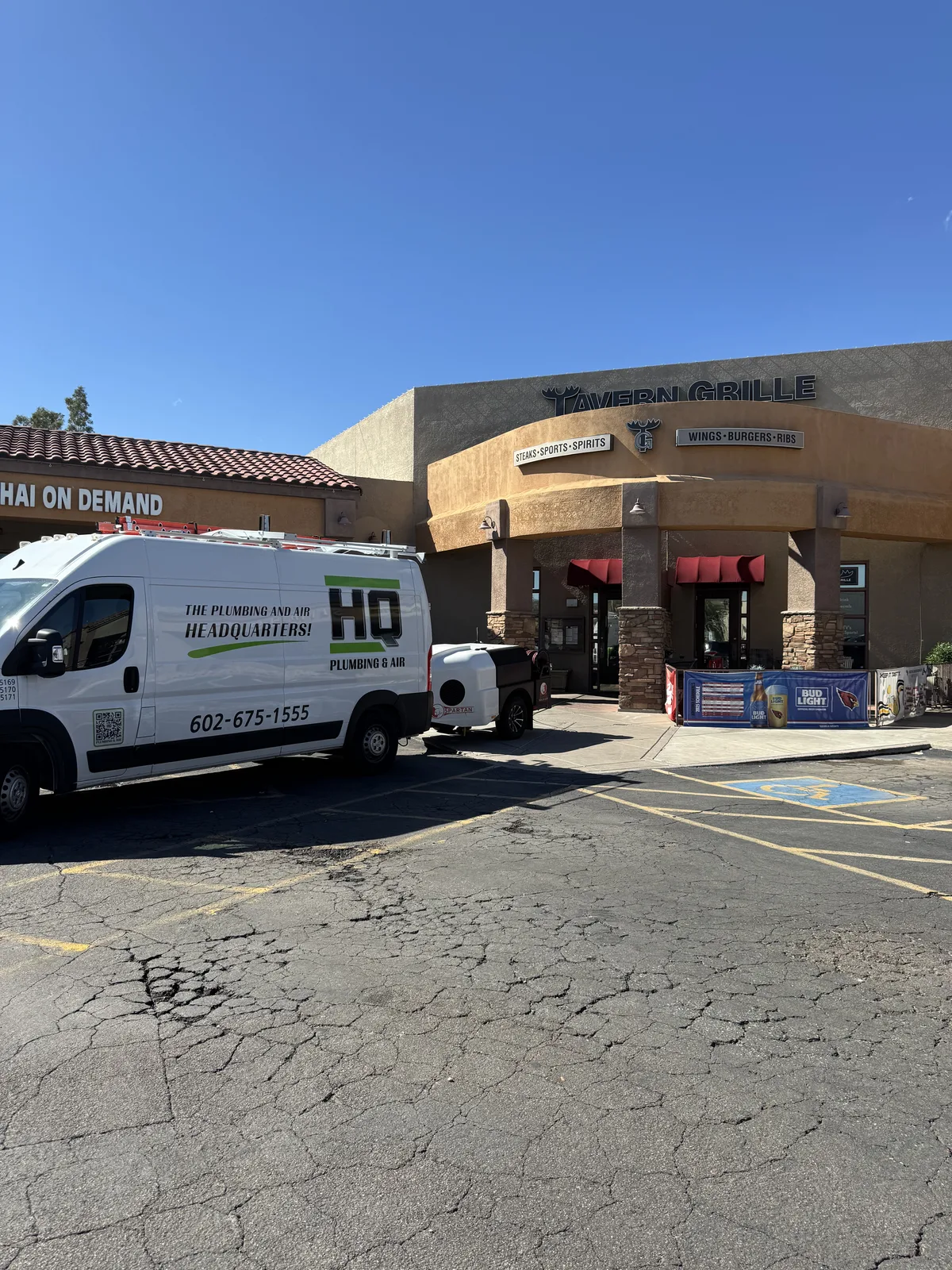
Restaurant Sewer Camera Inspection in the Valley
Floor sinks to interceptor to city lateral, scoped in order, with grease ledges and sagging sections shown on video.
A restaurant sewer camera inspection shows what grease has done to your drain lines: ledges at joints, sagging sections that hold water, and buildup the jetter missed. The best time to scope is right after cleaning, so the video shows pipe condition instead of grease. We inspect from your floor sinks to the city connection.
The rules that apply
Each rule links to the official text we read it from. Cities change these, so check the source before a big decision. Last checked 2026-10-04.
Pipe upstream of an interceptor needs more slope
PhoenixHorizontal drainage piping upstream of a grease interceptor must slope at least 1/4 inch per foot (2 percent), steeper than the standard slope for the same pipe, so a belly in that run is a code problem as well as a clog risk.
Source: Phoenix amendment to 2024 IPC Sec. 704.1Cleanout after a hydromechanical grease trap
PhoenixA two-way cleanout is required on the discharge side of every hydromechanical grease interceptor, so the line downstream and back to the device can be cleaned, and a camera can enter there.
Source: Phoenix amendment to 2024 IPC Sec. 1003.3.5.3Grease damage downstream is billed back
PhoenixPhoenix's FOG manual warns that grease blockages in or downstream of a facility can mean routine jetting, an emergency overflow during business hours, or damage downstream that you could be billed back to remediate.
Source: Phoenix FOG BMP Manual (June 2024)No grease solvents to hide the problem
PhoenixUsing chemicals, enzymes, proteins, bacteria, grease solvents or emulsifiers to temporarily dissolve fats, oils and grease is prohibited, so a camera scope after cleaning should show real pipe, not dissolved grease headed downstream.
Source: Phoenix FOG BMP Manual (June 2024)Plumbing kept in good repair, and a sewage backup ends service
Maricopa County (FDA Food Code 2017)A food establishment's plumbing system must be repaired according to law and maintained in good repair (5-205.15). A permit holder must immediately stop operating and notify the regulator if a sewage backup creates an imminent health hazard (8-404.11).
Source: FDA Food Code 2017, adopted by Maricopa CountyAlso: Maricopa County Environmental Health Code, Ch. VIII Sec. 2What the scope has to see to be useful
National standard (NASSCO)The pipe must be clean enough that all defects, features and observations are seen and logged, and cleaning dates are recorded. A post-cleaning inspection is the stage that confirms condition after cleaning.
Source: NASSCO CCTV performance specification guidelineWhy restaurant lines get their own inspection
Restaurant drains fail differently than office or retail lines. Grease does not just float. It cools in the lateral, clings to joints and builds ledges that catch solids. A section of pipe that sags even a little holds water, and standing water gives grease a place to collect. The camera shows the whole story: where the buildup starts, how thick it is and whether the pipe underneath is still sound.
That matters because Phoenix treats the line downstream of your kitchen as your problem. Its FOG manual says a grease blockage can lead to routine jetting, a shutdown during business hours for an emergency overflow, or damage downstream that the city can bill back to the business. Under the Food Code the county follows, a sewage backup is also a reason to stop serving and call the regulator. Seeing the problem on camera first beats learning about it from a backup.
What to scope, in order
The route matters. We run the camera in this order, and you should expect your inspector to do the same:
- 1The kitchen floor sinks and floor drains that take the pre-rinse, dish and prep sinks. These are the first runs grease touches.
- 2The line to the interceptor. Phoenix requires pipe upstream of an interceptor to slope at least 1/4 inch per foot, so a belly here is a defect you can point to in the code.
- 3The interceptor outlet and the cleanout after it. A hydromechanical trap in Phoenix must have a two-way cleanout on the discharge side, which gives the camera a clean way in without disturbing the device.
- 4The lateral to the city sewer. This run is longest and holds most of the surprises: roots, offset joints, scale on old cast iron and grease that has slipped past the interceptor.
If the grease interceptor itself looks failed, that is a tank job for a licensed hauler and then repair. See grease trap and interceptor service and grease in the sewer line after an interceptor.
Scope after jetting, not before
The video is only as good as the pipe is clean. NASSCO's specification wants the pipe clean enough that every defect is seen and logged, and it records whether and when the line was cleaned. In practice this means two cases. If you already do maintenance jetting, we scope right after the cleaning visit and the video shows the real pipe. If you have a stoppage, we clear it first and scope the line next. Either way the report says whether the line was cleaned before the camera went in.
We jet restaurant laterals from inside, and main lines out to the city sewer, before opening or after close, typically one to two hours inside. For soda and ice-well drains we use cleaning solution. See hydro jetting and commercial drain cleaning. Phoenix prohibits chemicals that dissolve grease, so cleaning here means mechanical jetting, not solvents.
What the findings usually mean
- Grease ledge at joints, pipe sound. Maintenance problem. A tighter jetting schedule and interceptor discipline usually fix it.
- Standing water in a section (a belly). Grease will keep returning there. Cleaning only delays it. Repair is the long-term answer.
- Cracks, offsets or roots. Structural. These need repair, and grease will keep getting trapped until they get it.
- Grease past the interceptor. Often a missing tee or baffle, which sends you back to the interceptor.
Ask for distances on every finding. A distance lets a repair crew find it and lets you compare quotes against the same footage. For how to read the severity codes, see belly in a sewer line.
Inspector visits and your records
Phoenix's routine inspection centers on the interceptor and your records. A video that shows clean, sound pipe after a documented cleaning is useful evidence if a downstream blockage is ever traced to your property, and a video that shows damage gives you the paper trail to repair it before it becomes a violation. Keep the video with your cleaning logs. The grease trap maintenance log is a free place to start.
When a camera is the wrong answer
If the kitchen drains slowly and the line has never been cleaned, jet first. If a hand sink is slow, you probably have a local clog and a cable will fix it. If you only smell sewer, a dry floor drain or a vent problem is likelier than a grease-damaged lateral. See restaurant sewer odor smoke testing. HQ offers 24/7 emergency service, free estimates and an upfront price before any work starts.
Why is there grease in my sewer line after the interceptor?
Grease gets past an interceptor when it is overdue for cleaning, a baffle or part is missing, hot water or emulsifiers push grease through, or a fixture bypasses the device. Phoenix and Chandler both name these problems. Fix the device first, then jet the line to remove what already coated it.
Read full answer: Why is there grease in my sewer line after the interceptor?What does a belly in a sewer line mean?
A belly, or sag, is a low spot where the sewer pipe has lost its slope and holds water. It's usually a problem only if debris settles there and builds up into backups. Seattle's utility calls a sag under 25 percent of the pipe diameter minor, and 50 percent or more severe.
Read full answer: What does a belly in a sewer line mean?Why camera the line after hydro jetting?
A camera pass after jetting documents visible cleaning results and defects that buildup may have hidden. Ask for the video and any limits from access, standing water or visibility. It does not prove every branch is clean, measure remaining wall thickness or guarantee the pipe is structurally sound.
Read full answer: Why camera the line after hydro jetting?Why does my restaurant smell like sewer?
Most often a dried-out floor drain. The water seal in a P-trap blocks sewer gas, and floor drains in a restaurant sit unused for days, so the seal evaporates and rotten-egg gas rises up. Other causes are a full grease trap, a blocked vent, or a broken sewer line.
Read full answer: Why does my restaurant smell like sewer?Sources
- City of Phoenix: Amendment to the 2024 International Plumbing Code (Ord. G-7397)
- City of Phoenix: FOG Best Management Practices for Food Service Establishments (June 2024)
- FDA Food Code 2017
- Maricopa County Environmental Health Code, Chapter VIII, Section 2 (Food Establishments)
- NASSCO: Pipe Condition Assessment Using CCTV, Performance Specification Guideline
Related commercial services
Cleanout access, pipe sizes, and what the video and report should show for a commercial building's private sewer.
What a buyer's scope should find, what a residential-style scope leaves out and how the video supports a price talk.
Portfolio scoping order, how to rank findings, and the landlord duties that apply to plumbing and digging.
How a sonde locate works, what limits it and why it does not replace the one-call process for other utilities.
How to use before and after video to decide between a cleaning schedule and a structural repair.
Finding cracks, cross-connections and illegal storm tie-ins, plus how to prepare tenants and your alarm company.
Grease Backing Up Again?
Talk to a real dispatcher who knows commercial work. Upfront pricing before work starts, 24/7 for emergencies.