
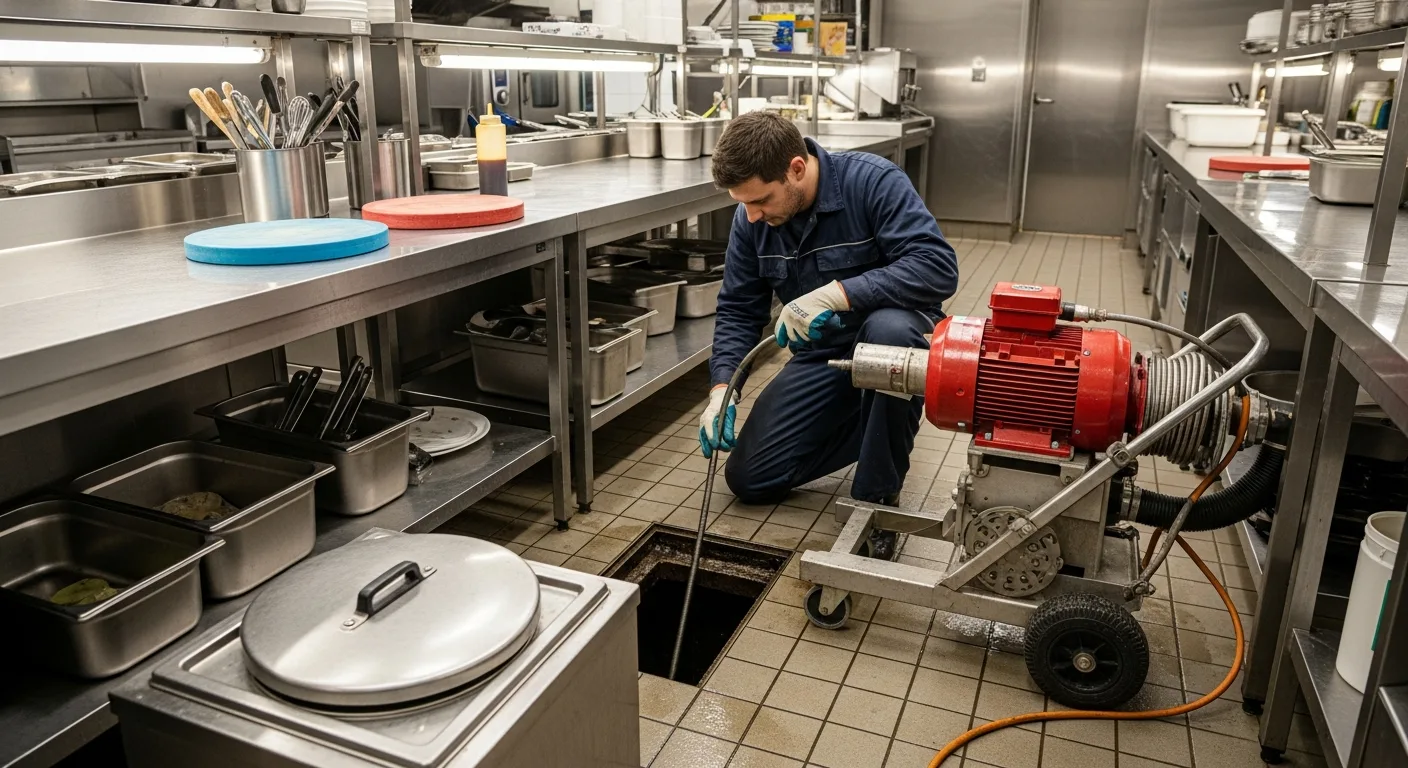
Emergency Restaurant Plumber in Phoenix
Shutoffs, the health authority rules for backups and water loss, and a night dispatcher with a supervisor callback. No promises about reopening times.
In a restaurant emergency, shut off water to the affected fixture, stop sending wastewater down the drain, and call. A sewage backup or extended water loss can be an imminent health hazard that the food code says to report, and approval is needed to reopen. Our night dispatcher takes the call and a supervisor calls back.
The rules that apply
Each rule links to the official text we read it from. Cities change these, so check the source before a big decision. Last checked 2026-10-04.
Stop operations and notify the health authority
Maricopa County (FDA Food Code 2017, 8-404.11)A permit holder must immediately discontinue operations and notify the regulatory authority if an imminent health hazard may exist, such as a fire, flood, extended interruption of water service or a sewage backup. An unaffected area of the establishment need not stop.
Source: FDA Food Code 2017, 8-404.11Approval before you reopen
Maricopa County (FDA Food Code 2017, 8-404.12)When operations were discontinued under the hazard rule, the permit holder must obtain approval from the regulatory authority before resuming. The county adopted the 2017 Food Code effective October 6, 2021.
Source: FDA Food Code 2017, 8-404.12Also: Maricopa County Environmental Health Code (Food Code adoption)Emergency operating plan for a water outage
Maricopa County (FDA Food Code 2017, 8-404.11(C))The authority may agree to continued operation during an extended water or electrical interruption only if a written emergency operating plan has been approved, immediate corrective action controls the risk, and the authority is told when the plan is put in place.
Source: FDA Food Code 2017, 8-404.11Hand sink must stay usable
Maricopa County (FDA Food Code 2017, 5-205.11)A handwashing sink must be accessible at all times for employee use and may not be used for other purposes. A prep sink or dish sink is not a substitute.
Source: FDA Food Code 2017, 5-205.11Hot water must keep up
Maricopa CountyEach permitted establishment needs its own properly sized water heater set at 120 degrees F or higher, delivering hot water to sinks within 45 seconds. Hot or tempered water is required at all sinks.
Source: County hot water supply guidelineValves you can use in a leak
PhoenixShutoff valves go on the fixture supply to each plumbing fixture and on the supply to each appliance or mechanical equipment, with access provided to every shutoff. Valves not next to the fixture they serve must be identified.
Source: Phoenix Plumbing Code 2024, 606.2 to 606.4After a grease overflow
PhoenixA full cleaning of the interceptor by a licensed pumper is required once grease and solids reach 25 percent of capacity, and enzymes or grease dissolvers cannot stand in for pumping. Records stay on site for three years.
Source: Phoenix FOG BMP ManualWhat to do in the first ten minutes
Stop the flow, protect the food and keep people away from the water. That order matters. If a floor sink or drain is overflowing, stop using every sink, dish machine and ice machine that feeds it. If a line has burst, close the fixture shutoff or the main. Phoenix's code puts a shutoff on every fixture supply and every appliance supply, so the valve under the sink or behind the machine is usually the fastest fix. Know where the main is before you need it.
Then move food out of the water's path, photograph what you see for the insurance carrier, and call us. If you smell gas, leave first, then call the gas utility from outside. Our FAQ on a gas smell in a restaurant explains how to tell it from sewer gas.
When a restaurant has to stop serving
A sewage backup or an extended loss of water can be an imminent health hazard, and the rule is to stop and report. The FDA Food Code, which Maricopa County adopted effective October 6, 2021, says a permit holder must immediately discontinue operations and notify the regulatory authority if a hazard such as a fire, flood, extended interruption of water service or sewage backup may exist. An area that is unaffected does not have to stop.
The same code requires approval from the authority before you resume. That approval is the county's call, not ours. We can fix the pipe, document what we did and clear the line, but we do not decide when you open, and nobody should promise you an exact reopening time before the authority weighs in. For the reopening steps, see what to do after a restaurant sewage backup.
A water outage has one exception. The county can agree to keep operating through an extended water interruption only if a written emergency operating plan was approved in advance. If you do not have one, ask your inspector about it on a calm day.
The common emergencies and how we handle them
Most after-hours restaurant calls we handle fall into four buckets. A kitchen drain or floor sink backing up, a restroom stoppage, a leaking supply line or valve, and a grease overflow.
For a stoppage, we send a technician with a cable first and a jetter on standby for same-day work, then propose hydro jetting if the line needs a permanent clean. Cables clear the blockage, and jetting clears the buildup that caused it. Our commercial kitchen drain overflow FAQ walks through what to check first, and floor drain backing up covers the one place customers see it.
A grease overflow is a different job. If the interceptor is full, a licensed hauler has to pump it, because Phoenix requires a full cleaning by a licensed pumper once grease and solids reach 25 percent of capacity and does not accept enzymes in place of pumping. We do not pump. We can coordinate with the hauler and repair what is broken inside the tank afterward.
A hand sink that stops working is an emergency for a health inspector, not just for you. The food code says it must stay usable and that other sinks are not a substitute. See what to do when a hand sink stops working and our hand sink and prep sink repair page.
How our night dispatch works
After hours, a dispatcher answers, collects the details and gets a technician moving, and a supervisor calls you back. That callback is how we check what we know against what you see, line up the right equipment and tell you what to expect. We offer 24/7 emergency service. We do not promise a specific arrival time or a reopening time, because traffic, access and the condition of the line decide those.
Have these ready when you call: the address and which suite or door to use, what stopped working, whether water is still running and who can open the building. If you can safely shut off the fixture or the main, say so. If you cannot find the main, we will talk you through it, and a water meter leak test can tell you later whether anything is still leaking.
When it can wait until morning
Plenty of problems feel urgent and are not. A slow drain that still empties, a dripping faucet, a running toilet or a stained ceiling tile that is dry can often wait for a scheduled visit that does not interrupt service. A schedule built around your hours, before opening or after close, is cheaper in lost sales than a rushed midday repair.
If the problem is not an imminent hazard and you can isolate it with a fixture shutoff, close it and book a daytime visit. Our after-hours checklist helps decide.
What HQ does
We clear restaurant drains, jet laterals and mains to the city sewer, repair supply lines and valves, and coordinate with your hauler on interceptors. We give an upfront price before any work starts and free estimates on follow-up repairs. See emergency plumber service, commercial drain cleaning, hydro jetting and our restaurant plumbing page.
What do I do in a commercial plumbing emergency at 2 a.m.?
Make it safe first: if you smell gas, leave and call 911 and Southwest Gas; otherwise shut off the water at the nearest valve and stay out of standing water near electrical equipment. Then call a 24/7 commercial plumber with the address, what's leaking, where the shutoff is, and how to get in.
Read full answer: What do I do in a commercial plumbing emergency at 2 a.m.?Why does my commercial kitchen drain keep overflowing?
Grease is the usual cause. Fats, oils, and grease wash down warm, then cool and harden on the pipe walls until the line chokes. The EPA found grease causes 47 percent of sewer blockages. A full grease trap, food solids, or a clog in the main line make it worse. The fix is hydro jetting plus regular interceptor service.
Read full answer: Why does my commercial kitchen drain keep overflowing?Why is my floor drain backing up?
Your floor drain backs up because it usually sits at the lowest point in your home's drain system. When the main sewer line or a shared branch clogs, wastewater has nowhere to go and surfaces there first. A blocked or dried-out drain trap is the other common cause.
Read full answer: Why is my floor drain backing up?What should a restaurant do when a required handwashing sink stops working?
Keep a required restaurant handwashing sink accessible and usable; a prep sink, warewashing sink or sanitizer bottle is not an automatic substitute. Identify the affected workstation and contact Maricopa County Environmental Services about safe operation. Stop affected operations when an imminent health hazard may exist, and obtain required approval before resuming discontinued work.
Read full answer: What should a restaurant do when a required handwashing sink stops working?Gas smell in my restaurant: is it a leak or sewer gas?
Treat it as a natural gas leak first. Both natural gas and sewer gas smell like rotten eggs, and a gas leak can explode. If the smell is strong or near gas equipment, evacuate, then call 911 and Southwest Gas at 877-860-6020. If it is near drains, it is likely sewer gas.
Read full answer: Gas smell in my restaurant: is it a leak or sewer gas?How do I use my water meter to check for a leak?
Turn off every water source in the home, then read your meter. On a digital meter, watch the flow screen for at least 10 flashes; any number above zero means a leak. On an analog meter, note the low-flow triangle and sweep hand, wait 10 minutes, and recheck. Any movement signals a hidden leak.
Read full answer: How do I use my water meter to check for a leak?Sources
- FDA Food Code 2017 (adopted by Maricopa County effective October 6, 2021)
- Maricopa County Environmental Health Code (Rev 08/19/2026)
- Maricopa County: Guideline to Sizing Water Heaters, Water Temperature and Potable Water Supply (Rev 10/15/2025)
- Phoenix Plumbing Code 2024, Chapter 6
- City of Phoenix: FOG Best Management Practices for Food Service Establishments (June 2024)
Related commercial services
Grease device rules for coffee shops by city, espresso water filtration and backflow, hand sinks, ice machine drains and hot water sizing.
Bakery grease interceptor rules, flour and dough clogs, floor drains around coolers and proofers, and water heater sizing from the county table.
Commissary agreements, dump station drains, potable fill backflow, truck tank sizes and grease device rules for kitchens that host food trucks.
Hand sink placement and temperature, prep sink air gaps, splash guards and which sinks go to the grease device, with repair options.
Drain stack, water riser, slab and underground main leaks in apartment buildings, owner duties, riser valves and leak detection.
Stopping a unit leak, Arizona entry and repair rules, tenant self-help limits and in-unit water heater failures.
Restaurant Plumbing Emergency?
Talk to a real dispatcher who knows commercial work. Upfront pricing before work starts, 24/7 for emergencies.