
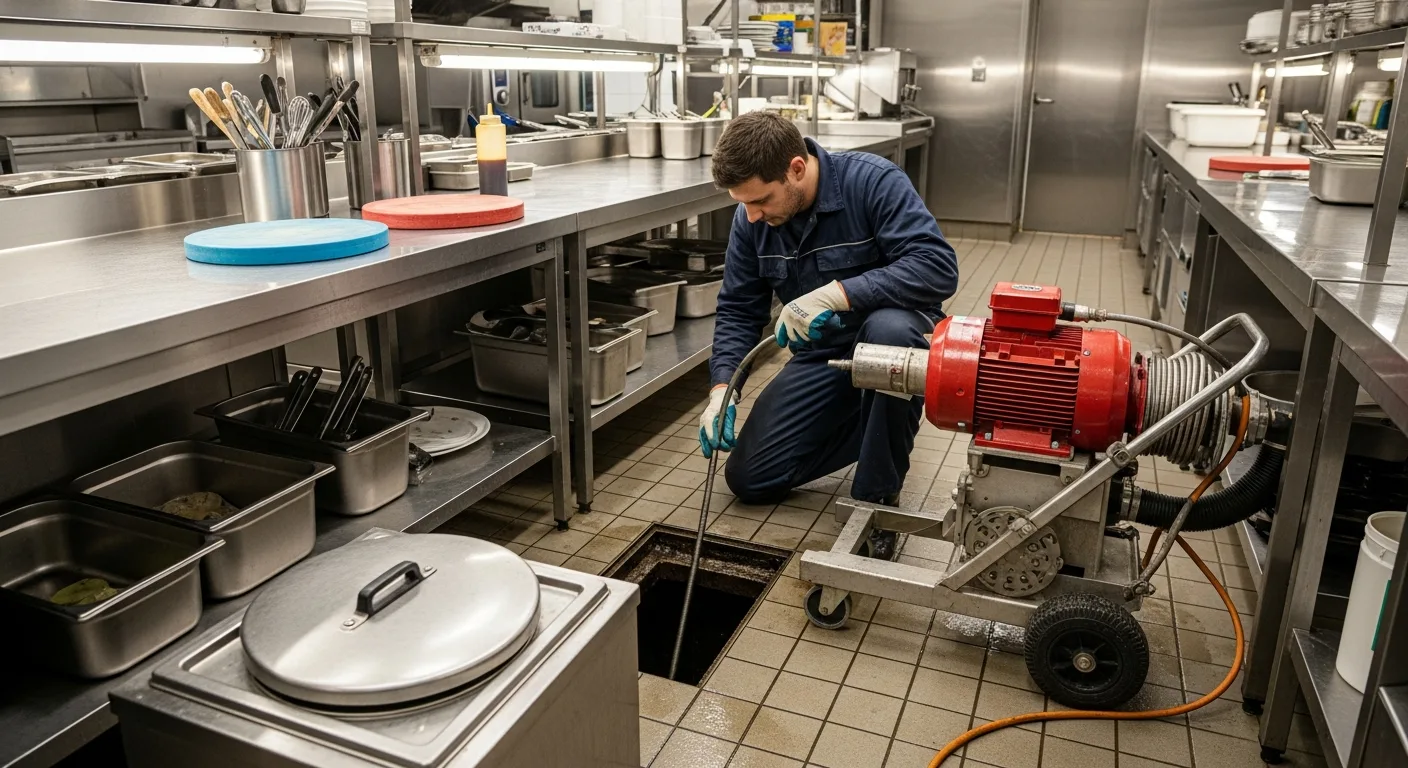
After-Hours Commercial Drain Cleaning in Phoenix
Interior line work booked around your doors: before opening or after close, one to two hours inside, with a night dispatcher for the calls that cannot wait.
HQ books interior drain work before you open or after you close, usually one to two hours inside, so the line is clear before the next service. Stoppages that cannot wait go to a night dispatcher, and a supervisor calls back in the morning. Keep floor sinks clear, cleanouts reachable and have someone ready to let us in.
The rules that apply
Each rule links to the official text we read it from. Cities change these, so check the source before a big decision. Last checked 2026-10-04.
Sewage backup closes the kitchen until the health authority says otherwise
Maricopa County (FDA Food Code 8-404.11 and 8-404.12)A permit holder immediately discontinues operations and notifies the regulatory authority if an imminent health hazard such as a sewage backup may exist, need not stop in areas the hazard does not affect, and must get approval before resuming. Planned after-hours work exists so you never reach this point on a service night.
Source: FDA Food Code 2017, Sections 8-404.11 and 8-404.12Also: Maricopa County Environmental Health Code, Chapter VIII, Section II (adopts the 2017 Food Code)The owner maintains the plumbing
Phoenix (IPC 102.3)Plumbing systems must be kept in proper operating condition in a safe and sanitary condition, the owner or the owner's agent is responsible for maintenance, and the code official can require reinspection.
Source: 2024 IPC Chapter 1 as adopted by Phoenix, Section 102.3Cleanouts need clear space in front of them
Phoenix (IPC 708.1.10 and 708.1.11)Cleanouts for 6 inch and smaller pipe need at least 18 inches of clearance, perpendicular to the opening, from any obstruction, and required cleanouts cannot be concealed. A shelf in front of a cleanout is an easy way to turn an hour into two.
Source: 2024 IPC Chapter 7, Sections 708.1.10 and 708.1.11Floor drains and receptors must be reachable
Phoenix (IPC 413.2 and 802.4)Floor drains need ready access and removable strainers, and waste receptors need ready access and a removable strainer or basket. Equipment parked over a floor sink blocks both the cleaning and the inspection.
Source: 2024 IPC Chapter 4, Section 413.2Also: 2024 IPC Chapter 8, Section 802.4Low-flow hours suit line work
Federal (EPA fact sheet)EPA's sewer cleaning and inspection fact sheet says inspections should take place during low flow, and for lines that can overtop the camera, between midnight and 5 a.m. The same logic applies to a building drain: it is easier to clean when nobody is flushing into it.
Source: EPA Collection Systems O&M Fact Sheet: Sewer Cleaning and Inspection (EPA 832-F-99-031)Keep the service paperwork
PhoenixThe city's FOG manual says maintenance records, including invoices from third-party service contractors, must be available on site for three years. Inspectors arrive unannounced and try to come in off hours, so the record has to be in the building when they do.
Source: Phoenix FOG BMP Manual, records and routine inspectionsHow after-hours drain service works
Interior drain work is booked into the hours your doors are closed, which means before you open or after you close. The inside portion usually takes one to two hours. For a restaurant, that window sits between the last cleaning and the prep crew's arrival, or between the last ticket and the night cleaning. For an office or retail space, it is an evening. We agree on the window when you book, and we tell you the upfront price before we start.
The reason is mechanical. A drain job puts fixtures out of service while we work, the jetter puts water and hose across the floor, and kitchen work has to be finished and flushed before the dish machine runs again. Doing it with guests in the room means doing it slower. Doing it at 5 a.m. means doing it once.
What to have ready
Most of what makes a visit run long is access, and you control it. Before we arrive:
- Clear the cleanouts. The 2024 plumbing code, as Phoenix adopts it, calls for at least 18 inches of clearance in front of cleanouts on 6 inch and smaller pipe, and bars concealing required cleanouts. Move stock and shelving away from the wall where the cleanout sits.
- Clear the floor sinks and drains. The code requires ready access to floor drains and waste receptors. Pull equipment that sits over a floor sink.
- Empty what we will drain. Ice bins, steam tables and mop buckets that empty into the lines we are cleaning should be empty.
- Arrange entry. We need someone to open the building or a clear instruction for the alarm and the lock, and a contact who answers the phone.
A short list sent by text or email ahead of time is enough. If you do not know where your cleanout is, tell us, and we will look for it first.
What happens at night when a stoppage hits
We run 24/7 emergency service. After-hours calls go to a night dispatcher, who takes the details and dispatches an emergency. A supervisor calls back in the morning for anything that can wait. If your drain stopped at 9 p.m., you reach a person that night, and you do not wait for the office to open to find out. The same-day process is on its own page: same-day commercial drain stoppage.
For a restaurant, the stakes of a night stoppage are higher than the clog. Under the food code that Maricopa County adopts, a sewage backup is an imminent health hazard. You stop operating in the affected area and notify the regulatory authority, and you get approval before resuming. That is the scenario planned after-hours work is meant to prevent.
Why scheduled visits beat daytime emergencies
A scheduled visit costs you an hour or two of an empty building. An emergency during service costs you the shift. Phoenix's FOG manual itself notes that keeping grease out of the plumbing reduces the chance of a shutdown during business hours for an emergency overflow. We use after-hours slots for the work that prevents that call: restaurant kitchen drain cleaning, branch and main jetting, and recurring scheduled drain maintenance.
How the window changes by business
The same one to two hours looks different depending on what you run.
- Restaurants. Kitchen lines come first, with the dish machine and sinks off until we flush. Do the drains before the closing clean, not after, so the crew is not mopping a floor we are about to wet again.
- Bars and breweries. After last call, with the ice well and soda station drains done while the bins are empty. See breweries and bars for what else those buildings carry.
- Offices and retail. Evenings or a weekend morning, one restroom at a time so another stays available to staff and customers.
- Medical, dental and churches. After the last patient or between services, with the fixtures that serve procedure areas and the restrooms treated as separate jobs. Our pages on medical and dental plumbing and churches cover their rules.
When after-hours is the wrong answer
- The drain is stopped right now. Waiting for a quiet window turns a clog into a backup. Call, and we dispatch as an emergency.
- The work does not need an empty building. A single office restroom branch can often be done in the afternoon if you can close that restroom for an hour. Ask us whether your job needs the night window.
- Nobody can open the building. After-hours work without a key holder just burns the window. Sort entry first.
Setting up your window
Call with the type of business, what you are seeing, and your preferred window: before opening, after close, or a weekend morning. We give free estimates, and we put the job on the calendar with the access list above. For the services we schedule most, see commercial drain cleaning, hydro jetting, and restaurant plumbing.
Services and tools
Codes and permits
Can a restaurant's drains be cleaned while it stays open?
A restaurant's drains can often be cleaned while it stays open, if the line is still draining and the work is planned for a slow window. A sewage backup is different. The Food Code says stop operating, notify the health department, and get approval before you reopen, though unaffected areas may keep running.
Read full answer: Can a restaurant's drains be cleaned while it stays open?What needs to happen before a restaurant reopens after a sewage backup?
After a restaurant sewage backup, stop affected operations, prevent exposure and notify Maricopa County Environmental Services when an imminent health hazard may exist. Repairing the drain addresses the source but does not resolve contaminated food, equipment or surfaces. Document cleanup and restored sanitary functions, and obtain the required regulatory approval before resuming discontinued operations.
Read full answer: What needs to happen before a restaurant reopens after a sewage backup?Can a business stay open with its restrooms out of service?
A business can stay open with restrooms out of service only if it still meets the rules. Federal safety rules, which Arizona adopts, require a minimum count of employee toilets by headcount. The plumbing code expects public access to required restrooms while the building is open. Food businesses face stricter county rules on water outages and backups.
Read full answer: Can a business stay open with its restrooms out of service?How often should a commercial building have its drains cleaned or jetted?
Set commercial drain-cleaning intervals from grease load, roots, pipe condition, clog history and camera findings. The reviewed IPC maintenance rule and Phoenix/Scottsdale programs do not give one interval for all building drain lines. Grease interceptors have separate requirements; check the applicable local rules.
Read full answer: How often should a commercial building have its drains cleaned or jetted?Sources
- FDA Food Code 2017, Sections 8-404.11 and 8-404.12
- Maricopa County Environmental Health Code, Chapter VIII, Section II: Food Establishments
- 2024 International Plumbing Code as adopted by Phoenix, Chapter 1, Section 102.3
- 2024 International Plumbing Code as adopted by Phoenix, Chapter 7, Section 708
- 2024 International Plumbing Code as adopted by Phoenix, Chapter 4, Section 413.2
- 2024 International Plumbing Code as adopted by Phoenix, Chapter 8, Section 802.4
- EPA Collection Systems O&M Fact Sheet: Sewer Cleaning and Inspection
- City of Phoenix: FOG Best Management Practices for Food Service Establishments (June 2024)
Related commercial services
Which kitchen drains clog first, how they are cleared from the fixture side, and what the air gap rules mean for the fix.
Why interior branch lines need a small hose, what a cable leaves behind, and how the job is paired with a main line pass.
Where the private main ends and the city sewer begins, why a cleanout decides the job, and why the main and the branches get jetted as a pair.
Why soda and ice well drains stink, what Maricopa County and the plumbing code say about their air gaps, and what a cleaning visit does.
How to tell a fixture problem from a line problem, why a cable alone keeps failing, and what the repeat call sequence looks like.
Why floor drains back up or stink in the Valley, what a trap primer does, and what a cleaning visit includes.
Need Drains Cleaned After Hours?
Talk to a real dispatcher who knows commercial work. Upfront pricing before work starts, 24/7 for emergencies.