
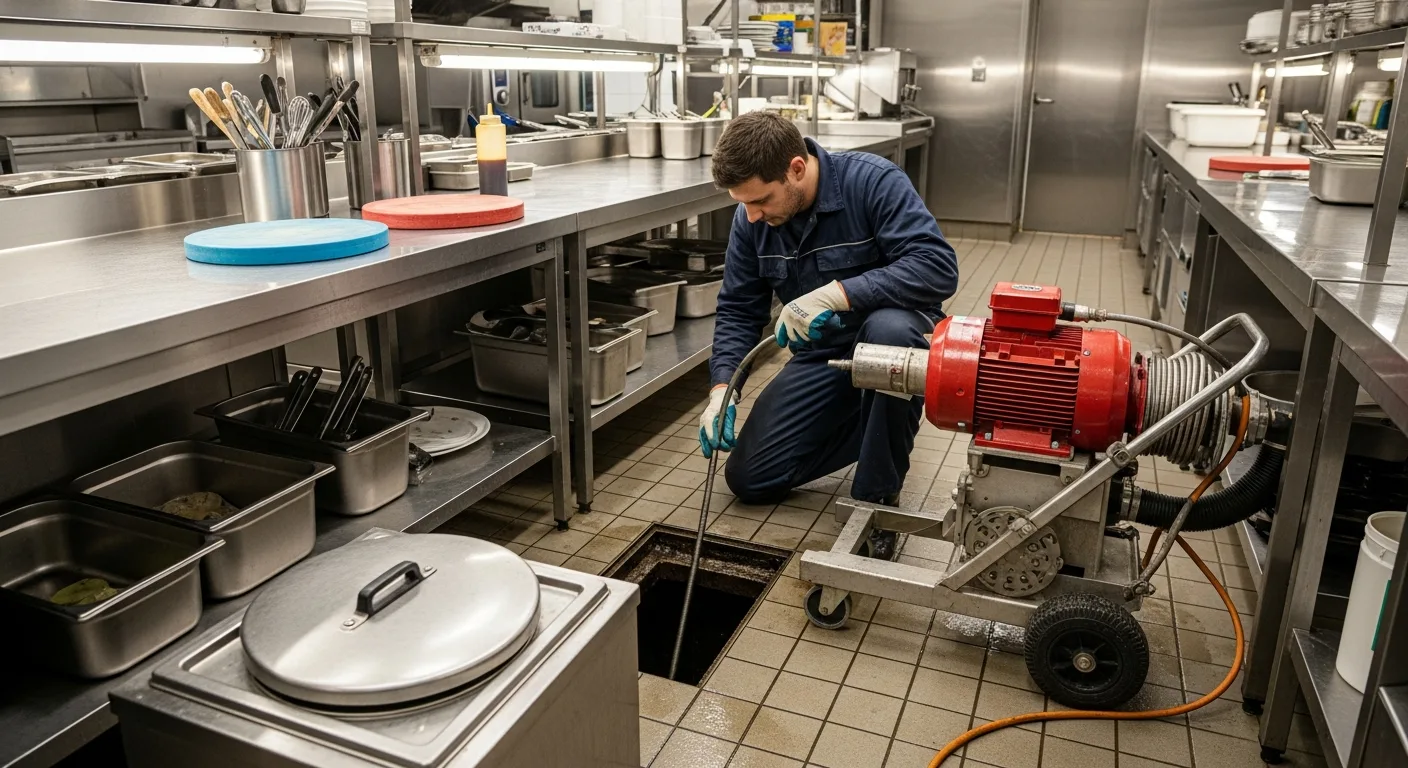
Restaurant Main Line Jetting in Phoenix
The pipe that carries the whole kitchen to the city sewer, jetted through the cleanout so a restaurant does not lose a Friday night to one backed up line.
When every drain in a restaurant slows at once, the main is the suspect. HQ jets the main through the cleanout, working out toward the city sewer, then checks the run. The private pipe belongs to the owner up to the city connection, so we also tell you which side of the line the problem is on.
The rules that apply
Each rule links to the official text we read it from. Cities change these, so check the source before a big decision. Last checked 2026-10-04.
Where the building drain ends and the building sewer begins
Phoenix (IPC definitions)The building drain is the lowest piping inside that extends 30 inches beyond the exterior wall. From there the building sewer runs to the public sewer or other point of disposal. The cleanouts that matter for a main sit on that second pipe.
Source: 2024 IPC Chapter 2 as adopted by Phoenix, Building Drain and Building SewerA cleanout at the junction
Phoenix (IPC 708.1.3)The junction of the building drain and the building sewer needs a cleanout at the junction or within 10 feet of piping upstream of it, and pulling a toilet cannot be the only way in.
Source: 2024 IPC Chapter 7, Section 708.1.3Cleanouts along a long run
Phoenix (IPC 708.1.2)Building sewers smaller than 8 inches need cleanouts at intervals of not more than 100 feet. Larger sewers need a manhole within 200 feet of the junction and at intervals of not more than 400 feet.
Source: 2024 IPC Chapter 7, Section 708.1.2Buried cleanouts must reach grade
Phoenix (IPC 708.1.11)Required cleanouts cannot be in concealed locations, and cleanouts below grade must extend to grade so the top of the plug is at or above it. A cleanout under a landscape bed or patio slab is a defect, not a hidden asset.
Source: 2024 IPC Chapter 7, Section 708.1.11The owner is responsible from the connection back to the building
PhoenixThe city is responsible only for city-owned infrastructure in rights of way and easements. Everything from the connection back to the home or business is the owner's, and cleanouts on private property fall outside city staff's jurisdiction.
Source: Phoenix Water Services, Sewer Cleaning FAQs, questions 9 and 13Private pipe repair, and who the city repair offer covers
Phoenix (City Code 28-5.1)The property owner must repair or replace the broken piping section on private property. The city's offer to repair a verified break in the right of way is written for single-family and duplex property.
Source: Phoenix City Code Chapter 28, Article ICleaning and unstopping the private main
Chandler (City Code 51-6)The property owner is responsible for cleaning, unstopping, maintenance and repair of the building service line and private sewer mains from the building to the public sewer main, including the tap on the city main.
Source: Chandler City Code 51-6Overflow from the city main
PhoenixA water or sewer emergency such as a main break or overflow is reported to the 24/7 Phoenix Water Services Emergency Hotline at 602-261-8000.
Source: Phoenix Water Services, Contact UsWhere your main ends and the city's begins
A restaurant's main line is the private pipe that carries every fixture's waste out of the building and to the city sewer, and the owner is responsible for all of it. Phoenix Water Services says it plainly: the city handles the infrastructure in public rights of way and easements, and everything from that connection back to the business belongs to the owner. Chandler's code says the owner is responsible for cleaning, unstopping, maintenance and repair of the building service line and private sewer mains, up to and including the tap on the city main.
Phoenix's repair offer in City Code 28-5.1 is written for single-family and duplex properties. A restaurant should assume the whole run is its own until the Water Services Department says otherwise. Other Valley cities word this differently, so if you are outside Phoenix and Chandler, ask your city's utility before you assume.
How to tell it is the main and not a branch
If every drain in the kitchen is slow and the lowest fixtures back up first, it is the main. A branch clog affects the fixtures on that branch only. A main clog affects everything upstream of it, and the sewage comes up in the lowest opening, which is usually a floor sink or a floor drain near the back door. Our guide to telling a main line clog from a branch clog walks through the checks.
Check one other thing before you call a plumber. If neighbors in the same building or the same block are also backing up, the blockage may be in the city main. Phoenix takes sewer overflow reports on its 24/7 emergency hotline at 602-261-8000. A crew working in your private line cannot fix a blockage in the street.
How we jet the main
We jet the main through the cleanout and work out toward the city sewer. The 2024 plumbing code requires a cleanout where the building drain meets the building sewer, within 10 feet upstream of that junction, and further cleanouts at 100 foot intervals on building sewers under 8 inches. Those access points decide how the job goes. A cleanout that reaches grade opens in minutes, and one nobody can find is the first thing we look for.
The hose for a main is larger than the one used inside. RIDGID's manual for its larger jetters pairs 4 to 6 inch lateral and main lines with a 1/4 inch hose on the mid-size machine, and 4 to 10 inch lines with a 3/8 inch hose on the largest. We use the nozzle and hose that fit the pipe, and a camera pass after jetting is worth the extra time. It shows the wall, the joints and any sag. See our sewer camera inspection page for what the footage tells you.
Why we jet the main and the branches together
A main that has been jetted but fed by dirty branches will be full again within weeks. The branches carry the grease, and they are cleaned from inside, with a smaller hose, which our page on restaurant lateral line jetting explains. We usually do both in one visit: branches first, then the main, then a camera on the main. That order keeps loosened material from getting trapped at the first bend.
If your cleanout is not accessible, we will say so. Jetting without one is possible in some layouts and not in others, and the code requires a cleanout at the junction in the first place. Our FAQ on hydro jetting without an accessible cleanout explains the options.
When jetting the main is the wrong answer
- The city main is the problem. If the sewer in the street is blocked, it is the city's to clear, and you report it on the emergency line.
- The pipe is broken or collapsed. Jetting cannot restore a pipe that has lost its shape. A camera will show it, and the answer is sewer repair.
- Roots are the cause, and they keep returning. Jetting cuts and flushes roots, and a root-bound joint will grow them back. A camera finds the joint, and a spot repair stops the cycle.
- Only one fixture backs up. That is a kitchen branch problem, not a main problem. See restaurant kitchen drain cleaning.
Before you call us
Call us with your city, where your cleanout is if you know, and what you are seeing. For a main that is only slow, we book the work before opening or after close. For a main that has backed up into the kitchen, we run 24/7 emergency service, and our night dispatcher takes the call with a supervisor calling back in the morning for anything non-urgent. We give an upfront price before work starts, and estimates are free. For more on how we serve kitchens, see restaurant plumbing, hydro jetting and commercial drain cleaning.
Services and tools
How do I tell a main sewer line clog from a single drain clog?
If only one fixture drains slowly, the clog is local to that branch line. If several fixtures act up at once, or running one fixture makes another gurgle or back up, the blockage is in the shared building drain or main sewer line. Waste surfaces at the lowest opening first.
Read full answer: How do I tell a main sewer line clog from a single drain clog?Can a sewer line problem cause multiple drains to back up?
Yes. When a tub, shower, sink and toilet all slow or back up together, the blockage is usually in the main sewer line that every drain shares, not in one fixture. Stop using water, and check whether neighbors or a street manhole are affected to learn whether it is your line or the city's.
Read full answer: Can a sewer line problem cause multiple drains to back up?What is a sewer cleanout and where is it located?
A sewer cleanout is a capped, accessible fitting on your sewer lateral that lets a plumber clear and camera-inspect the line without going through a toilet. In Phoenix slab homes it usually sits outside near the foundation or toward the property line. Knowing its spot speeds up service and lowers cost.
Read full answer: What is a sewer cleanout and where is it located?Can a drain be hydro jetted when the property has no accessible cleanout?
An inaccessible cleanout does not automatically rule out jetting, but the plumber must establish a suitable drain opening, hose route and equipment setup. RIDGID's KJ-2200/3100 instructions allow fixture removal for access and prohibit feeding its hose through an installed fixture. Camera access alone does not establish jetter access. Adding a permanent cleanout may be the better choice.
Read full answer: Can a drain be hydro jetted when the property has no accessible cleanout?Sources
- 2024 International Plumbing Code as adopted by Phoenix, Chapter 7 (Sanitary Drainage)
- 2024 International Plumbing Code as adopted by Phoenix, Chapter 2 (Definitions)
- City of Phoenix Water Services: Sewer Cleaning FAQs (May 2026)
- Phoenix City Code Chapter 28, Article I (Sections 28-5 and 28-5.1)
- Chandler City Code Section 51-6, Responsibility for cleaning, repair and replacement of building sewers
- City of Phoenix Water Services: Contact Us (24/7 emergency hotline)
- RIDGID KJ-2200 and KJ-3100 Water Jetting Machines Operator Manual
Related commercial services
Which kitchen drains clog first, how they are cleared from the fixture side, and what the air gap rules mean for the fix.
Why interior branch lines need a small hose, what a cable leaves behind, and how the job is paired with a main line pass.
Why soda and ice well drains stink, what Maricopa County and the plumbing code say about their air gaps, and what a cleaning visit does.
How interior drain work is scheduled around service, what the window looks like, and what happens when a stoppage hits at night.
How to tell a fixture problem from a line problem, why a cable alone keeps failing, and what the repeat call sequence looks like.
Why floor drains back up or stink in the Valley, what a trap primer does, and what a cleaning visit includes.
Whole Kitchen Draining Slow?
Talk to a real dispatcher who knows commercial work. Upfront pricing before work starts, 24/7 for emergencies.