
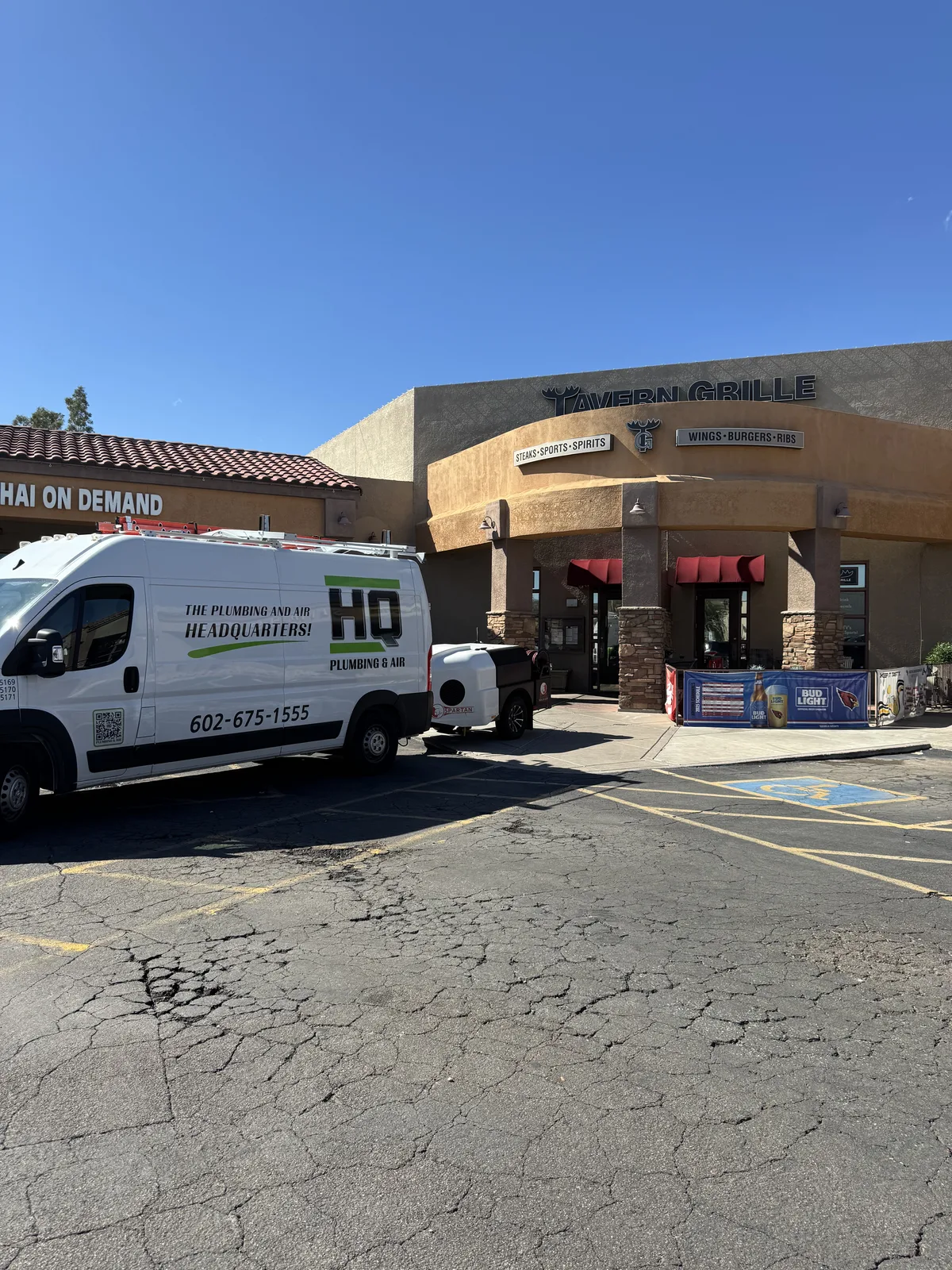
Soda Machine and Ice Well Drain Cleaning in Phoenix
Slime builds in beverage and ice drains where nothing flushes them. We jet them with a cleaning solution and look at the air gap that makes the smell come back.
Soda and ice well drains smell because slime grows where nothing flushes them. HQ jets these drains with a cleaning solution, then checks the air gap, receptor and trap that let the smell back in. The work is scheduled before opening or after close, and the bin and ice come out first.
The rules that apply
Each rule links to the official text we read it from. Cities change these, so check the source before a big decision. Last checked 2026-10-04.
Ice storage equipment must drain indirectly
Phoenix (IPC 801.2 and 802.1.1)Devices that store ice or food and discharge to the drainage system must be protected against backflow, flooding, fouling and stoppage of the drain, and food storage and handling equipment discharges through an indirect waste pipe by means of an air gap.
Source: 2024 IPC Chapter 8 as adopted by Phoenix, Sections 801.2 and 802.1.1How big the air gap has to be
Phoenix (IPC 802.3 and 802.3.1)Indirect waste pipe ends in an air gap or air break over a trapped and vented waste receptor, and the air gap must be at least twice the effective opening of the pipe. Indirect waste piping longer than 30 inches horizontally, or 54 inches total, must be trapped.
Source: 2024 IPC Chapter 8, Sections 802.3 and 802.3.1The receptor needs a strainer and access
Phoenix (IPC 802.4)Waste receptors have a removable strainer or basket, cannot be in concealed spaces such as ceilings or crawl spaces, and must have ready access. Standpipes must have access for rodding.
Source: 2024 IPC Chapter 8, Sections 802.4 and 802.4.3Sink drain lines get a 1 inch air gap
Maricopa County Environmental ServicesFor open food service and beverage establishments, the three-compartment sink drain line is indirectly plumbed with a minimum 1 inch air gap where permissible, and the separate prep and rinse sink has an approved minimum 1 inch air gap off its drain line.
Source: Maricopa County Plan Review Minimum Requirements for Food Establishments (rev. 09/02/2026)Manufacturer air gap for an ice machine
Manufacturer manualHoshizaki's installation manual says the ice machine drain line should not be piped directly to the sewer, and requires an air gap of at least 2 vertical inches between the drain pipe and the floor drain. It also says to clean the ice storage bin drain every 3 months, or as needed, because slime can clog it and water can overflow the bin.
Source: Hoshizaki AM-50BAJ Instruction Manual (2023)Soda carbonators need a testable RPZ on the water supply
Maricopa County Environmental ServicesIf the establishment serves carbonated beverages, an approved testable reduced-pressure backflow preventer goes between the water supply and the carbonator, and ice machines are typically exempt from the supply-side backflow rule. That rule governs the supply line, not the drain.
Source: Maricopa County Plan Review Minimum Requirements for Food EstablishmentsWhat a cleaning solution may do once it reaches the sewer
Phoenix (City Code 28-8)No user may discharge water with a pH below 5.0 or above 10.5 standard units, or water hotter than 150 degrees Fahrenheit, to the public sewer. A strong acid or caustic left in a drain line is not an option.
Source: Phoenix City Code Chapter 28, Article II, general user prohibitionsNo direct connection from food equipment to the sewer
Federal food code, adopted by Maricopa CountyA direct connection may not exist between the sewage system and a drain originating from equipment in which food, portable equipment or utensils are placed, with listed exceptions for refrigerated space floor drains and some warewashing connections.
Source: FDA Food Code 2017, Section 5-402.11Also: Phoenix FOG manual: the kitchen drain line example includes the floor drain receiving ice machine and mop sink wasteWhy soda station and ice well drains smell
They smell because the drain carries almost nothing but a trickle of sugary or mineral water, which never rinses the pipe. Ice melt, soda gun drips and syrup residue run into a small drain and sit there. Slime grows on the wall of the pipe and in the trap, and the odor comes up through the air gap every time the bin drains.
Ice machine makers describe the same thing. Hoshizaki's manual says slime can build up inside the ice storage bin drain and stop water from draining, and it tells operators to clean the bin drain every 3 months or as conditions require. If it clogs, water builds up and can overflow the bin. That interval is the manufacturer's maintenance step for the bin. The line behind it is separate, and it is the part a plumber cleans.
What we do on a drain cleaning visit
We jet beverage and ice drains with a cleaning solution, because a brush and a rinse reach only the first stretch of pipe. A visit goes in this order:
- 1The ice bin and well are emptied before we start. Ice that has touched a drain or a cleaning solution should be discarded, not reused.
- 2We trace the drain to its receptor, whether that is a floor sink, a standpipe or a floor drain, and check that the trap holds water.
- 3We run a small-bore jet and the cleaning solution through the drain line, then flush the line with clear water.
- 4We look at the air gap, the receptor strainer and the receptor's access, since a bad gap is how the smell and the contamination risk get back in.
- 5We run water into the well to confirm that it drains fast and does not splash out of the receptor.
The work is scheduled before opening or after close, and the inside portion usually takes one to two hours. We give an upfront price before work starts.
The air gap and indirect waste rules, in one place
The drain from ice and soda equipment must end above the receptor, not in it. The 2024 plumbing code, as Phoenix adopts it, requires indirect waste for ice and food storage equipment, an air gap of at least twice the pipe's effective opening, and a trapped, vented receptor with a removable strainer and ready access. Maricopa County's plan review sheet asks for a minimum 1 inch air gap on sink drain lines, and the Hoshizaki manual wants at least 2 vertical inches between the ice machine drain and the floor drain. When two numbers apply, the safe move is the larger one.
The failures these rules are written to prevent are easy to picture: a drain hose pushed down into a standpipe, a receptor under a shelf where nobody can reach it, or a strainer that went missing. Each one lets the smell, and in a bad case sewer water, travel back into the equipment. Fixing it is part of the job. See our guide to draining a commercial ice machine legally for the code and manufacturer detail.
What the cleaning solution can and cannot be
The solution has to be one the pipe and the sewer can take. Phoenix's city code bars discharging water with a pH below 5.0 or above 10.5, or hotter than 150 degrees Fahrenheit, to the public sewer. That rules out strong acid or caustic left in the line, and it is another reason a flush with clear water is part of every visit. Keep the supply-side rule separate in your head: the county's RPZ requirement for carbonators protects your water line and has nothing to do with the drain. Our page on the soda and ice machine backflow preventer covers that side.
When the drain is not the problem
- The smell is a dry trap. A floor sink or floor drain that only receives occasional water loses its trap seal to evaporation, and a dry trap smells like a drain. Pouring water in, or fixing the trap primer, solves it. See commercial floor drain cleaning.
- The machine is dirty, not the drain. The ice machine's own cleaning and sanitizing is the manufacturer's maintenance, done by your staff or a service tech. We are plumbers, and we do not service the machine.
- The bin overflows only after the machine cycles. That can be a drain pump or a kinked drain hose. If the drain line clears with a quick flush, we will say the machine is the next place to look.
What to tell us when you call
Tell us where the smell is strongest, whether the receptor is a floor sink or a standpipe, and when the drain was last cleaned. We offer free estimates, and if you already have a kitchen visit booked, such as a hydro jetting pass on the laterals, ask us to add the beverage drains to it. See also commercial drain cleaning and restaurant plumbing, and for bars in particular our page on breweries and bars.
How do I drain a commercial ice machine legally?
Pipe the ice machine's drain to a floor sink, trapped standpipe or floor drain through an air gap, never as a direct connection to the sewer line. Maricopa County's guide calls for a minimum 1-inch air gap; Hoshizaki's manual calls for 2 inches. Where both apply, meet the larger one.
Read full answer: How do I drain a commercial ice machine legally?Does a soda machine, ice machine or coffee maker need a backflow preventer?
Yes, in a Valley food business. A soda carbonator needs backflow protection between the water line and the carbonator, and Maricopa County recommends a testable RPZ there. Plumbed coffee and other non-carbonated beverage machines need an ASSE 1022 device or an air gap. Ice machines must drain through an air gap to a floor sink.
Read full answer: Does a soda machine, ice machine or coffee maker need a backflow preventer?Do commercial sinks need an air gap or indirect waste?
Yes, for food sinks. The plumbing code has sinks used to wash utensils, pots and dishes drain indirectly through an air gap or air break, and Maricopa County wants a three-compartment sink drained with at least a 1-inch air gap. Each sink compartment drains on its own into a trapped receptor such as a floor sink.
Read full answer: Do commercial sinks need an air gap or indirect waste?Does an undercounter ice maker need gravity drainage or a drain pump?
Choose the drain arrangement from the actual ice-maker model and available route before buying. Whirlpool's cited freestanding guidance distinguishes gravity drainage to a suitable lower drain from an approved pump arrangement. A pump does not approve a sealed sewer connection or overcome every route restriction. Confirm the exact accessory, hose, discharge receptor and local requirements together.
Read full answer: Does an undercounter ice maker need gravity drainage or a drain pump?Sources
- 2024 International Plumbing Code as adopted by Phoenix, Chapter 8 (Indirect/Special Waste)
- Maricopa County Environmental Services: Plan Review Minimum Requirements (rev. 09/02/2026)
- Hoshizaki: AM-50BAJ Instruction Manual, drain connections and storage bin drain
- Phoenix City Code Chapter 28, Article II (28-8 general user prohibitions)
- FDA Food Code 2017, Section 5-402.11 Backflow Prevention
- City of Phoenix: FOG Best Management Practices for Food Service Establishments (June 2024)
Related commercial services
Which kitchen drains clog first, how they are cleared from the fixture side, and what the air gap rules mean for the fix.
Why interior branch lines need a small hose, what a cable leaves behind, and how the job is paired with a main line pass.
Where the private main ends and the city sewer begins, why a cleanout decides the job, and why the main and the branches get jetted as a pair.
How interior drain work is scheduled around service, what the window looks like, and what happens when a stoppage hits at night.
How to tell a fixture problem from a line problem, why a cable alone keeps failing, and what the repeat call sequence looks like.
Why floor drains back up or stink in the Valley, what a trap primer does, and what a cleaning visit includes.
Soda or Ice Drain Smelling?
Talk to a real dispatcher who knows commercial work. Upfront pricing before work starts, 24/7 for emergencies.