
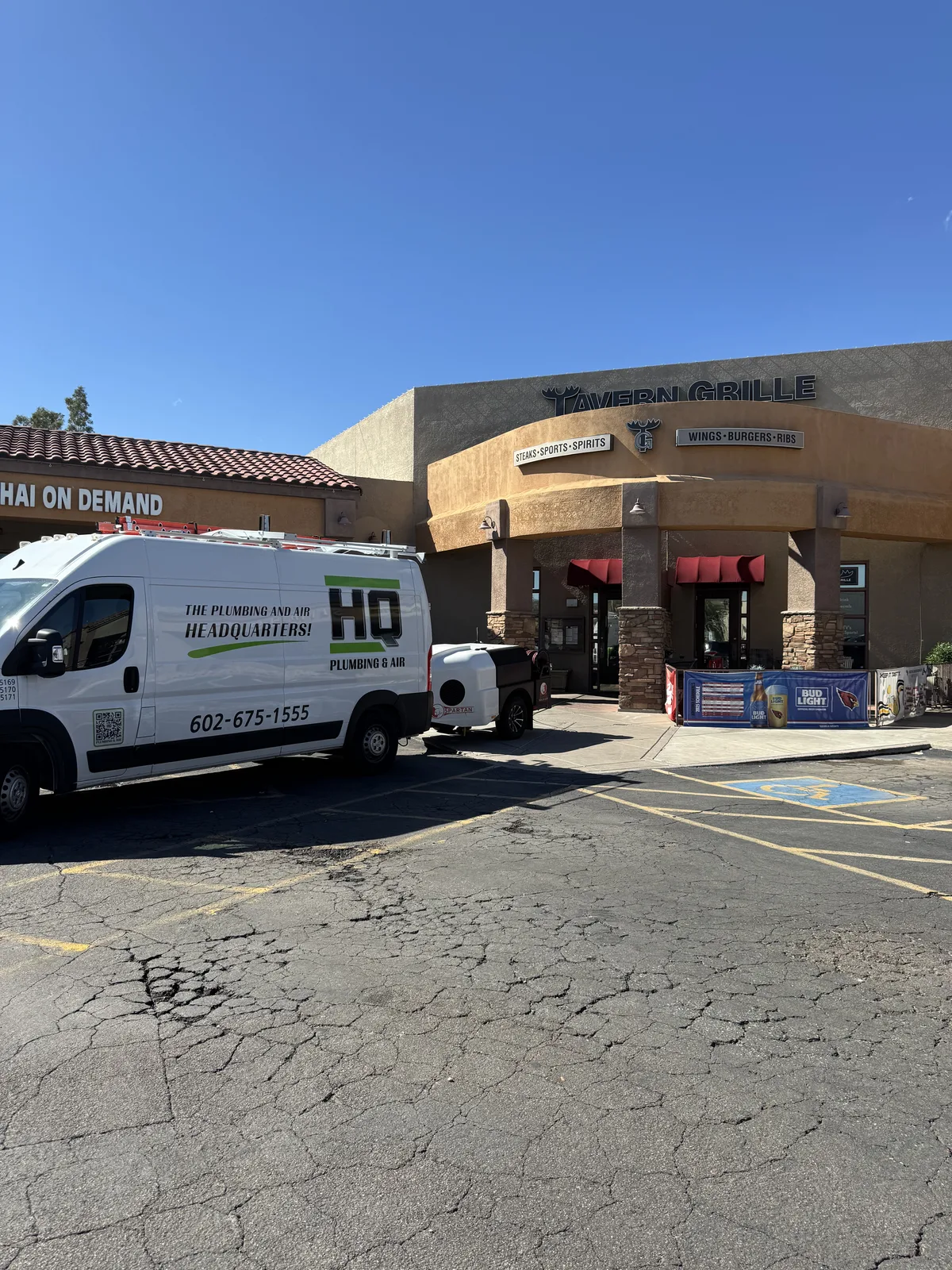
Restaurant Backflow Testing in the Phoenix Valley
The assembly at your water service, the RP on the soda carbonator and the devices on ice and dish machines, tested before you open.
A Valley restaurant usually has two layers of backflow protection to test each year. Phoenix, Mesa and Scottsdale list restaurants for an RP assembly or air gap at the water service. Inside, Maricopa County wants an RP or other testable device on the soda carbonator. Each testable assembly gets a certified test at least annually.
The rules that apply
Each rule links to the official text we read it from. Cities change these, so check the source before a big decision. Last checked 2026-10-04.
Protection at the water service
PhoenixSupermarkets, butcher shops and restaurants are on the city's list of facilities that need an air gap or a reduced pressure (RP) assembly, located as close as practicable to the meter.
Source: Phoenix City Code 37-144(B)Protection at the water service
Mesa and ScottsdaleMesa lists restaurants and convenience stores for an RP assembly at each service connection. Scottsdale lists restaurants for an RP.
Source: Mesa City Code 8-1-8Also: Scottsdale Revised Code 49-62(a)(47)Soda carbonator
Maricopa CountyAn approved reduced pressure backflow preventer, or another approved testable continuous-pressure device, goes between the water line and the carbonator. No copper or brass downstream of it.
Source: County food establishment Construction GuideUntestable carbonator devices
Maricopa CountyAn ASSE 1022 device is the minimum. It is not testable, so if it is the only protection, the restaurant needs a written maintenance policy requiring an annual inspection.
Source: County food establishment Construction GuideDevice by machine
MesaCarbonated beverage dispensers need an RP. Ice makers and non-carbonated beverage dispensers need a double check or dual check. Point-of-use assemblies sit no more than 5 feet above the floor and are tested yearly.
Source: Mesa City Code 8-1-9Annual test
Arizona and PhoenixRequired assemblies are tested at least once a year by a certified tester, with records kept at least three years in Phoenix.
Source: A.A.C. R18-4-215(F)Also: Phoenix City Code 37-143The two layers in a restaurant
Most Valley restaurants carry backflow protection in two places, and both can come due.
At the water service. Cities treat a restaurant as a building that could push contaminated water back into the main. Phoenix City Code 37-144 lists "supermarkets, butcher shops, and restaurants" for an air gap or a reduced pressure (RP) assembly. Mesa's list in City Code 8-1-8 says restaurants and convenience stores need an RP. Scottsdale's list in Revised Code 49-62 says the same. That assembly usually sits outside, near the meter, often shared with other tenants in a strip center.
At the equipment. Inside, the plumbing code and the county health rules protect your own water from your own machines. The soda carbonator is the big one. Maricopa County's food establishment construction guide wants an RP or another testable device on the carbonator supply. Mesa goes further and names a device for each machine in City Code 8-1-9.
A restaurant can have an RP at the meter, another on the soda line and a smaller device on each ice maker. The city's notice usually covers the service assembly. The point-of-use RP is your job to track, though Mesa expects its reports too.
Why the soda line gets an RP
The carbonator pushes carbon dioxide into water under pressure. If a check valve leaks, that gas can flow back into the building's water line. A Public Health Reports study, kept in the CDC's library, tied illness at drink machines to exactly this: cases "seemed to occur only after a faulty check valve allowed carbon dioxide to flow into a copper waterline." Carbonated water dissolves copper, and the next drinks carry it.
So the county rule has two halves. Put a testable RP between the water line and the carbonator. Then keep copper and brass out of the run after it, using flexible line or stainless instead. Mesa's code says the same about copper downstream of a point-of-use assembly where water is carbonated or treated by reverse osmosis. A beverage vendor who swaps carbonators and reuses old copper tubing has undone the protection. For the full machine-by-machine breakdown, see soda and ice machine backflow rules.
Testing without losing a service
A test shuts water off behind the assembly while the gauge readings are taken, so timing matters.
- The service assembly cuts water to the whole restaurant during the test. Book it before prep starts or after close.
- The carbonator RP only takes the soda system down. Test it during a slow stretch, and tell the bar.
- Group the visits. Testing the service assembly and the point-of-use RP on the same visit means one outage and one report packet.
Mesa adds two rules that matter to a busy kitchen. Point-of-use assemblies have to sit no more than 5 feet above the floor and be reachable, even if a panel has to come off. And a point-of-use RP needs an air-gapped drain line at least as large as the assembly, run to a floor sink or mop sink, never a flexible hose. An RP that dumps water behind the soda rack is a slip hazard, and it often means a part needs attention. See why an RPZ spits water.
When a test is not the answer
Some soda systems only have a small ASSE 1022 dual check. The county accepts it as the minimum, but it has no test cocks, so no tester can certify it. Its rule instead is a written maintenance policy with an annual inspection. If you'd rather have a yearly test report to hand an inspector, the county calls a testable RP "highly recommended," and swapping one in is an installation, not a test.
Likewise, if your restaurant is new to a space that wasn't a restaurant before, the city may require an assembly that isn't there yet. That's a permit job. See backflow installation for a new business and what a change of use triggers.
What HQ does for restaurants
HQ is certified to test and certify domestic backflow assemblies, and we file the results with the city. For a restaurant that means the service assembly, the carbonator RP and the double checks on ice makers. We work on the water side of the machine, not the machine itself. If a test fails, we can usually rebuild the assembly the same visit and retest it, covered on our backflow assembly repair page.
Send us the city notice and your opening hours, and we'll schedule the test around them. You get an upfront price before work starts, and 24/7 emergency service when something can't wait. Related: restaurant plumbing, bars and breweries, commercial backflow testing and hydro jetting for the drain side of the kitchen.
Services and tools
Does a soda machine, ice machine or coffee maker need a backflow preventer?
Yes, in a Valley food business. A soda carbonator needs backflow protection between the water line and the carbonator, and Maricopa County recommends a testable RPZ there. Plumbed coffee and other non-carbonated beverage machines need an ASSE 1022 device or an air gap. Ice machines must drain through an air gap to a floor sink.
Read full answer: Does a soda machine, ice machine or coffee maker need a backflow preventer?Why is my RPZ backflow preventer spitting water?
An RPZ spits from its relief valve when pressure between its two check valves gets too close to the supply pressure. A short spit when street pressure dips can be normal. Steady or repeated discharge usually means a fouled first check, a leaking second check with backpressure, or a worn relief valve. It needs a test and repair.
Read full answer: Why is my RPZ backflow preventer spitting water?RPZ vs double-check backflow assembly: what's the difference?
Both stop water from flowing backward into the clean supply, but they fit different risk levels. A double-check assembly suits low-to-medium hazard, non-health cross-connections. An RPZ adds a relief valve for high-hazard, health connections, making it the strongest protection. The hazard level decides which one code requires.
Read full answer: RPZ vs double-check backflow assembly: what's the difference?How often does a commercial backflow preventer need testing in Arizona?
At least annually. Arizona rules require a certified tester to check each commercial backflow assembly once a year, and again after any install, relocation, or repair. In Phoenix you file results by the date the city sets, and fire system results are due within 30 days.
Read full answer: How often does a commercial backflow preventer need testing in Arizona?Sources
- Phoenix City Code 37-144, Backflow prevention methods
- Phoenix City Code 37-143, Responsibility for backflow prevention control
- Mesa City Code Title 8 Chapter 1, Backflow Prevention (2025)
- Scottsdale Revised Code 49-62, Backflow prevention assemblies required
- Maricopa County Environmental Services: Food Establishment Construction Guide (Rev. 09/04/2026)
- Arizona Administrative Code R18-4-215, Backflow Prevention
- Hopper and Adams, Copper poisoning from vending machines, Public Health Reports (CDC Stacks)
Related commercial services
Who may test, what the report must show, how long the water is off, and where each Valley city wants the results.
Master meter rules by city, the assemblies a typical complex carries, who the city holds responsible, and how to batch the yearly tests.
When a PVB is allowed on landscape water, when the city requires an RP instead, and what fails most on irrigation assemblies.
Who may repair an assembly in Phoenix and Scottsdale, the parts that usually fail, and each city's clock for repair and retest.
Repair or replace, picking the assembly type the hazard calls for, and how permits differ for a replacement across the Valley.
What to do in the first hour after a theft, why nobody may pipe across the gap, and how the replacement and retest go.
Restaurant Backflow Due?
Talk to a real dispatcher who knows commercial work. Upfront pricing before work starts, 24/7 for emergencies.