
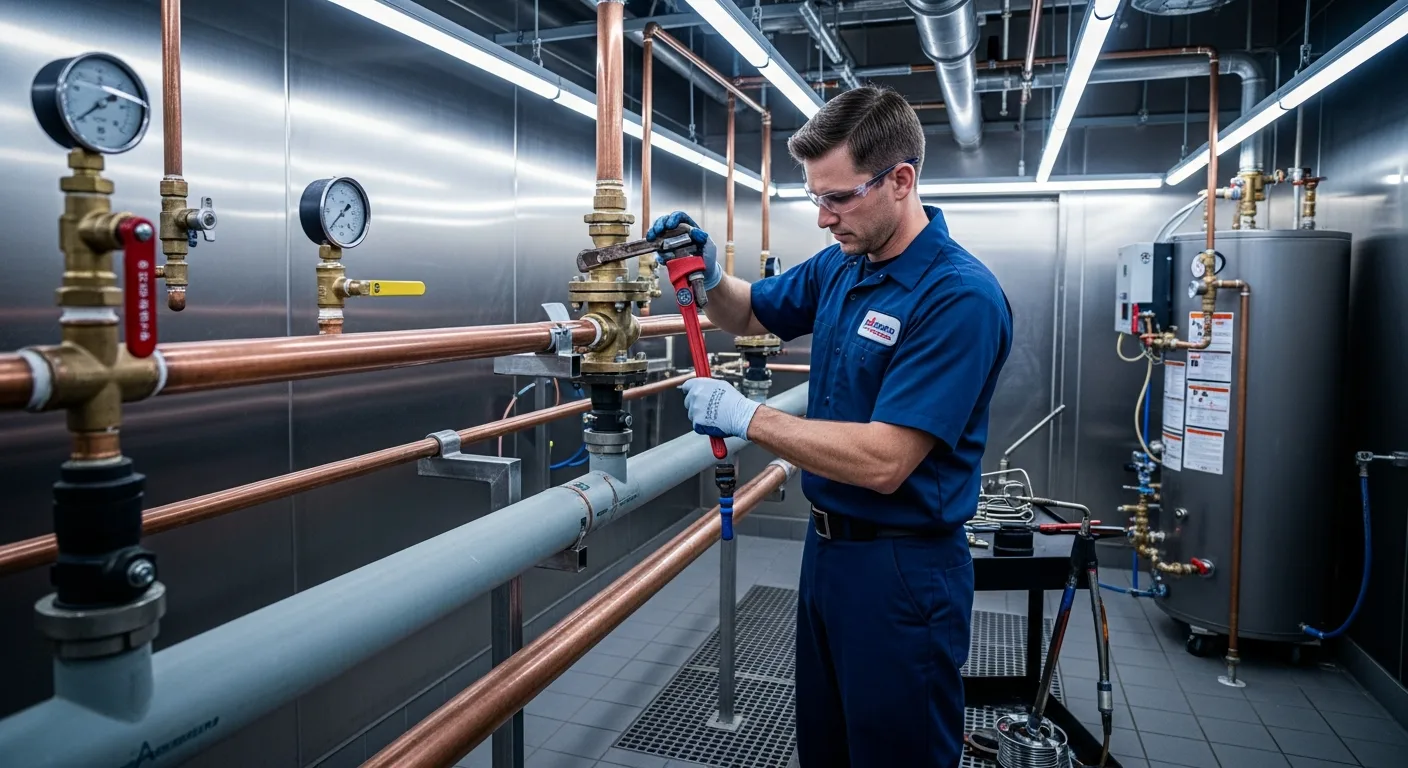
Tenant Improvement Plumbing in Phoenix
A new tenant changes the fixture count, the drains and the permit path. Get the plumbing in the plan set before the walls go up.
Tenant improvement plumbing is the water, drain, vent and fixture work that turns a leased space into one a new tenant can use. HQ roughs in the piping and sets fixtures and floor sinks to the plan the city approves. Fixture counts follow occupant load, and concealed piping is inspected before it is covered.
The rules that apply
Each rule links to the official text we read it from. Cities change these, so check the source before a big decision. Last checked 2026-10-04.
What a Phoenix commercial plumbing plan must show
PhoenixThe commercial permit checklist asks for a complete plumbing floor plan for the project area, a minimum plumbing fixture analysis, fixture specifications and connection schedule, drain, waste and vent sizing isometrics, water pipe and meter sizing, backflow devices by type and location, and expansion tanks where required.
Source: Phoenix Commercial Building Permit Submittal Checklist (TRT 00029)Fixture counts come from the use and occupant load
2024 IPCFixtures are provided in the minimum number shown in Table 403.1 based on the actual use of the building or space, uses not in the table are considered individually by the code official, and occupant numbers come from the International Building Code.
Source: 2024 IPC Sec. 403.1Small tenants can skip separate men's and women's rooms
PhoenixSeparate-sex toilet facilities are not required in a structure or tenant space with total occupant load of 15 or fewer, in mercantile occupancies with load of 50 or fewer, or in business occupancies with load of 50 or fewer, or where single-user rooms are provided.
Source: Phoenix amendment to 2024 IPC Sec. 403.2Concealed plumbing is inspected before it is covered
PhoenixNo portion of building service equipment intended to be concealed by a permanent part of the building may be concealed until inspected and approved. A final inspection follows, and the equipment may not be connected to the water or sewer until the building official authorizes it.
Source: Phoenix PBCC, IBC Sec. 110.3.10.1Mesa offers a voluntary permit-by-inspection path
MesaEligible tenant improvements are Group B, M or S occupancies, with no change of occupancy except between B and M, not more than 10,000 square feet, with no high-piled storage or hazardous materials and no extra zoning approvals. Inspectors review the application and issue the permit.
Source: Mesa City Code 4-1-4, Permit-by-Inspection ProgramScottsdale limits temporary occupancy and stale applications
ScottsdaleA temporary certificate of occupancy for a nonresidential space may not exceed 180 days, and a permit application is considered abandoned 180 days after the last completed review unless pursued in good faith or a permit issued.
Source: Scottsdale City Code 31-9 (amendments to IBC 105.3.2 and 111.3)Altering a space can trigger the restrooms and the path to them
Federal (ADA)An altered element must comply with the 2010 Standards, and an alteration affecting a primary function area must make the path of travel, including restrooms, accessible to the maximum extent feasible, unless the cost is disproportionate. The advisory cites 20 percent of the alteration cost as the disproportionality test.
Source: 2010 ADA Standards, Sec. 202.3 and 202.4What plumbing does a tenant improvement include?
A TI covers whatever the new use requires, and the plumbing scope follows the business. It usually includes demolishing abandoned fixtures and capping lines, rough-in of new drains, vents and water lines, setting restroom fixtures, adding floor sinks or a mop sink, a water heater, backflow protection where the use calls for it, and sometimes gas piping. The existing FAQ on what plumbing a commercial tenant improvement involves lists the common items by business type. A restaurant adds interceptors and kitchen drains, a clinic adds sinks at every exam room, and a retail shell may add only restrooms and a service sink.
Two jobs in a TI are large enough to have their own pages: restroom remodel plumbing and mop sink and floor sink installation.
How many fixtures does the space need?
The number comes from the occupancy classification and the occupant load, not from what the previous tenant had. Table 403.1 in the 2024 IPC sets minimums for water closets, lavatories, drinking fountains and service sinks by use, and the occupant load comes from the building code. Phoenix amends Section 403.2 so that separate men's and women's facilities are not required in a tenant space of 15 occupants or fewer, in mercantile or business occupancies of 50 or fewer, or where single-user rooms are used. Anything not in the table is decided by the code official. This is why the fixture analysis goes into the plan set before pricing: a change of use from office to restaurant can change the count on its own.
What does the permit path look like?
Plans go to the building department that covers the address, and the plumbing plan has to be specific. Phoenix's checklist asks for the floor plan, a minimum plumbing fixture analysis, fixture schedules, drain, waste and vent sizing isometrics, water and meter sizing calculations, backflow devices and expansion tanks. Mesa has a voluntary permit-by-inspection program for small Group B, M and S tenant improvements of 10,000 square feet or less, where inspectors review and issue the permit. Scottsdale sets 180-day limits on stale applications and temporary certificates of occupancy, so a schedule that slips can restart paperwork. Other cities differ again, so ask for the city's checklist before you price. Our Phoenix tenant improvement permit and Mesa permit by inspection pages go into more detail.
How is the plumbing sequenced with the general contractor?
Plumbing goes in twice, before the walls close and after the finishes. Rough-in comes first: any under-slab trenching and drains are set and inspected before the slab is patched, and water, drain and vent piping in walls and ceilings is inspected before it is covered. Phoenix's amended code says concealed service equipment may not be covered until it is inspected and approved. Finish plumbing follows, setting fixtures, trim and floor drains, with a final inspection before the space opens. HQ works with the general contractor on timing so the slab, framing and ceiling are not closed ahead of the inspector. Ask for the rough-in date in writing, because a missed inspection can mean opening finished work. Commercial plumbing permit revisions are worth reading if the layout changes after approval.
Do the accessibility rules change in a TI?
Often they do. Under the 2010 ADA Standards, an altered element or space must comply, and an alteration affecting a primary function area must also make the path of travel to it, including the restrooms, accessible to the maximum extent feasible, unless the cost is disproportionate. The advisory text cites 20 percent of the alteration cost as the disproportionality benchmark. That is why a small TI can still include a restroom upgrade. See alteration and the ADA path of travel for how this works in practice.
When a full TI plumbing scope is the wrong answer
If the tenant is taking a space for the same use, with the same fixtures in the same places, you may only need a repair, a fixture swap or a permit-exempt change. Minor work may not need plans at all. Check whether the job is repair or new work before hiring for a build-out. If an existing floor sink or interceptor is shared with neighbors, a repair may be a landlord item. And if the real need is a new restroom, a restroom remodel is the better fit.
How to book
Send the plan set, the suite address, the permit status and your target open date. HQ gives free estimates, upfront pricing before work starts, and is licensed and insured. For related needs, see our commercial plumbing page, restaurant plumbing, property management plumbing and gas line service.
Services and tools
What plumbing is involved in a commercial tenant improvement (TI)?
A commercial tenant improvement is the build-out of a leased space for a new tenant. The plumbing depends on the use, but it often means relocating or adding fixtures, floor sinks and drains, a grease interceptor, a water heater, ADA restrooms, and backflow protection, all under a city permit.
Read full answer: What plumbing is involved in a commercial tenant improvement (TI)?When does a plumbing change require revising approved commercial plans?
When commercial plumbing changes after permit issuance, compare the proposed work with the current approved plans and ask the responsible designer and building department what revision is required. Keep contract authorization separate from permit approval. Give the installer and inspector the accepted version, and preserve the change in the final project records.
Read full answer: When does a plumbing change require revising approved commercial plans?Does a commercial restroom alteration also require an accessible path of travel?
Identify which restroom elements or spaces are being altered and whether the project also changes an area containing a primary function. Altered features generally must meet accessibility requirements, while primary-function alterations can trigger a separate accessible path-of-travel duty. Restrooms usually are not primary-function areas themselves. Have the designer evaluate scope and feasibility before treating a cost threshold as an exemption.
Read full answer: Does a commercial restroom alteration also require an accessible path of travel?Does a new tenant or change of use require a new backflow assembly?
Often, yes. In Phoenix, tenant improvements and changes in occupancy go through the same backflow review as new construction, and the city can require an assembly as a condition of the building permit. A new use with a higher hazard, like a restaurant, clinic or car wash, can need an RP at the service plus point-of-use devices.
Read full answer: Does a new tenant or change of use require a new backflow assembly?Sources
- City of Phoenix: Commercial Building Permit Submittal Checklist (TRT 00029)
- City of Phoenix: Amendment to 2024 IPC (Sec. 403.2)
- City of Phoenix: Amendment to 2024 IBC Chapter 1 (Sec. 110.3.10.1)
- 2024 International Plumbing Code, Chapter 4 (Sec. 403.1)
- Mesa City Code Sec. 4-1-4, Permits
- Scottsdale City Code Sec. 31-9, Amendments to IBC Chapter 1
- U.S. Access Board: 2010 ADA Standards for Accessible Design
Related commercial services
How a meter test, section-by-section pressure test and acoustic listening locate a leak, and who pays once it is found.
Repair in place, reroute or open the slab, what Phoenix says about permits for concealed pipe, and planning around tenants.
Gauge test, replacement, fail-open design, vacuum breakers and why exposed plastic pipe is banned outdoors in Phoenix.
Where owner responsibility starts, how a failed service line is repaired or replaced, and what comes before the excavator.
What HQ does and does not do on a fire line, the Phoenix certificate rule, and the owner's upkeep duties.
The first ten minutes, the valve Phoenix says to close, what to document, and the notification clock in Phoenix code.
Planning a Build-Out?
Talk to a real dispatcher who knows commercial work. Upfront pricing before work starts, 24/7 for emergencies.