
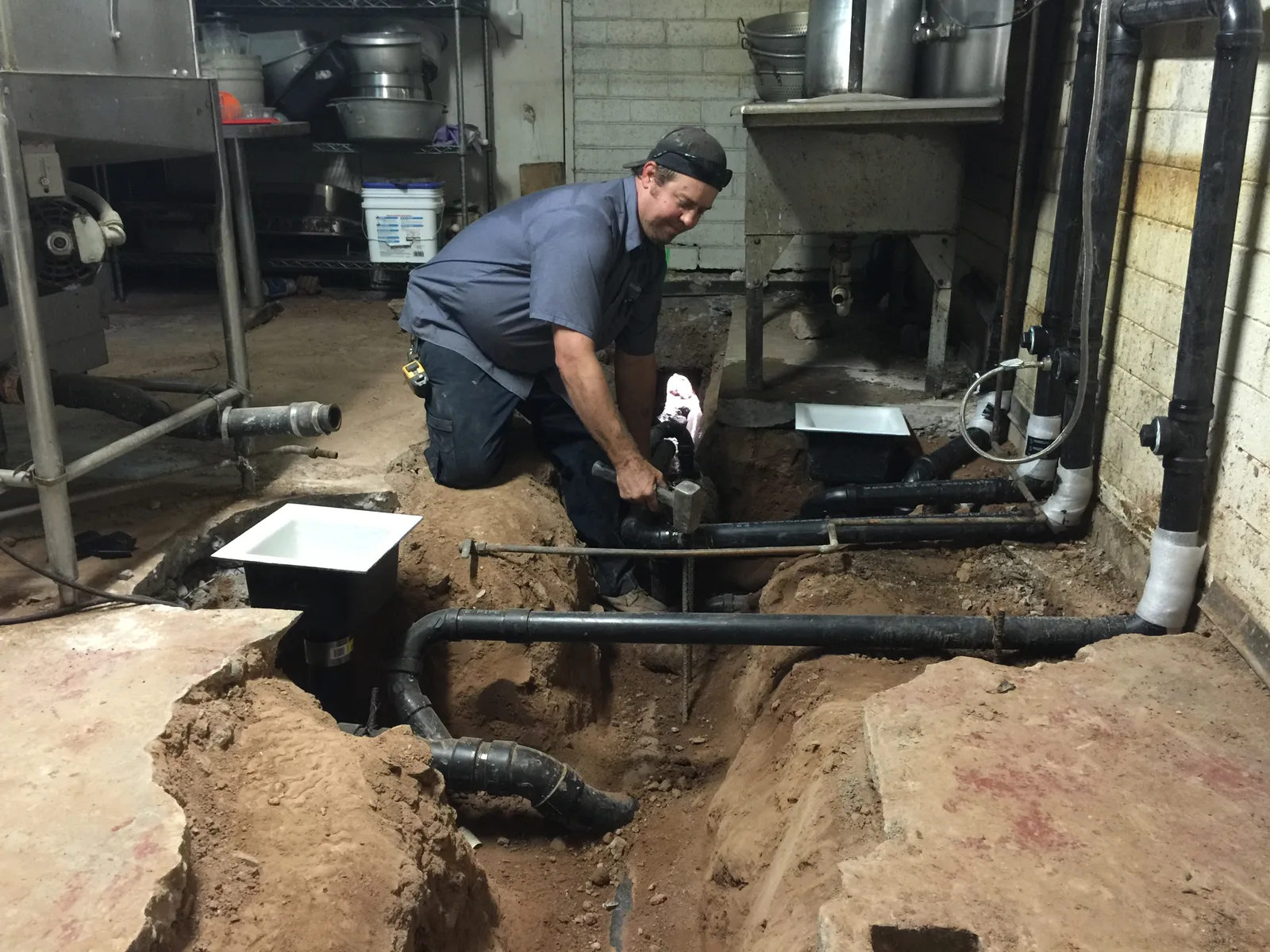
Underground Commercial Gas Line Repair in Phoenix
Locating a yard line 811 won't mark, hand-digging to the leak, and replacing corroded steel with coated steel or polyethylene with tracer wire.
Underground commercial gas line repair starts with locating a line Arizona 811 will not mark, because the buried pipe from the meter to your building is yours, not Southwest Gas's. Then the leak is found, the bad section is dug out by hand, replaced with coated steel or polyethylene with tracer wire, tested and inspected before backfill.
The rules that apply
Each rule links to the official text we read it from. Cities change these, so check the source before a big decision. Last checked 2026-10-04.
811 does not mark your yard line
Southwest GasCalling 811 gets utility-owned lines marked, but customer buried piping, everything from the meter to your equipment, can't be located by calling 811. Call at least two working days before digging.
Source: Southwest Gas Home and Business SafetyLocate before you dig
Arizona (A.R.S. 40-360.22)No excavation in a street, right-of-way, utility easement, apartment community or mobile home park until underground facilities are located. Operators mark within two working days of the request, and marks are valid for 15 working days.
Source: A.R.S. 40-360.22(A), (B) and (J)Hand tools near marked lines
Arizona (A.R.S. 40-360.21)Excavating in a careful and prudent manner means that within 24 inches of a marked underground facility, it is exposed carefully with hand tools, and the uncovered facility is supported and protected.
Source: A.R.S. 40-360.21(4)Burial depth
Phoenix vs. Mesa and GilbertPhoenix uses the base code: 12 inches below grade, or 8 inches for an individual line to an outdoor light or grill where approved. Mesa and Gilbert require 12 inches for metal and 18 for plastic and delete the 8-inch exception.
Source: IFGC 404.12 (Phoenix Fuel Gas Code 2024)Also: Mesa City Code 4-7-2, IFGC 404.12Also: Gilbert Town Code 10-35-2, IFGC 404.12Plastic pipe and tracer wire
Phoenix (2024 IFGC)Plastic gas pipe goes outdoors underground only, never within or under a building or slab (outdoor patio, walkway and driveway slabs excepted). A yellow insulated copper tracer of at least 18 AWG runs beside it, accessible or above ground at each end.
Source: IFGC 404.17.1 and 404.17.3Corrosion protection on buried steel
Phoenix (2024 IFGC)Zinc coating is not adequate protection underground. Buried steel needs corrosion-resistant material, a factory-applied insulating coating with coated joints, or a monitored cathodic protection system.
Source: IFGC 404.11.1 and 404.11.2Who owns the buried line
You do, from the meter outlet onward. Southwest Gas's customer buried piping brochure puts it directly: the business, not the utility, owns the gas piping that runs from the meter to the structure and to other outside gas appliances. At an older commercial property the meter can sit well away from the building, which leaves a long buried run that nobody has looked at in decades. Pad sites, multi-building campuses and restaurants with patio heaters and outdoor fireplaces often have several. Our page on why underground gas lines at businesses fail explains the corrosion side in depth.
If the leak is on the service line between the street and the meter, or at the meter itself, that's Southwest Gas's pipe and its repair.
Signs a buried line is leaking
Southwest Gas lists the signs: a rotten egg smell, even faint; hissing from the ground; dirt or water blowing into the air; dead or dying plants with no other explanation; standing water that keeps bubbling. Around a commercial building that might be a dead strip in the landscaping between the meter bank and the back door, or a gas bill that climbs with no new equipment.
If you notice any of those, get people away from the area. From a safe place, call 911 and Southwest Gas at 877-860-6020. Don't probe or dig to find it.
Locating a line 811 won't mark
This is the step people skip, and it's the one that matters most on a commercial lot. Arizona's excavation law, A.R.S. 40-360.22, requires anyone digging in a street, right-of-way, utility easement, apartment community or mobile home park to find out first where underground facilities are. The utilities mark their lines within two working days of the request, and the marks are good for 15 working days. Southwest Gas tells customers to call 811 at least two working days before digging.
But Southwest Gas also says plainly that customer buried piping can't be located by calling 811. The one-call system marks the operators' lines: the gas service, water, sewer, electric and telecom crossing your site. Your yard line isn't on anyone's map but yours. So a buried gas repair has two locates:
- 1The 811 ticket, white-lined first as the statute requires, so every utility line near the dig is marked.
- 2A private locate of your own line. Plastic gas pipe installed to code has a tracer wire we can put a signal on. Steel pipe can often be traced directly. A line with no tracer and no records takes more work: following it from the riser at each end and potholing by hand.
Within 24 inches of a marked line, the statute's definition of careful excavation means hand tools only. On a gas leak, we hand-dig the last stretch over our own line too.
Repair a section or replace the run
Once the leak is exposed, what we see decides the job. A single failed joint or a short damaged section on otherwise sound, coated pipe can be cut out and replaced. But if the steel is pitted along its length, is bare or galvanized, or has failed before, patching it just moves the next leak a few feet. The code says zinc coating "shall not be deemed adequate protection for underground gas piping," so galvanized pipe in the ground is already out of compliance.
The replacement is usually polyethylene with a yellow tracer wire, rising through an approved anodeless riser at each end, or factory-coated steel with every joint wrapped. Chandler's permit manual adds detail many cities share in practice: buried metal pipe is factory coated and at least Schedule 40, field wrapping is two layers of 20 mil tape with primer, and galvanized pipe or fittings are prohibited underground. Plastic can't run under the building; Section 404.14 allows pipe beneath a building only inside a protective conduit.
Sometimes the better answer isn't new pipe. Southwest Gas's brochure offers relocating the meter next to the building, at the customer's expense, which can shrink or eliminate the buried run you're responsible for. On a long, failing yard line, we'll lay both options side by side.
Depth, inspection and backfill by city
New pipe goes back at the depth your city requires, and that isn't the same everywhere:
| City | Metal | Plastic | 8-inch outdoor appliance exception |
|---|---|---|---|
| Phoenix | 12 in. | 12 in. | Allowed where approved |
| Mesa | 12 in. | 18 in. | Deleted |
| Gilbert | 12 in. | 18 in. | Deleted |
The trench gets a firm, continuous bed under the pipe, and the work stays open until it's pressure tested and inspected. In Phoenix, a meter locked for a customer-side leak needs a permit, a city inspection and a city clearance before Southwest Gas restores service. More cities are compared on our gas pipe burial depth by city page, and the test is covered under commercial gas pressure testing.
What HQ does on a buried gas line
We locate the line, find the leak, hand-dig to it, repair or replace the section, run tracer wire with any plastic pipe, pressure test, call for the inspection and send the clearance to Southwest Gas. We offer 24/7 emergency service for leaks and give you an upfront price before work starts. Related: commercial gas line service, leak detection, commercial gas line repair for above-ground piping, and property management plumbing.
Why do underground gas lines at businesses fail?
Buried steel gas lines fail mostly from corrosion. Once the protective coating is scraped, cracked or worn at joints, soil and moisture eat the steel until it leaks. Galvanizing doesn't protect gas pipe underground. Code-compliant replacements are polyethylene plastic with a tracer wire, or factory-coated steel, buried at least 12 inches deep.
Read full answer: Why do underground gas lines at businesses fail?What is an excess flow valve on a gas line?
An excess flow valve is an automatic safety valve on the underground gas service line between the street main and your meter. If that line is broken or cut, the valve closes and restricts the flow of gas. It won't stop a leak inside your house or at an appliance, and some gas can still escape after it closes.
Read full answer: What is an excess flow valve on a gas line?Who builds and owns an offsite gas line extension?
For Southwest Gas customers, the utility builds, owns, operates and maintains the gas main and service line up to the meter, on an economic-feasibility basis. The owner furnishes and maintains the piping past the point of delivery, which is usually the meter outlet. A licensed contractor handles that owner-side piping.
Read full answer: Who builds and owns an offsite gas line extension?Who owns and repairs gas piping in a strip center?
Southwest Gas owns and maintains everything up to and including the meter. Every pipe past the meter outlet belongs to the property side, not the utility. Between landlord and tenant, the lease decides who pays, but tenant-installed piping and appliance hoses usually belong to the tenant, and buried yard lines and shared building piping usually belong to the landlord.
Read full answer: Who owns and repairs gas piping in a strip center?Sources
- A.R.S. 40-360.22, Excavations; locating underground facilities; validity of markings
- A.R.S. 40-360.21, Definitions (careful and prudent manner)
- Southwest Gas: Home and Business Safety (811 and customer buried piping)
- Southwest Gas: customer buried piping brochure
- Phoenix Fuel Gas Code 2024 (IFGC 2024), Chapter 4 (404.11 to 404.17)
- Mesa City Code Sec. 4-7-2, Amendments to the 2024 IFGC (404.12)
- Town of Gilbert: Technical Codes, Town Code 10-35 (IFGC 404.12 as amended)
- City of Chandler: Homeowner Building Permit Manual, Gas Permits
- City of Phoenix: Gas Clearance Requirements for Existing Structures (TRT/DOC/00930)
Related commercial services
New kitchen gas piping from load list to meter set, with Southwest Gas lead times, city test rules and the hood shutoff tie-in.
Leak repair on your side of the meter, what a red tag means for permits, and how service gets restored in Phoenix.
The valve, hose, restraint and pressure checks behind every appliance on the line, and when a swap needs a permit.
Whether your pipe, meter and pressure can take another gas appliance, and what upsizing involves when they can't.
Test pressures and hold times by Valley city, who witnesses the test, and what happens when the gauge drops.
Leak on a Buried Gas Line?
Talk to a real dispatcher who knows commercial work. Upfront pricing before work starts, 24/7 for emergencies.