
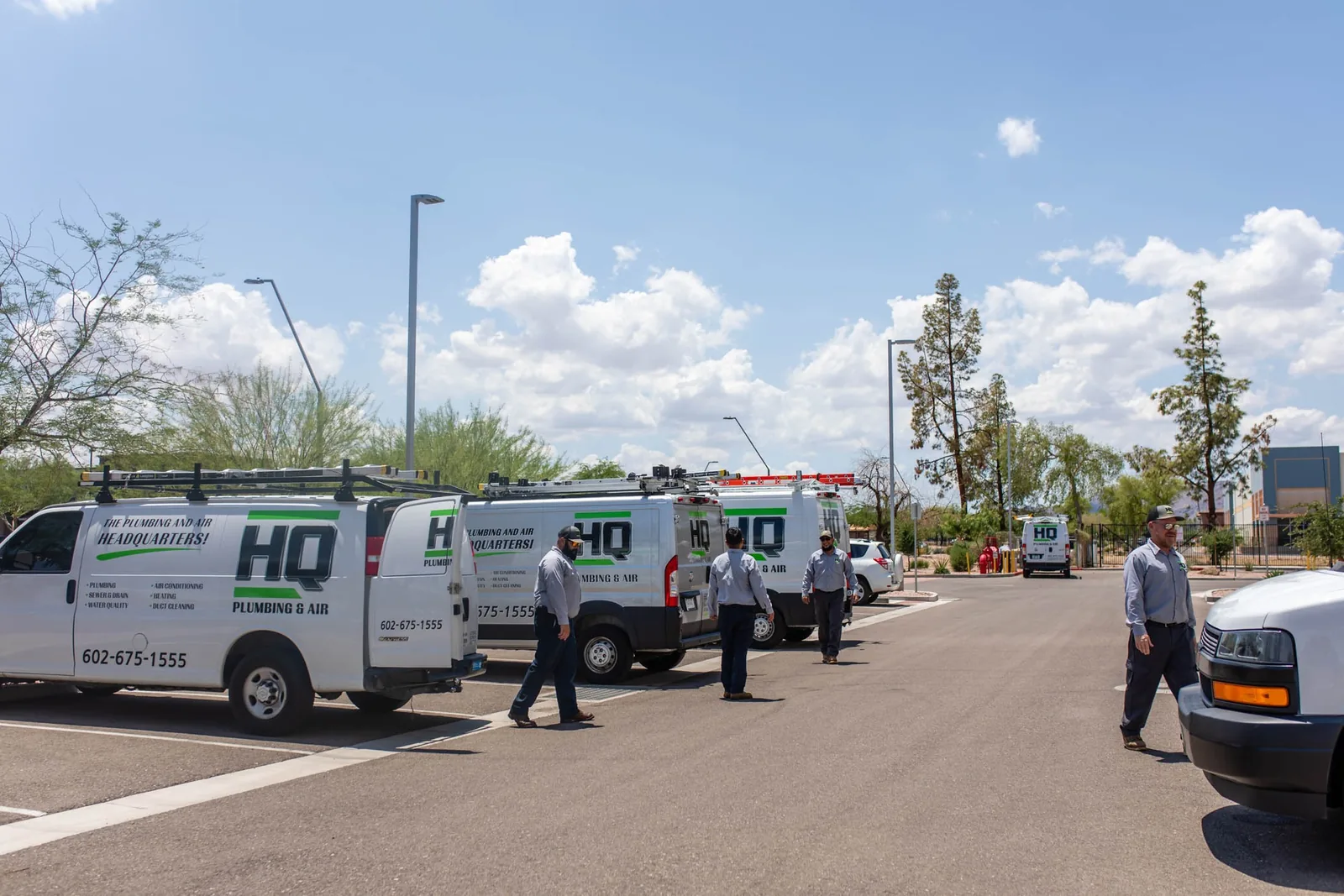
Plumber in Phoenix
Underground water lines, sewer lines and leaks for Phoenix homes and businesses, worked to the city's own rules on who owns which pipe, which permit applies and when the inspector has to see the trench.
Plumbing in Phoenix
Phoenix is the biggest job in the Valley for a plumber, and the rules here decide who pays before anyone picks up a shovel. The city owns the water line up to the meter and the sewer main in the street. Almost everything past those points is yours. Since August 1, 2025, Phoenix enforces the 2024 plumbing codes with its own amendments, and since April 27, 2026, commercial plan review and inspections run through the SHAPE PHX portal. HQ Plumbing & Air works across the city around the clock, with upfront pricing before work starts and free estimates.
- Water line split
- At the meter
- Codes in force
- 2024 IPC and UPC
- Water hardness
- 10 to 17.6 grains per gallon
- Median home built
- 1986
Underground water lines: the meter is the dividing line
Phoenix Water Services puts it simply: issues from the street to the water meter are the city's, and issues after the meter are the owner's. On the city's side, its design manual calls for Type K copper service lines for meters under 3 inches and ductile iron for 3 inches and up. On your side, the pipe is whatever the builder or the last plumber put in, and in older parts of the city that can still be galvanized steel.
Check one thing before you pay to replace an old line. Under the federal Lead and Copper Rule Revisions, Phoenix inventoried its service lines, submitted the inventory to ADEQ in October 2024, and posted it online for public view. When a line is identified as galvanized requiring replacement, the city says it schedules the work and covers the entire cost, from the city meter box to the hose bib or connection at the house or building. The city stopped installing galvanized service lines in 1983, and it says its field work since 2021 has not found a lead line.
Three local rules shape a repair on your side. The city's design manual requires a private pressure reducing valve on the customer side of the meter where static pressure exceeds 80 psi, and that regulator is yours to maintain. Phoenix amended the 2024 plumbing codes so plastic water pipe, fittings and valves cannot be left exposed outdoors, because summer heat softens them and sunlight makes them brittle. And only the Water Services Department may move or remove a meter; if anyone else does, the city shuts the water off until the customer pays to put it back.
Sewer lines and camera work: yours to the main
Phoenix property owners are responsible for cleaning and maintaining the sewer line from the building to the connection with the city main in the street or alley. For single-family and duplex properties, City Code 28-5.1 adds a step: the owner finds the approximate location of the break, and if it sits in the public right-of-way, the city verifies it and repairs that section. The owner fixes the part on private property. Every other property, from a restaurant to an apartment complex, owns the street section too: under City Code 28-5(C), a break off the property in a street or alley is the owner's to repair, and the owner or contractor must get a City permit before working in the right-of-way. A camera inspection with a locator is how that location gets proven.
Clearing a stoppage needs no permit in Phoenix. Replacing a defective buried or concealed drain pipe is treated as new work, which needs a plumbing permit, and the pipe must pass an underground inspection before it is buried. Work inside the public right-of-way, including any connection to the public sewer, needs its own permit from Planning and Development, and City Code 28-27 bars anyone from opening into or disturbing a public sewer without a Water Services permit.
Leaks: what a winter leak does to your sewer bill
A Phoenix leak can cost you twice. The monthly sewer charge is calculated from a percentage of your average water use in the January, February and March billing cycles, so a significant leak in those months raises your sewer fee for the year ahead. The city lets you ask for a Sewer Fee Review after the leak is fixed, but the request has to arrive within 60 days of the July bill date, and the city says exceptions will not be granted. Keep the repair invoice as a PDF, since photos and screenshots of documents are not accepted.
If water is running and you cannot stop it at the building's own shutoff, Phoenix Water Services has a 24/7 emergency number, 602-261-8000, for field staff to turn the water off. Stopping a leak needs no permit. Cutting out and replacing concealed pipe does.
Phoenix water and the age of its pipes
Phoenix's 2025 water quality report says about 97 to 99 percent of the city's water was surface water, mainly from the Salt, Verde and Colorado rivers, with the rest from about 20 city wells. Total hardness ran from 10 to 17.6 grains per gallon. The USGS calls anything over about 10.5 grains very hard, and that scale is what wears out valves, water heaters and older pipe.
Census figures put the median Phoenix home at 1986. About 40 percent of homes, around 270,000, were built before 1980, and roughly 92,000 date from before 1960. Those older homes are where we expect galvanized supply lines, cast iron and clay sewer pipe, and joints that roots have found. The build year is a clue, not a diagnosis, so we check what is actually in the ground.
For Phoenix businesses: grease, backflow and permits
Restaurants answer to the city's grease program. Hydromechanical grease traps must be pumped every 30 days and never go past 90, gravity interceptors at least every 3 months, and maintenance records stay on site for three years. A licensed pumper does the pumping. HQ inspects and repairs interceptors and jets the lines downstream.
City Code 37-144 lists the businesses that need a backflow assembly at the service, including restaurants, supermarkets and multi-tenant retail shells, and 37-143 requires every assembly to be tested at least once a year by a certified tester, with results filed with Planning and Development. HQ tests, repairs and replaces domestic water assemblies and files the results. Fire line and fire sprinkler backflow assemblies are outside what HQ does.
For commercial work, Phoenix lets a facility that employs qualified tradespeople hold an annual permit instead of one permit per alteration. Since April 27, 2026, commercial plan review, permits and inspections run through SHAPE PHX.
For Phoenix homes: what you can skip and what you cannot
Phoenix's permit exemptions cover the small stuff: clearing a stoppage, stopping a leak, resetting a toilet, and swapping a fixture or valve in the same spot. A licensed contractor can replace a water heater in kind in a one- or two-family home without a permit, but the city's residential projects page lists a do-it-yourself electric water heater swap as needing one.
Moving or adding a sink, toilet or tub needs a permit. So does replacing a buried water or sewer line. When a job needs one, we pull it and schedule the inspections, so the pipe is approved before it disappears under dirt or concrete.
Phoenix Areas We Cover
Our crews regularly work throughout Phoenix, including Downtown and Central City, Arcadia and Camelback East, Biltmore, North Mountain, Deer Valley, Desert View, Paradise Valley Village, Maryvale, Encanto, Estrella, South Mountain, Laveen, Ahwatukee Foothills and the surrounding areas. If you don't see your neighborhood listed, call us. Chances are we cover it.
We dispatch across Phoenix 24/7. We find the failure before we price the fix, you get the price before work starts, and the estimate is free.
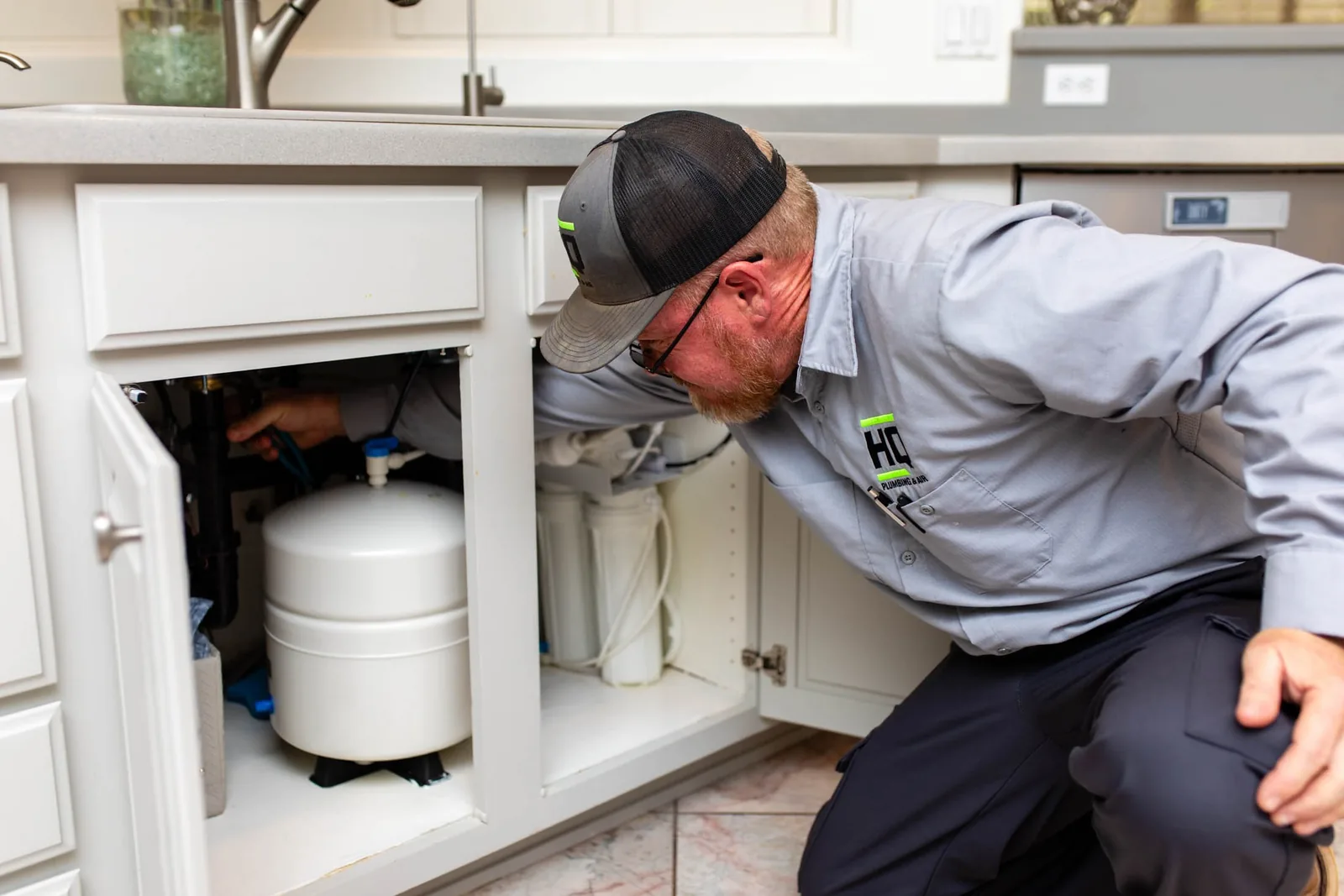
What We Do in Your Area
What plumbing work needs a permit in Phoenix?
Under Section 105.2 of the 2024 Phoenix Building Construction Code, plumbing work needs a permit unless it is on a six-item exempt list: stopping leaks unless a concealed pipe must be replaced, clearing clogs, same-spot fixture swaps, appliance hookups, a licensed contractor's in-kind water heater swap, and small secondary backflow work.
Read full answer: What plumbing work needs a permit in Phoenix?How do I verify a plumber's license in Arizona?
Use the Arizona Registrar of Contractors free public license search at roc.az.gov/search. Look up the plumber by license number, business name, or qualifying-party name, then confirm the license is Active, the classification matches your job, the bond is current, and the complaint history is clean before you sign anything.
Read full answer: How do I verify a plumber's license in Arizona?Why are slab leaks so common in Arizona?
A slab leak can develop when a buried supply pipe corrodes, rubs against concrete or soil, or is stressed by ground movement, thermal expansion or excessive pressure. Water chemistry can contribute to copper pitting, but hardness alone does not identify the cause. Leaks beneath a slab can remain hidden.
Read full answer: Why are slab leaks so common in Arizona?Does HQ Plumbing & Air really answer 24/7?
Yes. A real Phoenix dispatcher answers the HQ line day or night, including weekends and holidays. No answering service, no offshore call center. For true emergencies we dispatch a licensed plumber same day across the Phoenix metro. Call (602) 675-1555 anytime.
Read full answer: Does HQ Plumbing & Air really answer 24/7?Sources for this page
- City of Phoenix Water Services: General Service Issues
- City of Phoenix: Lead Service Line Inventory and Replacement
- City of Phoenix: Design Standards Manual for Water and Wastewater Systems (2021)
- City of Phoenix: 2024 IPC Amendments (Ord. G-7397)
- City of Phoenix: 2024 IBC Chapter 1 Administrative Amendments (Ord. G-7397)
- Phoenix City Code Sec. 28-5
- Phoenix City Code Sec. 28-5.1
- Phoenix City Code Sec. 28-27
- Phoenix City Code Sec. 37-53
- Phoenix City Code Sec. 37-143 and 37-144
- City of Phoenix: Water and Sewer Rates
- City of Phoenix: Submit a Sewer Fee Review
- City of Phoenix: 2025 Water Quality Report
- City of Phoenix: FOG Best Management Practices Manual (June 2024)
- City of Phoenix: SHAPE PHX
- City of Phoenix: Residential Projects
- USGS: Hardness of Water
- Census Reporter: Phoenix, AZ (ACS 2024, tables B25034, B25035)
Need a Plumber in Phoenix?
HQ Plumbing & Air dispatches licensed technicians to Phoenix around the clock. Call now for upfront pricing and fast response.