
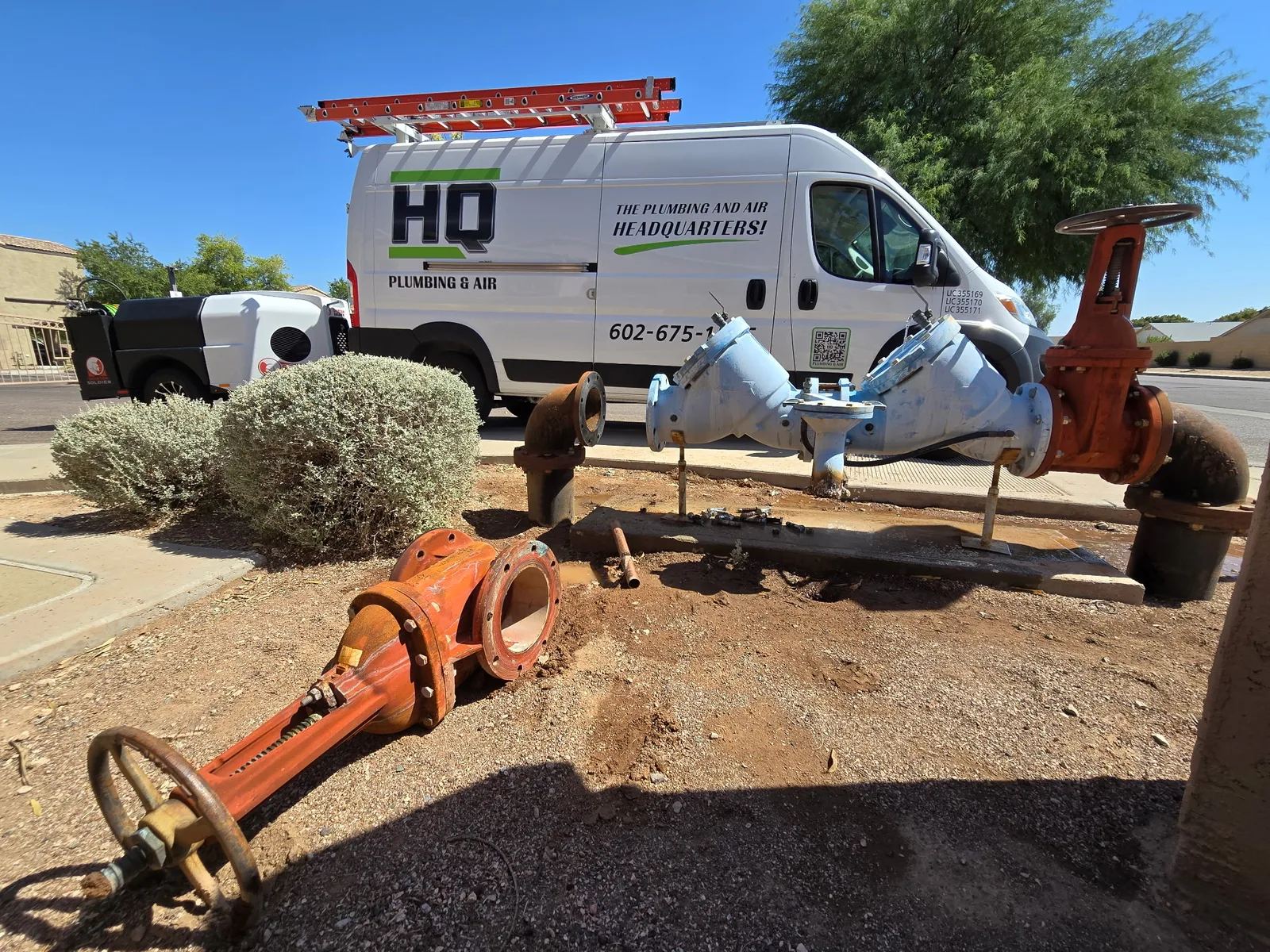
Backflow Testing in Phoenix
Annual tests on domestic water assemblies, repairs by a certified repairer, and the report filed with the city, plus the Phoenix rules on which assembly your building needs and where it can go.
Phoenix requires every backflow assembly on a business or other regulated property to be tested at least once a year by a certified tester, with results filed with Planning and Development. HQ tests, repairs and replaces domestic water assemblies and files the report. Which assembly you need, and where it may sit, comes from City Code 37-144.
The rules that apply
Each rule links to the official text we read it from. Cities change these, so check the source before a big decision. Last checked 2026-10-04.
Test every year, and after any repair or move
PhoenixThe customer tests all backflow assemblies at least once a year and submits the results to the Planning and Development Director. Phoenix's adopted 2024 code also requires a test at installation and immediately after repairs or relocation.
Source: Phoenix City Code 37-143(c)Also: Phoenix amendment to 2024 IPC Sec. 312.11.2Restaurants, supermarkets and shared retail services
PhoenixSupermarkets, butcher shops and restaurants need an air gap or RP. Retail centers, strip malls and shell buildings where one service supplies more than one tenant need an RP. Multi-story buildings with booster pumps or rooftop tanks need an air gap, RP or double check.
Source: Phoenix City Code 37-144(b)Where the assembly may sit
PhoenixAs close as practicable to the point of service delivery, which past a driveway or sidewalk means the nearest point after the obstacle but never beyond the first tap. RP and double check assemblies may not go in a basement, meter box, pit or vault.
Source: Phoenix City Code 37-144(d) and (f)Clearance for the tester
PhoenixAt least 12 inches between the bottom of the assembly and grade or floor, a platform if it is more than 5 feet up, and for secondary assemblies an above-ground install with a 3-foot clear space for testing and repair.
Source: Phoenix amendment to 2024 IPC Sec. 608.15.3Permits for replacement: Phoenix documents conflict
PhoenixFor an existing secondary assembly 2 inches or smaller, PBCC 105.2 exempts repair or replacement with a certified tester's report, while TRT 00634 and City Code 37-143 call for a permit. Primary assemblies, anything over 2 inches, new installs and relocations need a permit under all three. Ask Planning and Development (602-262-7811) before a swap.
Source: Phoenix TRT 00634 (Rev. 7/25), Sec. B1Also: Phoenix PBCC, IBC Ch. 1 Sec. 105.2 (Plumbing item 6), Ord. G-7397Also: Phoenix City Code 37-143Skipping the test has a price
PhoenixIf corrective action is not taken, the Director may impose a civil penalty of up to 1,000 percent of water charges per billing period, and may shut off water on ten days' written notice, or immediately if there is a health hazard.
Source: Phoenix City Code 37-146What the Phoenix backflow rule requires
A yearly test of every assembly, by a certified tester, filed with the city. City Code 37-143 puts the duty on the customer: test all backflow prevention assemblies at least once a year, submit the results on city forms to the Planning and Development Director, repair or replace anything that fails, and keep the records for three years. Testing follows the USC Manual of Cross-Connection Control, and repairs have to be made by a certified repairer working to ASSE Standard 5130. Phoenix's adopted 2024 code also requires a test at installation and right after any repair or relocation.
The city's rules apply to businesses, apartments, HOAs, schools and other regulated properties. A single-family home used only as a home is outside City Code Article XII unless a cross-connection problem is identified, so most homeowners never get a Phoenix test notice. For what a passing report has to show, see commercial backflow testing and reading a backflow test report.
Which assembly does your Phoenix business need?
City Code 37-144 lists it by use, and the list is more specific than most owners expect. Restaurants, supermarkets and butcher shops need an air gap or a reduced pressure (RP) assembly. A retail center, strip mall or shell building where one water service feeds more than one tenant needs an RP. A multi-story building with booster pumps or a rooftop tank needs an air gap, RP or double check. Car washes, nurseries, schools with labs, mobile home and RV parks, and construction water services each have their own entry, and irrigation systems with chemical injection, or with areas higher than the vacuum breaker allows, need an RP. See the full list on our Phoenix backflow facilities page.
This matters at test time. If your building's use has changed since the assembly went in, say a retail suite became a restaurant, the assembly on the wall may no longer be the type the code requires. A passing test does not fix a wrong assembly type, so raise the change of use before the test.
Where the assembly is allowed to sit
Phoenix is strict about location, because the tester has to reach it. The city's design manual puts the assembly on private property, outside the right-of-way or utility easement. City Code 37-144 says as close as practicable to the point of service delivery, and if a driveway or sidewalk is in the way, the nearest point after the obstacle but never beyond the first tap. RP and double check assemblies may not go in a basement, meter box, pit or vault, and Phoenix's 2024 amendment adds the clearances: at least 12 inches off the ground, a platform above 5 feet, and a 3-foot clear space around secondary assemblies. An assembly buried in a pit or jammed against a wall can fail inspection even when it passes the test.
Repair, replacement and the permit question
When a test fails, the usual cause is a fouled check, a torn diaphragm or a worn relief valve, and a repair kit puts it back in service, followed by a retest. See backflow assembly repair and replacement.
Replacement is where Phoenix's own documents conflict. City Code 37-143 says "The customer shall obtain a permit from the Planning and Development Department for the installation of any backflow prevention assembly." The city's backflow location guideline, TRT 00634 (Rev. 7/25), Section B1, says installation, alteration or replacement of all backflow prevention assemblies requires a plumbing permit. But the 2024 PBCC, Section 105.2 Plumbing item 6 (Ord. G-7397, in force since August 1, 2025), exempts repair or replacement of existing 2 inch and smaller secondary assemblies, as long as a test report by a certified tester is submitted to the city. No Phoenix text reconciles them.
The conflict covers one slice only: replacing an existing secondary assembly 2 inches or smaller. A primary assembly, anything over 2 inches, a new install or a relocation needs a permit under every one of these documents. If your swap falls in that slice, call Planning and Development at 602-262-7811 and ask which rule they apply before the old assembly comes out.
Fire line assemblies are a different contractor
Phoenix requires the initial and annual test on a fire line or fire sprinkler assembly to be done by a certified tester who is also permitted by the City Fire Marshal, with a full flow test. Fire line and fire sprinkler backflow work is outside what HQ does, so that assembly goes to your fire protection contractor. We handle the domestic water assemblies on the same property.
When a test is the wrong answer
If the assembly was stolen or the meter is locked off, there is nothing to test; see stolen backflow assembly replacement. If water is pouring from the relief port, that is a repair call first; see an RPZ spitting water. And if your notice is for a single-family home, ask the city why before you book a test.
Missing the deadline in Phoenix
City Code 37-146 lets the Director add a civil penalty of up to 1,000 percent of water charges per billing period until the work is done, and shut off water on ten days' written notice, or immediately if the system is a health hazard. Restoring service also means paying the city's costs. So book the test when the notice arrives. See missed backflow test deadline in Phoenix.
How to book
Send us the city notice or the assembly's size, make and location. We test, repair and replace domestic assemblies, and we file the report with the city. We give an upfront price before work starts and free estimates on replacements. For restaurants, see restaurant backflow testing; for the rest of our Phoenix work, the Phoenix service area page.
Services and tools
Do I have to register my backflow assembly with the City of Phoenix?
Yes. If your property has a required backflow-prevention assembly, the City of Phoenix tracks it under its cross-connection control program. You install it at your own cost, have it tested every year by a certified tester, send the test report to the City, and keep your records, usually about three years.
Read full answer: Do I have to register my backflow assembly with the City of Phoenix?What happens if I miss my Phoenix backflow test deadline?
Under City Code 37-146, Phoenix can shut off your water after 10 days written notice, or right away if your system could be a health hazard. It can also add up to 1,000 percent to your water charges per billing period. Service comes back only after the test is done and you pay the city's costs and penalties.
Read full answer: What happens if I miss my Phoenix backflow test deadline?How do I hire a backflow tester and what's on the report?
Hire a certified tester on your water provider's list and ask for their certificate number, test kit serial number and latest gauge calibration. In Phoenix, a valid report is on the city's form and shows the meter number, assembly make, model, size and serial, location, line pressure, readings, pass or fail and the tester's signature.
Read full answer: How do I hire a backflow tester and what's on the report?Where do I send backflow test reports in the Phoenix area?
Send the report to the water provider on your water bill, not to the state. Phoenix takes reports at Backflow.Prevention@phoenix.gov, Scottsdale at backflowtesting@ScottsdaleAZ.gov, Mesa through its backflow portal, and EPCOR at crossconnection@epcor.com. Filing deadlines depend on the provider and assembly type. Your tester usually files it, but confirm receipt.
Read full answer: Where do I send backflow test reports in the Phoenix area?RPZ vs double-check backflow assembly: what's the difference?
Both stop water from flowing backward into the clean supply, but they fit different risk levels. A double-check assembly suits low-to-medium hazard, non-health cross-connections. An RPZ adds a relief valve for high-hazard, health connections, making it the strongest protection. The hazard level decides which one code requires.
Read full answer: RPZ vs double-check backflow assembly: what's the difference?Sources
- Phoenix City Code Sec. 37-143, Responsibility for backflow prevention
- Phoenix City Code Sec. 37-144, Backflow prevention required
- Phoenix City Code Sec. 37-146, Violations and penalties
- City of Phoenix: 2024 IPC Amendments (Sec. 312.11.2, 608.15.3)
- City of Phoenix: 2024 IBC Chapter 1 Administrative Amendments (Sec. 105.2)
- City of Phoenix TRT 00634: Backflow Preventer Location for Secondary Protection
- City of Phoenix: Design Standards Manual for Water and Wastewater Systems (2021)
Related commercial services
How a Phoenix leak gets found and fixed, who owns which side of the meter, and how a January leak raises a year of sewer bills.
What a camera run proves under Phoenix City Code 28-5, which repairs need a permit and inspection, and when to skip the camera.
Where the city's pipe ends, the galvanized replacement program, Phoenix's pressure and pipe rules, and how a repair gets permitted.
Who clears what in Phoenix, why grease and roots cause most backups here, and how to stop paying for the same clog twice.
What a Phoenix inspector writes up, which kitchens must move to a gravity interceptor, and how a repair or replacement clears the finding.
When jetting beats a cable in Phoenix lines, what the city's grease rules mean for maintenance jetting, and when not to jet.
Backflow Test Due?
Talk to a real dispatcher who knows commercial work. Upfront pricing before work starts, 24/7 for emergencies.