
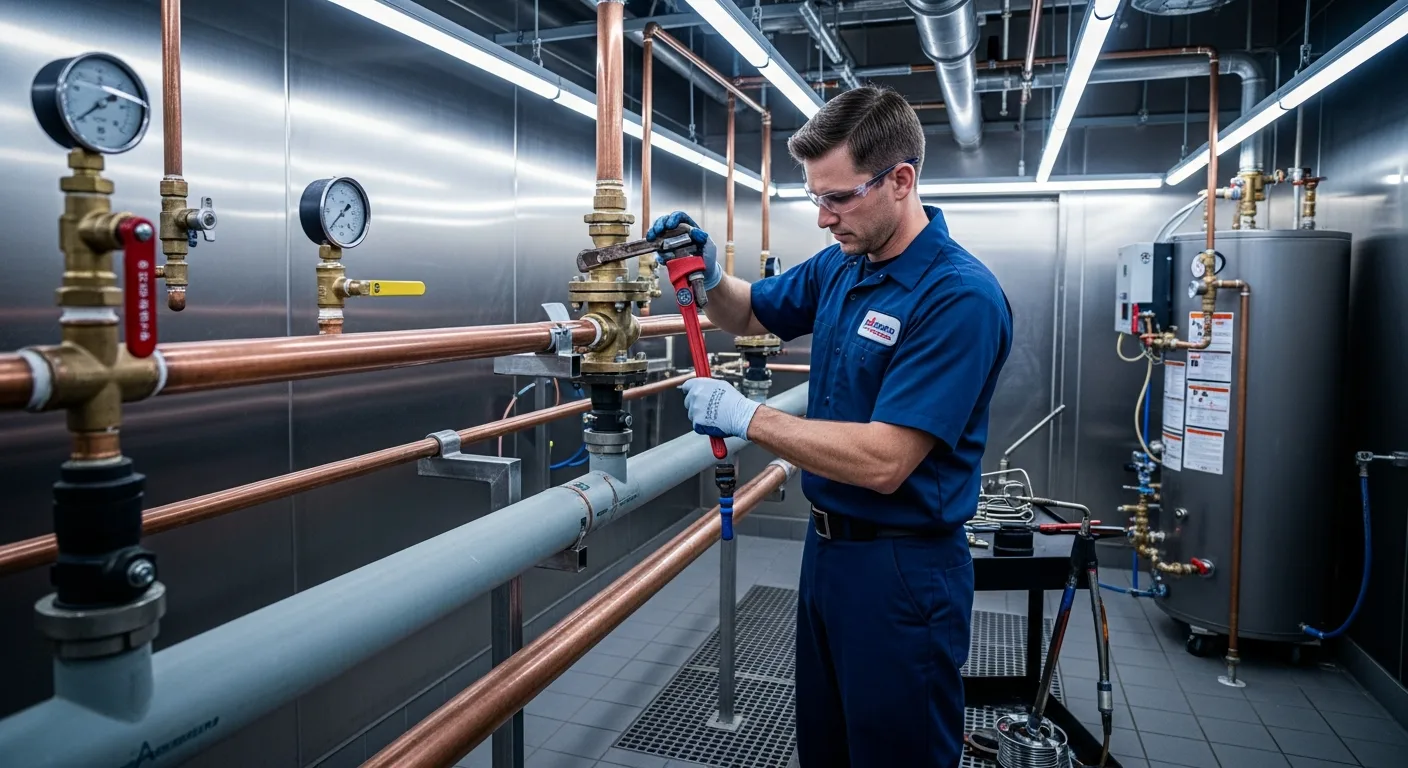
Urinal Drain Cleaning and Descaling in Phoenix
Uric salt and Phoenix hard water build a crust inside the trap and branch. Plungers open a channel and the crust closes again. Here is what removes it.
A urinal that keeps slowing down usually has scale, not a dropped object, in its trap and branch. Plungers and cables open a channel that closes again. HQ jets the branch with a small hose, checks it on camera, and tells you if the scale is hard enough that descaling or pulling the fixture comes next.
The rules that apply
Each rule links to the official text we read it from. Cities change these, so check the source before a big decision. Last checked 2026-10-04.
The flush must cleanse the fixture and refill the trap
Phoenix (IPC 415.1)Every urinal needs a flushometer valve, flushometer tank or flush tank designed and installed to supply water in the quantity and at the rate of flow needed to flush the contents, cleanse the fixture and refill the trap. A weak flush leaves the trap to scale up.
Source: 2024 IPC Chapter 4 as adopted by Phoenix, Section 415.1Phoenix water is hard
PhoenixThe City of Phoenix 2025 water quality report lists total hardness of 172 to 302 ppm, or 10 to 17.6 grains per gallon, and notes that hard water can cause scaling in pipes and on plumbing fixtures. That calcium adds to what urine deposits in a trap.
Source: City of Phoenix Water Services: 2025 Water Quality ReportHow scale forms in a urinal line
Distributor guidanceState Industrial Products, which supplies urinal treatments, says that when urinals are used, uric acid, calcium and lime naturally build up, forming crystals and sediment that stick to the drain pipes as a solid mass. It adds that severe buildup means removing the urinal from the wall to reach the pipe.
Source: State Industrial Products: urinal line scale and treatmentWaterless urinal cleaning, per the manufacturer
Manufacturer guidanceKohler's clearing method for a clogged waterless urinal uses an approved acid cleaner formulated for waterless urinals left in the drain for 5 to 10 minutes, then 1 gallon of water, then 3 ounces of sealing liquid, and says mineral acids such as muriatic, sulfuric and phosphoric are not recommended. If that fails, the urinal comes off the wall.
Source: Kohler Assist: waterless urinal problemsA removable trap counts as a cleanout
Phoenix (IPC 708.1.6)A fixture trap, or a fixture with an integral trap, that can be removed without altering concealed piping is acceptable as a cleanout equivalent. Where it cannot, a urinal branch needs a proper cleanout or the fixture has to come off.
Source: 2024 IPC Chapter 7, Section 708.1.6Match the hose to the pipe
Manufacturer manualRIDGID's manual pairs urinals and small lines of 1 1/4 to 2 inches with a 1/8 inch jetter hose. Urinal branches are among the smallest lines in a building, and the equipment is sized to match.
Source: RIDGID KJ-1350 and KJ-1750 Water Jetter Operator ManualWhy urinals back up on scale
Urinals usually back up because a mineral crust has been growing inside the trap and the drain behind it for months. When a urinal is used, uric acid, calcium and lime build up, and the crystals form a solid mass that clings to the pipe. Phoenix adds to the supply: the city's 2025 water quality report lists total hardness of 172 to 302 ppm, which is hard water that scales pipes and fixtures. Low-flow and waterless urinals rinse the line less, so they scale up sooner.
The signs are gradual. The fixture drains a little slower each week, a plunge helps a little less each time, the odor returns soon after cleaning, and the staining will not wipe off. A dropped object stops a urinal suddenly. Scale closes it slowly. That difference tells you what you are dealing with.
Jetting, descaling and chemical treatment
These are three different tools, and they do different jobs.
- Chemical treatment is routine maintenance. A cleaner formulated for urinals dissolves fresh uric buildup, used on a schedule, and your staff can do it. Use the fixture maker's approved product. Kohler says mineral acids are not recommended for its waterless urinals.
- Jetting scours the pipe wall with a small hose. It clears the grease, sediment and soft scale from the trap arm and branch, and it carries the loosened material away. RIDGID's manual pairs small lines like urinals with a 1/8 inch hose, which fits a urinal branch.
- Descaling is for hard scale. It means knocking a crust off the pipe wall, and when the crust is thick, jetting alone may not do it. If the scale is hard enough, the next step may be to pull the urinal off the wall to reach the pipe. State Industrial calls that job time-consuming and says it can mean shutting the restroom.
A plunger or cable only opens a channel through scale, and the channel closes as new crystals grow. That is why a urinal that was "fixed" last month is slow again.
What we do on a urinal drain visit
The restroom is closed off while we find the way into the line, clean it and check the result:
- 1We check the flush and look at the trap to see how much scale there is.
- 2We find access. A fixture trap that comes off without disturbing hidden pipe counts as a cleanout under the code. If it does not, we find the nearest cleanout on the branch.
- 3We jet the branch with a small hose and clear the line to the point where it joins the main drain.
- 4We run a camera through the branch if scale is suspected or the problem is a repeat, and we flush and test the fixture.
- 5If the camera shows hard scale the jet will not remove, we tell you before we do anything else, and you decide on a fixture pull or a different approach.
Interior restroom work is scheduled before opening or after close, and we suggest closing one restroom at a time so another stays available. We give an upfront price before work starts.
Waterless urinals are different
A waterless urinal depends on a sealing liquid in the trap and a strainer, not a flush. Its maintenance has steps: lift the strainer, add the approved cleaner, let it stand 5 to 10 minutes, rinse with a gallon of water, and replace the sealing liquid. Kohler's instructions say to use cleaners formulated for waterless urinals and not mineral acids. We follow the maker's instructions for the fixture. See waterless versus flush urinals for the tradeoffs.
When descaling is the wrong answer
- It stopped suddenly. That is an object, not scale. A cable pass is the fix, and a camera is not needed unless it repeats.
- Several fixtures on the branch are slow. Then the line or a vent is the suspect, not the fixture. See commercial restroom repeat stoppages.
- The flush is weak. The code requires the flush to cleanse the fixture and refill the trap. A valve that delivers too little will scale the line again, and the valve needs adjusting.
- The pipe is old cast iron. Then the scale may be iron rust as well as mineral, and our page on cast iron drain descaling covers the next step.
Keeping scale from coming back
Treat the urinals on a schedule, with a product the fixture maker approves, and log the date in the same place you log other maintenance. Use screens to catch debris. If a restroom keeps coming up in the log, put the branch on a scheduled drain maintenance program.
Scheduling a urinal visit
Call with the fixtures affected, how long they have been slow, flush or waterless, and when the restroom can close. We offer 24/7 emergency service and free estimates. See also commercial drain cleaning, hydro jetting and our guide to why urinal lines clog with scale.
Why do commercial urinal lines clog with scale?
Deposits from urine and water can build up inside a urinal trap or drain line and restrict flow. Phoenix hard water can add mineral scale. Repeated slow drainage needs inspection: the cause may be scale or another obstruction. Cleaning and descaling methods must suit the fixture, pipe condition and access.
Read full answer: Why do commercial urinal lines clog with scale?Waterless vs flush urinals: pros, cons, and maintenance
A flush urinal uses water on every use (federal max 1.0 gpf, WaterSense models 0.5 gpf or less), while a waterless urinal uses no water and relies on a sealed cartridge that blocks sewer gas. Waterless saves more water but trades flush upkeep for scheduled cartridge service.
Read full answer: Waterless vs flush urinals: pros, cons, and maintenanceDo waterless urinals cause sewer odor?
A waterless urinal should not smell like sewage when it is maintained. Its odor seal is a floating sealant layer, so the usual causes are a cartridge that has run out of sealant, a drain line coated with urine deposits, or cleaning that washed the sealant away. Check the sealant first.
Read full answer: Do waterless urinals cause sewer odor?Do urinal flush valves need a vacuum breaker?
Yes. A urinal flush valve, or flushometer, needs a vacuum breaker, because the valve pipes clean water straight into the fixture. The 2024 IPC requires flushometer vacuum breakers to meet ASSE 1001 and to be accessible, and the vacuum breaker's critical level must sit at least 6 inches above the urinal's flood rim.
Read full answer: Do urinal flush valves need a vacuum breaker?Sources
- 2024 International Plumbing Code as adopted by Phoenix, Chapter 4, Section 415 (Flushing devices)
- 2024 International Plumbing Code as adopted by Phoenix, Chapter 7, Section 708
- City of Phoenix Water Services: 2025 Water Quality Report
- Kohler Assist: I have a problem with a waterless urinal
- State Industrial Products: Review of A-Salt and 877 U/X Urinal Line Renovator
- RIDGID KJ-1350 and KJ-1750 Water Jetter Operator Manual
Related commercial services
Which kitchen drains clog first, how they are cleared from the fixture side, and what the air gap rules mean for the fix.
Why interior branch lines need a small hose, what a cable leaves behind, and how the job is paired with a main line pass.
Where the private main ends and the city sewer begins, why a cleanout decides the job, and why the main and the branches get jetted as a pair.
Why soda and ice well drains stink, what Maricopa County and the plumbing code say about their air gaps, and what a cleaning visit does.
How interior drain work is scheduled around service, what the window looks like, and what happens when a stoppage hits at night.
How to tell a fixture problem from a line problem, why a cable alone keeps failing, and what the repeat call sequence looks like.
Urinals Draining Slow?
Talk to a real dispatcher who knows commercial work. Upfront pricing before work starts, 24/7 for emergencies.