
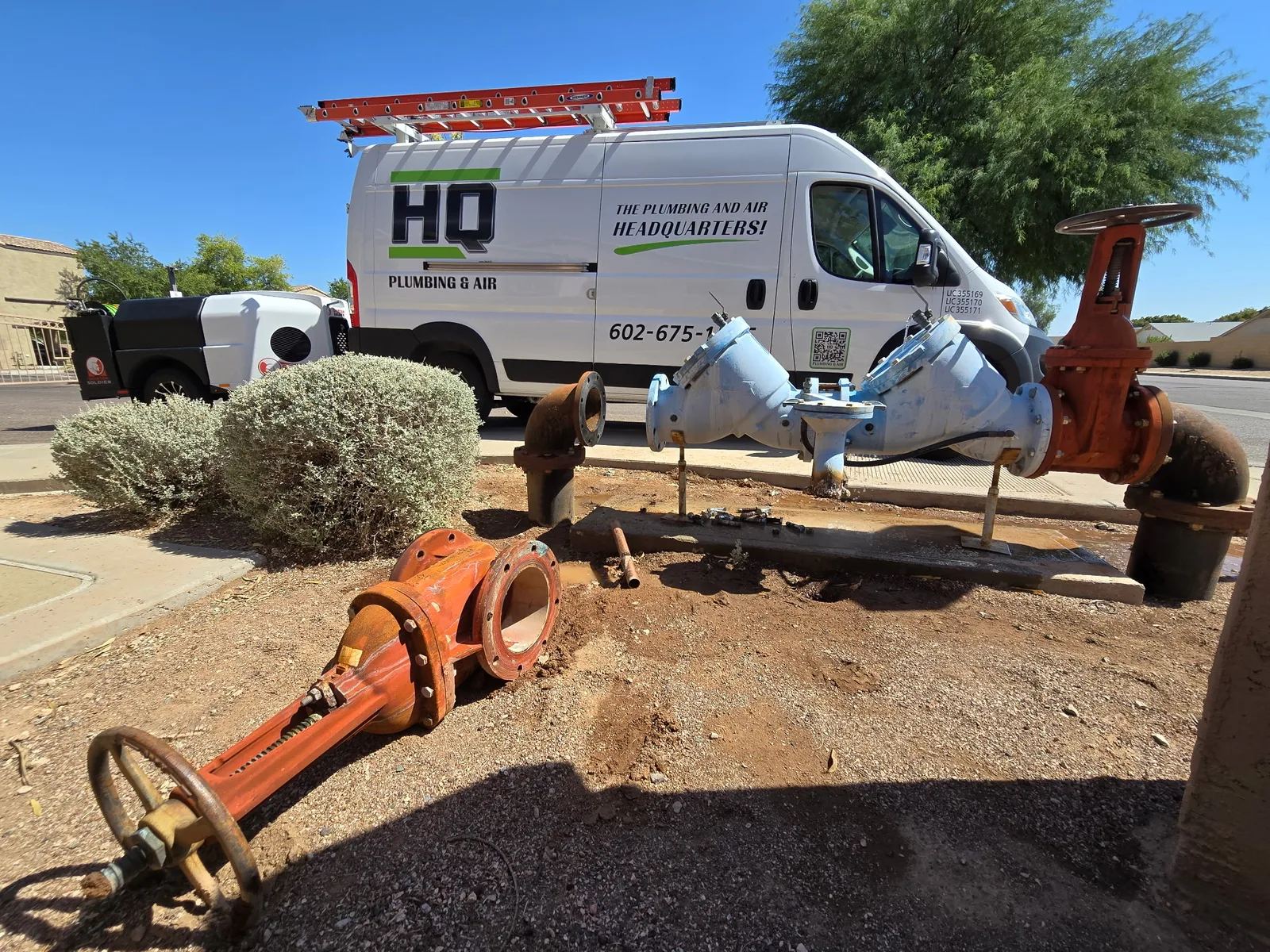
Commercial and HOA Irrigation Backflow Testing
Yearly tests of the PVB or RP on landscape water for business parks, retail centers and HOA common areas, and a check that it's the right device.
Commercial and HOA landscape irrigation on city water needs a testable backflow assembly, tested at least once a year. A pressure vacuum breaker (PVB) is allowed only when the system is irrigation-only, cannot create backpressure and injects no chemicals. Otherwise the state and Valley cities require a reduced pressure (RP) assembly.
The rules that apply
Each rule links to the official text we read it from. Cities change these, so check the source before a big decision. Last checked 2026-10-04.
When a PVB is allowed
ArizonaA PVB may protect landscape irrigation only if the water beyond it is for irrigation only, it is installed per the maker's specs, the system cannot induce backpressure, and no chemigation is used. If any condition fails, an RP is required.
Source: A.A.C. R18-4-215(E)(2)(d)Elevation and multiple services
PhoenixIrrigation with chemical injection, with elevated areas higher than six inches below the PVB, or with multiple services needs an RP. A system not subject to backpressure may use a PVB, installed above ground.
Source: Phoenix City Code 37-144Height of the PVB
MesaWhere a PVB cannot sit at least 12 inches higher than all downstream plumbing, the property needs an RP. Irrigation on a dedicated landscape meter otherwise takes a PVB.
Source: Mesa City Code 8-1-8Every landscape meter
MesaAll dedicated landscape water service connections need service protection, whether the property is residential or commercial.
Source: Mesa City Code 8-1-3(E)Looped and non-potable systems
ScottsdaleLandscape irrigation takes a PVB or RP. Systems served by more than one service connection, or premises using non-potable water for irrigation, need an RP.
Source: Scottsdale Revised Code 49-62(a)(31)Retest after any repair
GilbertIf any repair or maintenance is done on the assembly, a Town-recognized tester must retest it immediately and submit the report to the Backflow Prevention Department.
Source: Gilbert Backflow FAQPVB or RP: the four conditions
A PVB is the simpler assembly, and it's only allowed when the landscape system plays by four rules. Arizona's backflow rule, A.A.C. R18-4-215(E)(2)(d), lists them:
- 1The water past the assembly is used for irrigation only.
- 2The PVB is installed per the manufacturer's specifications.
- 3The irrigation system is designed and built so it can't create backpressure.
- 4No chemicals, fertilizers or pesticides are injected into the water.
Miss any one and the rule says an RP is required. That last one catches more commercial sites than you'd think. A fertilizer injector added to a business park's controller turns a PVB site into an RP site, and Phoenix and Mesa say so again in their own codes.
The elevation rule that trips up sloped sites
A PVB protects against back-siphonage only. Water sitting in pipes above it can press back on it, and a PVB is not built for that backpressure. So each city sets a height test:
- Phoenix requires an RP when the system has "elevated areas which are higher than six inches below the PVB" (City Code 37-144).
- Mesa requires an RP when a PVB "cannot be at least 12 inches higher than all downstream plumbing" (City Code 8-1-8).
Picture a retail center with the PVB at the street and a landscaped berm or raised planter behind it. If any head or drip line on that berm sits higher than the city's limit, the PVB is the wrong device, even if it passes its test every year. A passing test means the parts work. It doesn't mean the assembly fits the site.
Phoenix also requires an RP when the irrigation system has multiple services, and Scottsdale does the same for a looped system fed by more than one service connection. Large HOA common areas often run that way.
What the yearly test involves
Each required assembly gets a certified test at least once a year, and again after installation, relocation or repair. For a PVB, the tester checks that the check valve holds and that the air inlet opens when pressure drops. For an RP, it's both check valves and the relief valve.
Good news for property managers: an irrigation test doesn't touch domestic water. Only the landscape line behind the assembly goes dry while the tester works, so the test can run during business hours. After a repair, the retest clock depends on the city. Gilbert says a recognized tester must retest "immediately" and submit the report. Mesa allows up to 24 hours for the retest after any overhaul, repair or replacement, and the test record is due within seven calendar days (City Code 8-1-11(I) and (J)). Our backflow assembly repair page covers what happens when one fails.
Who's responsible on HOA and commercial land
The customer on the landscape water account carries the duty. For an HOA, that's usually the association for common areas. For a retail center or business park, it's usually the owner, with the property manager booking the test. Mesa removes any doubt for small properties: every dedicated landscape connection needs service protection, residential or commercial (City Code 8-1-3(E)). Our FAQ on HOA common-area irrigation testing goes through the board's side of it.
When testing isn't the fix
- The site fails the four conditions. Testing a PVB that should be an RP keeps you out of compliance. That's a backflow assembly replacement with a permit.
- The irrigation runs on reclaimed, canal or well water. Then the drinking water service needs an RP or air gap. See backflow for reclaimed water sites.
- It's a valve-box anti-siphon valve with no test cocks. Without test cocks there's nothing for a gauge to connect to, so it can't be tested.
- The controller or a leak is the problem. A sprinkler zone that won't shut off is a valve or controller issue, not a backflow one. See why a sprinkler system won't shut off.
What HQ does
HQ is certified to test and certify domestic backflow assemblies, including the PVBs and RPs on landscape water, and we file the results with the city. If heads sit above the PVB or an injector has been added, expect the city to ask for an RP, and ask us for a free estimate on the swap.
You get an upfront price before work starts, and free estimates for replacements. Related: HOA plumbing, property management plumbing, commercial backflow testing and the backflow preventers topic hub.
Services and tools
Does HOA common-area irrigation need backflow testing?
Yes. Common-area irrigation is a cross-connection, and Arizona requires each backflow assembly on it to be tested at least once a year by a certified tester. The duty falls on the water customer, which for common-area meters is usually the association. Failed tests must be repaired and retested.
Read full answer: Does HOA common-area irrigation need backflow testing?Do I need a backflow preventer and annual test for my sprinklers in Arizona?
Yes. An in-ground sprinkler system is a cross-connection, so Arizona requires a backflow preventer on it. Under A.A.C. R18-4-215, a testable assembly must be tested at least once a year, and after any install, repair, or move, by a certified tester.
Read full answer: Do I need a backflow preventer and annual test for my sprinklers in Arizona?RPZ vs double-check backflow assembly: what's the difference?
Both stop water from flowing backward into the clean supply, but they fit different risk levels. A double-check assembly suits low-to-medium hazard, non-health cross-connections. An RPZ adds a relief valve for high-hazard, health connections, making it the strongest protection. The hazard level decides which one code requires.
Read full answer: RPZ vs double-check backflow assembly: what's the difference?Why won't my sprinkler system shut off?
A zone that keeps running almost always has a stuck valve. Debris under the rubber diaphragm, a torn diaphragm, an open manual bleed screw, or a failed solenoid keeps it open. Shut the irrigation isolation valve or the backflow shutoffs to stop the water now, then clean or replace the bad part.
Read full answer: Why won't my sprinkler system shut off?Related commercial services
Who may test, what the report must show, how long the water is off, and where each Valley city wants the results.
Which kitchen and bar connections carry a testable assembly, which cities require one at the meter, and how to test without losing a service.
Master meter rules by city, the assemblies a typical complex carries, who the city holds responsible, and how to batch the yearly tests.
Who may repair an assembly in Phoenix and Scottsdale, the parts that usually fail, and each city's clock for repair and retest.
Repair or replace, picking the assembly type the hazard calls for, and how permits differ for a replacement across the Valley.
What to do in the first hour after a theft, why nobody may pipe across the gap, and how the replacement and retest go.
Irrigation Backflow Due?
Talk to a real dispatcher who knows commercial work. Upfront pricing before work starts, 24/7 for emergencies.