
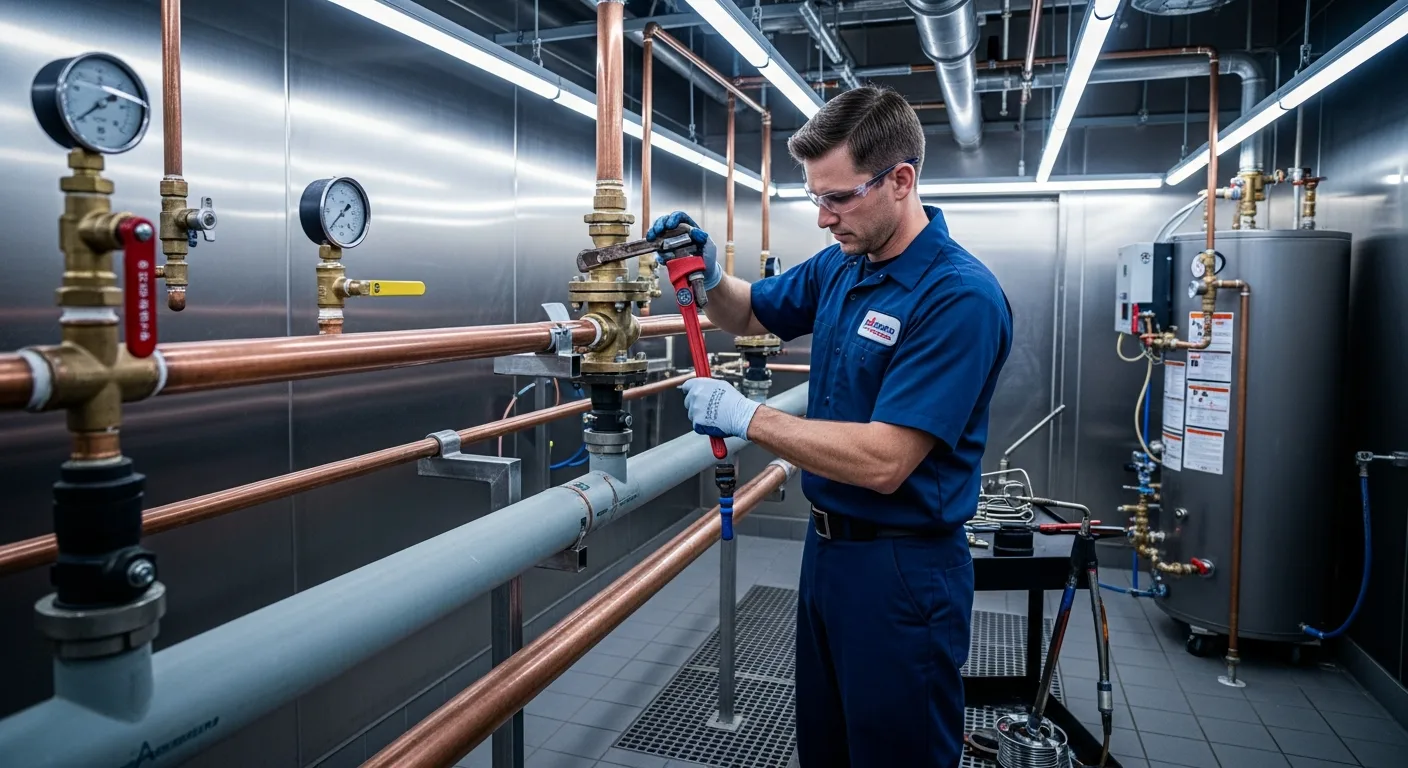
Apartment Complex Backflow Testing in the Valley
Domestic service, landscape meters and pool-area assemblies on one schedule, with resident notice planned before the water goes off.
Yes, most apartment complexes test backflow assemblies every year. Mesa and Scottsdale require an RP assembly on master-metered apartment properties, and landscape meters and pool fill lines carry their own devices. The city holds the customer on the water account responsible, so the owner or management company schedules the test and keeps the reports.
The rules that apply
Each rule links to the official text we read it from. Cities change these, so check the source before a big decision. Last checked 2026-10-04.
Master-metered complexes
MesaMobile home parks, RV parks, master planned communities, commercial plazas, apartment complexes and any other property served by one or more master meters need an RP assembly.
Source: Mesa City Code 8-1-8Master-metered complexes
ScottsdaleMaster metered apartments, condos and townhouses with more than two units per meter need an RP assembly at each service connection.
Source: Scottsdale Revised Code 49-62(a)(34)Landscape water on a shared meter
MesaA meter that serves both domestic and landscape needs must have the landscape connection isolated with an RP or PVB, in addition to the assembly at the service connection.
Source: Mesa City Code 8-1-8Pool auto-fillers
MesaPublic or semi-private pools with self-levelers or automatic fillers need a PVB at the point of use or an RP at the service connection.
Source: Mesa City Code 8-1-8Who the city holds responsible
PhoenixThe customer is any person with physical control, authority or responsibility for the water system, and must test every assembly at least once a year.
Source: Phoenix City Code 37-143Where the notice goes
TempeThe test notice goes to the user paying the water bill, 45 days before the annual due date, and lists the meter number and service address.
Source: Tempe Backflow Prevention ProgramThe assemblies a typical complex carries
Walk a garden-style complex in the Valley and you'll often find three kinds of backflow protection, each with its own test date.
- The domestic service. If the property is on one or more master meters, Mesa City Code 8-1-8 requires an RP assembly. Scottsdale's Revised Code 49-62 requires one where apartments, condos or townhouses have more than two units per meter. Big properties often have several services, so several assemblies.
- The landscape water. Common-area irrigation usually runs through a PVB or an RP. In Mesa, a meter feeding both domestic and landscape water needs the landscape side isolated on top of the service assembly. Our commercial irrigation backflow testing page covers which one you need.
- Around the pool. Mesa wants a PVB on a pool's automatic filler or an RP at the service.
Phoenix's list in City Code 37-144 doesn't name apartments as such. It does name multi-story buildings with booster pumps or storage tanks, and irrigation systems, and the city decides unlisted cases one at a time. A Phoenix complex with landscape water almost always has at least one testable assembly.
The fastest way to build your list is the city's last batch of notices. Each one names a meter and an assembly, and Phoenix's report form records the on-site location of each assembly. If you can't find one, see where a backflow preventer usually sits.
Who the city holds responsible
The duty follows the water account, not the lease. Phoenix defines the customer as "any person that has physical control, authority or responsibility for a water system," and that person tests every assembly at least once a year (City Code 37-143). Tempe mails its notice to whoever pays the water bill, 45 days ahead of the due date. On a master-metered complex that's the owner or the management company, not the residents.
Phoenix's test report asks for both the management company and the owner, with contact names and phone numbers. Keep both current with the city. A notice that goes to a former manager is how a due date gets missed. If a lease or management agreement splits costs differently, see who pays for backflow testing.
Testing a complex without surprising residents
An outage behind the domestic assembly reaches every unit it feeds. The test closes the assembly's shutoff valves while the gauges are read, so residents downstream lose water for that stretch.
Here's the play for a large property:
- 1Line up the due dates. Each city sets its own due dates, so ask the program office whether assemblies with scattered dates can be brought onto one cycle before you test any of them early.
- 2Test the landscape assemblies first. Irrigation and pool assemblies can be tested without touching domestic water.
- 3Post a resident notice for the domestic assembly, with the date and a time window, so nobody is mid-shower when the valves close.
- 4Plan for a failed test. If an assembly fails, it needs a repair and a retest. Doing both on one visit, when the parts are on hand, saves a second outage.
Some buildings can't take an outage at all. Tempe and Scottsdale require parallel assemblies where water can't be interrupted for testing, and taller buildings with booster pumps have their own rules. See high-rise backflow testing.
When the rules don't apply
Single-family rental homes are usually outside the program. Arizona's rule and Phoenix's code exempt single-family residences used solely as homes unless a cross-connection problem is identified. A duplex in Scottsdale with two units on its meter isn't caught by the more-than-two-units rule either, though a landscape meter or other hazard can still require an assembly. Mesa requires service protection on every dedicated landscape connection, residential or commercial.
What HQ does for apartment owners and managers
HQ is certified to test and certify domestic backflow assemblies and files the results with the city. On an apartment property that covers the domestic service, landscape and pool-area assemblies. Fire backflow assemblies and fire sprinkler work are outside what HQ does. Send us the city notice for each property, and we schedule the tests against each due date.
Each property gets an upfront price before work starts. If an assembly leaks or fails, we repair it and retest it. If one gets stolen, see stolen backflow assembly replacement. Related: multifamily plumbing, HOA plumbing and property management plumbing.
Services and tools
Do apartment complexes need annual backflow testing in Arizona?
Most do. Arizona's Valley cities require a backflow assembly on master-metered apartment complexes, tall buildings, buildings with booster pumps or tanks, and landscape irrigation, and every required assembly needs annual testing by a certified tester. A typical complex has several: the main service, irrigation, pools and fire sprinklers.
Read full answer: Do apartment complexes need annual backflow testing in Arizona?Who pays for backflow testing: landlord or tenant?
The lease decides who pays for backflow testing. City codes don't pick landlord or tenant. They hold the water customer responsible, meaning whoever controls the water system or holds the water account, and the city sends notices and penalties to that party. Your lease then decides who books the test and who covers the cost.
Read full answer: Who pays for backflow testing: landlord or tenant?Where is my backflow preventer and what does it look like?
On most Valley commercial properties, the main backflow assembly sits above ground on your side of the water meter, often near the street or a front building corner. It's a bronze or brass valve body with a shutoff valve on each end and small test cocks on top. An RPZ also has a relief port underneath.
Read full answer: Where is my backflow preventer and what does it look like?How long should I keep backflow test records in Arizona?
At least three years in Phoenix. City Code 37-143 counts from the date a copy went to the city, while the city's TRT 00636 guidance counts from the test date, so count from the later date. Arizona's state rule makes water systems keep their records three years. Mesa, Scottsdale and Tempe require records but set no period, so keep them for the assembly's life.
Read full answer: How long should I keep backflow test records in Arizona?Sources
- Mesa City Code Title 8 Chapter 1, Backflow Prevention (2025)
- Scottsdale Revised Code 49-62, Backflow prevention assemblies required
- Phoenix City Code 37-143, Responsibility for backflow prevention control
- City of Tempe: Backflow Prevention Program
- City of Phoenix TRT 00335: Backflow Assembly Test Report Instructions
- Arizona Administrative Code R18-4-215, Backflow Prevention
Related commercial services
Who may test, what the report must show, how long the water is off, and where each Valley city wants the results.
Which kitchen and bar connections carry a testable assembly, which cities require one at the meter, and how to test without losing a service.
When a PVB is allowed on landscape water, when the city requires an RP instead, and what fails most on irrigation assemblies.
Who may repair an assembly in Phoenix and Scottsdale, the parts that usually fail, and each city's clock for repair and retest.
Repair or replace, picking the assembly type the hazard calls for, and how permits differ for a replacement across the Valley.
What to do in the first hour after a theft, why nobody may pipe across the gap, and how the replacement and retest go.
Testing a Whole Complex?
Talk to a real dispatcher who knows commercial work. Upfront pricing before work starts, 24/7 for emergencies.