
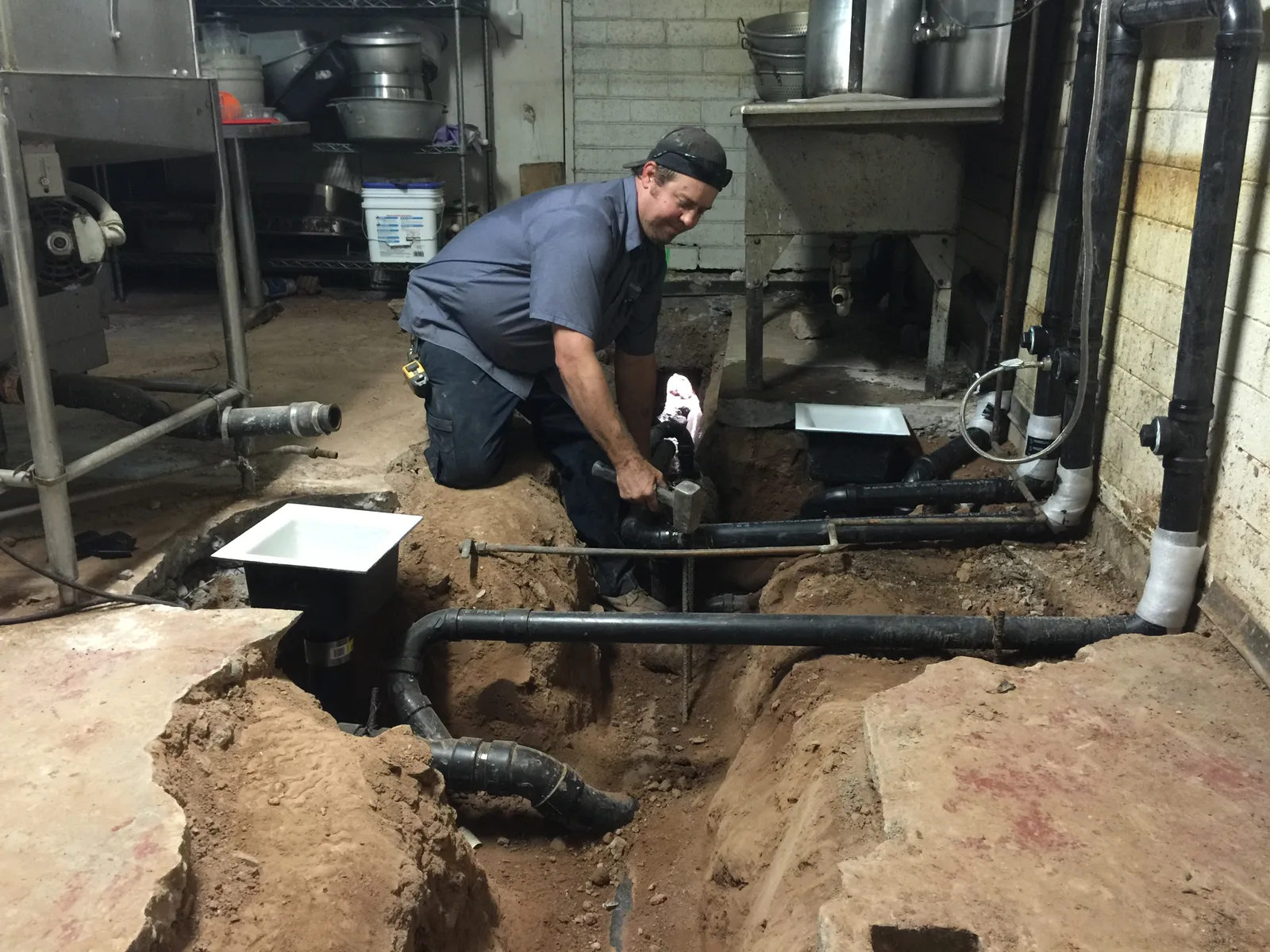
Sewer Line Locating for Commercial Sites
A transmitter in the camera head lets a receiver mark the sewer path and depth on the pavement for contractors and owners.
Sewer line locating finds where a buried sewer runs and how deep it is. A small transmitter, called a sonde, rides in the camera head. A handheld receiver above ground picks up its signal, so the path and depth can be marked on the pavement or ground for the contractor, owner or utility who needs to dig.
The rules that apply
Each rule links to the official text we read it from. Cities change these, so check the source before a big decision. Last checked 2026-10-04.
A locator needs a signal
Manufacturer guidance (RIDGID)A receiver cannot find a plastic or other non-metallic pipe on its own. It needs a tracer wire, a sonde (transmitter) in the line, such as one in a camera head, or a transmitter on a conductor placed in the pipe. If the line has none, the locator cannot detect it.
Source: RIDGID NaviTrack Scout locator, FAQDepth and accuracy depend on conditions
Manufacturer guidance (RIDGID)Depth and accuracy depend on transmitter power, frequency, soil type and moisture, pipe material, nearby conductive lines, concrete and rebar and interference. Locating through cast iron or concrete with rebar reduces signal strength and depth accuracy.
Source: RIDGID NaviTrack Scout locator, FAQFind underground facilities before you excavate
ArizonaNo one may excavate in a public street, alley, right-of-way, public utility easement, implied or express private utility easement, or an apartment community without first determining whether underground facilities will be encountered and where they are.
Source: A.R.S. 40-360.22(A)Mark the dig area first
ArizonaBefore submitting a location request to the one-call center, the excavator must mark the area to be excavated with white lining. Utility operators respond within two working days. This requirement does not apply to a person excavating on their own single-family property.
Source: A.R.S. 40-360.22(B) and (C)Sewers are underground facilities
ArizonaState law defines an underground facility as any buried item used to convey water, sewage and other substances, including pipes and sewers. Utility operators and landlords are the parties with the duty to mark theirs.
Source: A.R.S. 40-360.21 definitionsCleanouts are required to be reachable
Phoenix (2024 IPC)Required cleanouts cannot be installed in concealed locations such as inside walls, under floors in low crawl spaces or below grade. A reachable cleanout is the cleanest place to start a locate.
Source: 2024 IPC Sec. 708.1.11How sewer locating works
The camera goes into the line with a sonde in its head. That sonde transmits a signal from inside the pipe, and the receiver above ground finds it. The tech walks the surface, finds the strongest signal, marks that point and reads the depth. Repeat every few feet and the marks show the path of the pipe. When the receiver is directly over the sonde, it calculates depth automatically.
This is why locating and camera work are a single visit. The sonde follows the camera, so the pipe you saw on video is the same pipe you mark. Tell us when you book whether you want the path alone or the path with the inspection video.
What you get on the surface
We mark the sewer path and depth on the pavement, the slab or the ground, with paint or flags. You can use the marks to plan a repair, a new connection, a slab cut, a utility crossing or a landscaping or paving job. What you do not get is a guarantee. Depth reads are good for planning. Before you dig down to a pipe, confirm it by exposing the line (potholing), especially where the depth is near a minimum clearance or where there are other buried utilities.
What limits a locate
- Where the camera stops, the signal stops. A sonde can only be followed as far as the camera travels. A collapse or a blockage ends the locate there.
- Metal and concrete. Cast iron, rebar and thick slab weaken the signal and the depth accuracy. A locate through a concrete floor with rebar is possible, but treat the depth as an estimate.
- Crowded corridors. Nearby conductive lines and interference can distort the signal.
- No cleanout. If the line has no reachable cleanout, the sonde needs another way in, such as a vent or a fixture opening. That is slower. See sewer camera without a cleanout.
For the cleaner version of the underlying method, see how sewer locating works with a sonde.
Locating is not the same as calling for a utility locate
This is the part contractors and property managers mix up. Arizona's excavation law requires an excavator to determine where underground facilities are before digging, and it sets the process for utility operators and apartment-community landlords to mark theirs. The statute's definition of an operator centers on utilities and landlords with rights in streets, easements and apartment communities.
A private sewer lateral on your own commercial site may not be a line anyone else will mark for you. A sonde locate from a plumber fills that gap for your own pipe, but it does not replace the one-call process for the utilities around it. Call Arizona 811 and your own contacts first, then use our marks for the sewer. The law also requires newer underground facilities, installed after 2005, to carry a detectable locating device unless they can be detected from above ground another way. An older plastic line without tracer wire is the case where a camera sonde is often the only practical way in.
Who orders a locate
- Contractors about to cut a slab, trench a parking lot or tie in a new line.
- Property managers who need the path of a lateral under a building or lot before a repair, a tenant improvement or paving.
- Owners who have plans or as-builts that do not match what is in the ground.
- Developers and engineers checking a lateral before a connection. Public-agency projects have their own inspection specifications, so ask the project engineer what they require.
When locating is the wrong answer
If you already have an accurate as-built and the line is shallow and exposed at a cleanout, you may not need it. If your job is a water or gas line, a sewer sonde will not help. And if the line is collapsed at the first bend, a camera locate will tell you where it stops, not what lies beyond. For a long unknown run, a locate can be paired with an inspection. See sewer camera inspection and sewer repair.
Booking
Tell us the property, what you plan to dig and whether there is a cleanout. HQ offers free estimates, an upfront price before work starts and 24/7 emergency service. See also commercial plumbing and the pre-purchase sewer inspection page if you are buying.
How do plumbers locate a sewer line and its depth?
The camera head carries a small transmitter called a sonde, usually at 512 Hz. A handheld receiver above ground finds the strongest signal, marks the spot and shows an estimated depth. That tells the plumber where a defect sits and how deep it is. It is not a substitute for calling Arizona 811 before digging.
Read full answer: How do plumbers locate a sewer line and its depth?Can a sewer line be camera inspected without a cleanout?
Yes. Without a cleanout, a plumber can usually feed the camera in through a roof vent stack or by pulling a toilet, and in larger buildings through other openings on the drain system. Those routes are tighter, may not let the camera reach as far, and can add time. Installing a cleanout is the lasting fix.
Read full answer: Can a sewer line be camera inspected without a cleanout?What is a sewer cleanout and where is it located?
A sewer cleanout is a capped, accessible fitting on your sewer lateral that lets a plumber clear and camera-inspect the line without going through a toilet. In Phoenix slab homes it usually sits outside near the foundation or toward the property line. Knowing its spot speeds up service and lowers cost.
Read full answer: What is a sewer cleanout and where is it located?Utility easement vs right-of-way: who can dig to fix my sewer?
A utility easement is a strip on your land where a utility may run its lines. A public right-of-way is public land controlled by the city. To dig in either to fix a sewer line, you need a city permit, an Arizona 811 locate, and the right contractor license, like an ROC A-12.
Read full answer: Utility easement vs right-of-way: who can dig to fix my sewer?Sources
- RIDGID: NaviTrack Scout Locator (sonde locating, automatic depth and FAQ)
- A.R.S. 40-360.22, Excavations; determining location of underground facilities
- A.R.S. 40-360.21, Definitions (underground facility, operator)
- 2024 International Plumbing Code, Chapter 7 (Phoenix viewer), Sec. 708 Cleanouts
- NASSCO: Assessment (CCTV, laser profiling, ground penetrating radar)
Related commercial services
Cleanout access, pipe sizes, and what the video and report should show for a commercial building's private sewer.
What to scope after jetting, the slope rule before an interceptor and why grease damage downstream becomes your problem.
What a buyer's scope should find, what a residential-style scope leaves out and how the video supports a price talk.
Portfolio scoping order, how to rank findings, and the landlord duties that apply to plumbing and digging.
How to use before and after video to decide between a cleaning schedule and a structural repair.
Finding cracks, cross-connections and illegal storm tie-ins, plus how to prepare tenants and your alarm company.
Need the Sewer Path Marked?
Talk to a real dispatcher who knows commercial work. Upfront pricing before work starts, 24/7 for emergencies.