
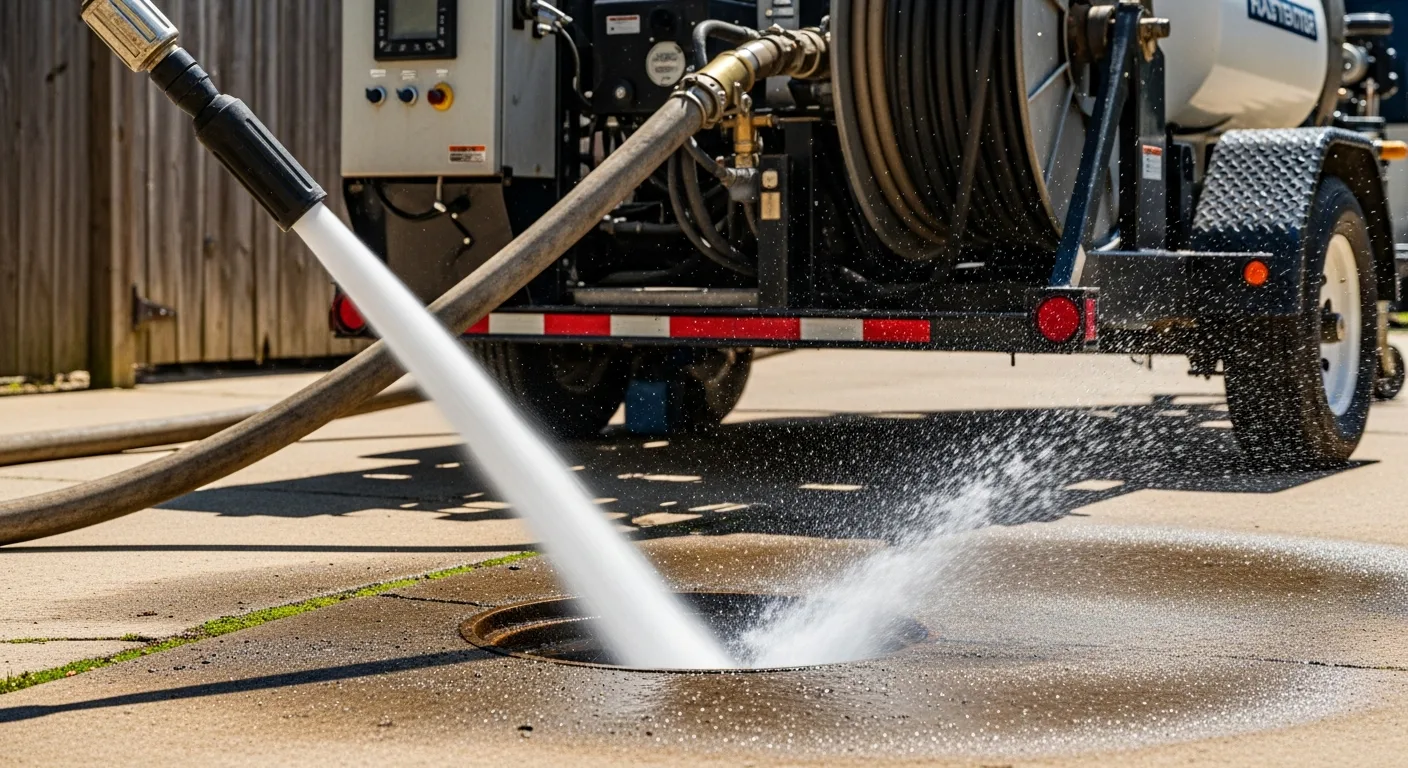
Camera Inspection After Jetting: Verify the Line
Before and after footage shows a clean pipe wall, leftover buildup or damage the grease was hiding.
Run a camera after jetting to confirm the line is actually clean and to see what the water pressure uncovered. Before and after video show whether the blockage was grease, roots or scale, and whether the pipe underneath is sound. That tells you if the answer is a maintenance schedule or a repair.
The rules that apply
Each rule links to the official text we read it from. Cities change these, so check the source before a big decision. Last checked 2026-10-04.
Inspect, clean, then inspect again
National standard (NASSCO)NASSCO's CCTV guideline runs inspection in phases: an initial inspection, cleaning if the owner decides it is needed, optional additional cleaning, and a post-cleaning inspection that evaluates the condition of the section after all cleaning has been performed.
Source: NASSCO CCTV performance specification guidelineThe pipe must be clean enough to log every defect
National standard (NASSCO)The pipe should be clean enough that all defects, features and observations are seen and logged. The survey header records whether the line was pre-cleaned and the date it was cleaned.
Source: NASSCO CCTV performance specification guidelineClean first so cracks are not hidden
City of Mesa (public sewer work)Mesa's video inspection specification requires pipelines to be cleaned thoroughly before inspection to remove debris and dirt that may obscure cracks or other defects, and a follow-up video after repairs to show the work was completed.
Source: City of Mesa Approved Products List, Wastewater, WW-7Old sewers may need cleaning before the camera
National practice (EPA)EPA notes that where old sewers are to be inspected, it may be important to clean the lines before inspection, and that logging and recording inspections is critical to their usefulness.
Source: U.S. EPA Report to Congress, Appendix LMaintenance defects and structural defects lead to different actions
National standard (NASSCO)Operational and maintenance defects trigger routine cleaning, root removal and similar work. Structural defects drive repair or replacement priority. A pipe with both is assessed for structural repair first because conveyance problems are removed during repair.
Source: NASSCO Tech Tips: PACP condition grading system (2023)How often to look again
Seattle Public Utilities (one city's guidance)Seattle's side sewer guidance says minor and moderate root intrusion should be re-inspected three to five years after the original inspection, and severe intrusion obstructing 50 percent or more of the pipe every one to two years with routine cleaning. Use it as a reference point, not a Phoenix rule.
Source: Seattle Public Utilities: Side Sewer Defects and IssuesRestaurants and routine jetting
PhoenixPhoenix's FOG manual says keeping grease out of the plumbing reduces the need for routine jetting of sewer lines and the risk of an emergency overflow during business hours.
Source: Phoenix FOG BMP Manual (June 2024)Why a camera belongs after the jetter
Jetting tells you the water went through. It does not tell you what is still on the pipe wall, and it does not show what the pressure uncovered. A camera after jetting answers three questions: Is the line actually clean? What was the blockage made of? And is the pipe underneath still sound?
The professional standard agrees with that order. NASSCO's guideline for television inspection runs in phases: look, clean if the owner decides it is needed, and then look again to evaluate the condition after all cleaning has been performed. The point of the post-cleaning pass is to verify the work, not to assume it.
What the before and after video shows
The pair is more useful than either half. The first pass records what was there: thick grease, root mass, scale, or a stoppage with no visible cause. The second pass records what the cleaning left. Compare them and you can see:
- A clean pipe wall. The cleaning worked. Any damage is now visible, like cracks, a joint that has slipped or a section that holds water.
- Remaining buildup. The nozzle or pass was not enough. Another pass, a different nozzle or a different tool is the next step.
- Roots. Roots tend to return. The video shows how severe they are and where, which sets how soon to come back.
- Damage hidden by the buildup. Buildup can mask cracks and holes. Clean the pipe and they show, which is why the standards clean before they inspect.
Our jetting work for restaurants runs from inside the building and out to the city sewer, before opening or after close. Maintenance jetting is logged per account, so a camera pass fits naturally into that visit and your records show the line before and after. See hydro jetting and camera inspection after hydro jetting.
Maintenance or repair: how to decide
Use the video to sort findings into two buckets, the same way NASSCO's grading does.
Maintenance problems are conditions that a cleaning fixes: grease, light scale, soft deposits, some roots. The answer is a schedule. If the line is sound and the buildup rate is steady, repeat jetting on an interval makes sense. Phoenix's own FOG manual points restaurants this way, saying that keeping grease out reduces the need for routine jetting.
Repair problems are structural: a crack, a broken or collapsed section, a bad offset or a belly. Cleaning will not cure these, and the line will keep stopping at the same distance. The right answer is a spot repair or replacement. A line with both gets the repair first, because it is wasted money to clean pipe that is about to fail.
If the video shows the same location blocking after every cleaning, treat that as a repair. See belly in a sewer line and root intrusion grades.
What to ask for when you book the pair
Ask that the report states the date of cleaning, the method used and the distance cleaned, so the after video can be matched to the before video footage for footage. Ask for both clips in the same file format, with the same on-screen footage counter. If the camera could not pass a spot the first time and passes it after cleaning, the report should say so, because that spot is where the blockage was and where to look first if it returns. If something still blocks the camera after cleaning, that is a finding too, and it belongs in the log with a distance.
How often to look again
There is no Phoenix rule that sets an interval for private sewer lines, so the video is your guide. Seattle's utility, for example, suggests re-inspecting minor roots in three to five years and severe roots every one to two years. That is a reference, not a requirement here. In practice the right interval is the one that matches how fast your buildup comes back, and the log shows you that.
When a camera after jetting is the wrong answer
For a simple local clog in one fixture, such as a hand sink, you do not need video. If the line has just been scoped and you only cleaned a small section, a full re-scope is overkill. And if the line is clearly collapsed on the first pass, cleaning is pointless and you go straight to repair. See sewer repair.
Booking
Tell us whether you want the camera pass added to a cleaning visit or scheduled separately. HQ offers 24/7 emergency service, free estimates and an upfront price before work starts. Also see commercial drain cleaning and sewer camera inspection.
Why camera the line after hydro jetting?
A camera pass after jetting documents visible cleaning results and defects that buildup may have hidden. Ask for the video and any limits from access, standing water or visibility. It does not prove every branch is clean, measure remaining wall thickness or guarantee the pipe is structurally sound.
Read full answer: Why camera the line after hydro jetting?What does a belly in a sewer line mean?
A belly, or sag, is a low spot where the sewer pipe has lost its slope and holds water. It's usually a problem only if debris settles there and builds up into backups. Seattle's utility calls a sag under 25 percent of the pipe diameter minor, and 50 percent or more severe.
Read full answer: What does a belly in a sewer line mean?What do fine, medium and ball roots mean on a sewer report?
PACP codes roots as fine, medium or ball, which shows progressive blockage. A root ball is graded 5, and fine roots 2, in one published example. Seattle's utility says minor intrusion usually doesn't affect the pipe, while roots blocking half the pipe or more will affect it and call for cleaning and frequent re-inspection.
Read full answer: What do fine, medium and ball roots mean on a sewer report?Can hydro jetting damage old cast iron or clay pipe?
Hydro jetting can damage pipe if pressure, nozzle, temperature or technique is unsuitable, even when no defect was previously known. Thin, cracked or separated old pipe has additional risk. Inspect accessible sections and select settings for the material and condition; a camera cannot prove remaining wall strength.
Read full answer: Can hydro jetting damage old cast iron or clay pipe?Sources
- NASSCO: Pipe Condition Assessment Using CCTV, Performance Specification Guideline
- City of Mesa Approved Products List, Wastewater, WW-7 Sewer Main Video Inspection
- U.S. EPA Report to Congress on CSOs and SSOs, Appendix L
- Underground Construction: NASSCO Tech Tips, PACP Condition Grading System (July 2023)
- Seattle Public Utilities: Side Sewer Defects and Issues
- City of Phoenix: FOG Best Management Practices for Food Service Establishments (June 2024)
Related commercial services
Cleanout access, pipe sizes, and what the video and report should show for a commercial building's private sewer.
What to scope after jetting, the slope rule before an interceptor and why grease damage downstream becomes your problem.
What a buyer's scope should find, what a residential-style scope leaves out and how the video supports a price talk.
Portfolio scoping order, how to rank findings, and the landlord duties that apply to plumbing and digging.
How a sonde locate works, what limits it and why it does not replace the one-call process for other utilities.
Finding cracks, cross-connections and illegal storm tie-ins, plus how to prepare tenants and your alarm company.
Want Proof the Line Is Clear?
Talk to a real dispatcher who knows commercial work. Upfront pricing before work starts, 24/7 for emergencies.