
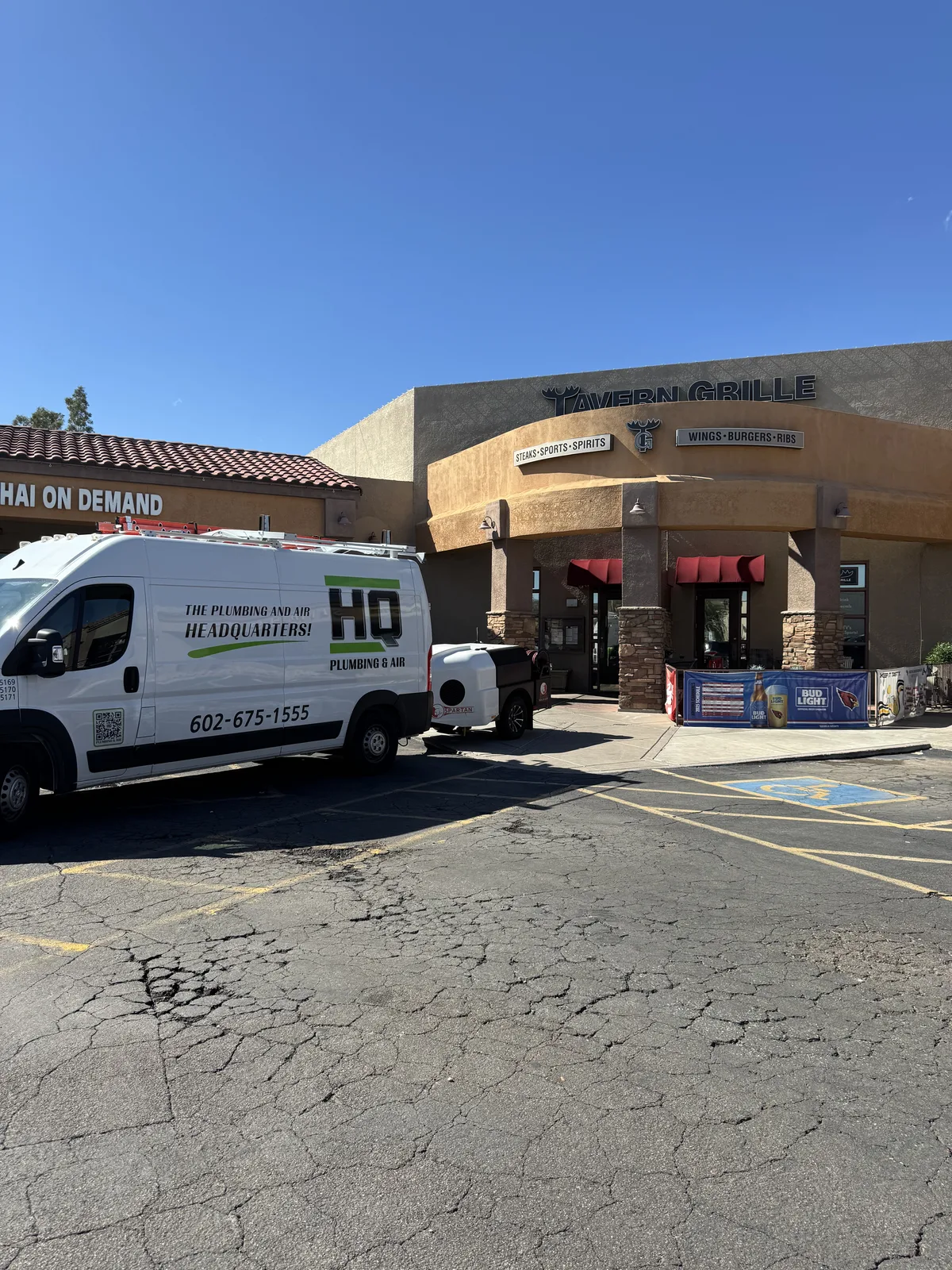
Restaurant Smells Like Sewer? Find It With Smoke
Floor sinks, dish-room drains and the interceptor lid are checked in one test, scheduled around your hours.
If your restaurant smells like sewer, a smoke test finds the path the gas is using. Smoke pushed through the drain and vent system shows up at dry floor drains and sinks, broken pipe, bad seals and open vents. The cause is often a dry trap, but a cracked line or a leaking interceptor lid can look the same.
The rules that apply
Each rule links to the official text we read it from. Cities change these, so check the source before a big decision. Last checked 2026-10-04.
Every trap needs a water seal
Phoenix (2024 IPC)Each fixture trap must have a liquid seal of at least 2 inches and no more than 4 inches. Trap seals subject to evaporation, such as floor drains that rarely see water, must be protected by one of the code's methods, including a trap primer.
Source: 2024 IPC Sec. 1002.4 and 1002.4.1 (Phoenix viewer)Plumbing must be maintained in good repair
Maricopa County (FDA Food Code 2017)A food establishment's plumbing system must be repaired according to law and maintained in good repair (5-205.15), and sewage must be conveyed to disposal through an approved system that is constructed, maintained and operated according to law (5-402.13).
Source: FDA Food Code 2017, adopted by Maricopa CountyAlso: Maricopa County Environmental Health Code, Ch. VIII Sec. 2Gravity interceptors belong outside
PhoenixPhoenix's gravity grease interceptor amendment says these tanks are generally installed outside, and gives the reason that outdoor placement prevents sewer gases and odors from entering the building.
Source: Phoenix amendment to 2024 UPC Sec. 209.0, justificationFill the drains before the test
National practice (EPA)All floor and sink drains must be filled with water before smoke is introduced to the system, and smoke shown on the surface marks where it exits, not always where it escapes underground.
Source: U.S. EPA Report to Congress, Appendix L (smoke testing)Why the nose is not the test
Federal (ATSDR/CDC)Hydrogen sulfide, the gas known as sewer gas, smells like rotten eggs, and people can usually smell it in air at very low concentrations, 0.0005 to 0.3 parts per million.
Source: ATSDR ToxFAQs: Hydrogen SulfideWhy restaurants smell like sewer
A restaurant has more openings to the sewer than most buildings, and many of them are in constant use. Floor drains in the kitchen and dish room, floor sinks that catch equipment drains, mop sinks, hand sinks, restroom fixtures and the grease interceptor all connect to the same drain system, and each is a possible path for sewer gas.
The plumbing code's defense against that gas is the trap seal, a standing 2 to 4 inches of water in each trap. That water evaporates. A floor drain in a storage room or a floor sink that only gets water when a piece of equipment drains can dry out over days. Code says a seal subject to evaporation has to be protected, usually with a trap primer. If it has not been, the smell comes straight up. See why a restaurant smells like sewer and trap primers for commercial floor drains.
What a smoke test shows in a kitchen
A smoke test tells you which of the possible causes it is, without opening floors. Here is what each result means in a restaurant:
- Smoke from a floor drain or floor sink. The trap was dry, or the seal is bad. This is the simplest fix: restore the seal, and add a primer if it keeps drying out.
- Smoke from around a drain or the base of a fixture. A leaking connection or a failed seal around the pipe.
- Smoke from a wall, ceiling or floor. A crack or open joint in the drain or vent pipe above or below. This is the case a trap fix will not cure.
- Smoke at the grease interceptor lid or its connections. The tank is open to the kitchen air. Phoenix says gravity interceptors are generally installed outside so their gases stay out of the building, so smoke at an indoor lid is worth following.
- Smoke at the ground outside. A break in the lateral or a cap missing at a cleanout. A camera confirms it, since EPA notes the surface point is not always the leak.
How we run it in a working restaurant
HQ uses liquid-smoke equipment that forces air into the vent system, not a smoke bomb with a shop vacuum. Before the smoke goes in, every floor drain and floor sink gets water, including the ones nobody remembers, so smoke shows leaks and not just empty traps. We note every drain that was dry. That list is often the whole answer.
Plan the test around your hours. After close or before opening is best, because smoke should not be near open food and staff need notice. Tell your alarm company, since smoke in a kitchen can set off detectors. HQ does not work on fire systems, so that notice is yours to give. See whether smoke tests set off fire alarms.
Why it matters for your inspection
Under the FDA Food Code adopted in Maricopa County, a plumbing system must be repaired according to law and kept in good repair, and sewage must go through an approved system that is maintained and operated according to law. An odor that points to a failed trap or a cracked pipe is also a compliance problem. ATSDR notes that people usually smell hydrogen sulfide at very low concentrations, so a guest can notice it before you find the source.
A smell is not always sewer
Before you book anything, rule out gas. A natural gas leak has its own smell, and a gas leak is an emergency handled by leaving the building and calling your gas utility. See gas smell in a restaurant: leak or sewer gas. Grease interceptors have their own odor. If it rises when the tank is full, pumping and cleaning is the fix. See grease trap smell: is it full.
When a smoke test is the wrong answer
If one floor drain is clearly dry, pour water in it and see if the smell stops. If a drain is slow and gurgling, you have a stoppage, not a vent problem, and a cable or jetter is the tool. If the smell started right after a grease trap service, check the lid and the cleaning first. A smoke test earns its place when the smell is general, keeps returning or has a source you cannot find. For the full diagnostic order, see commercial sewer odor diagnosis.
Booking
Tell us when the smell is worst and where. HQ offers 24/7 emergency service, free estimates and an upfront price before any work starts. See smoke testing, restaurant plumbing and sewer camera inspection, and the restaurant sewer camera inspection page if smoke points to the lateral.
Why does my restaurant smell like sewer?
Most often a dried-out floor drain. The water seal in a P-trap blocks sewer gas, and floor drains in a restaurant sit unused for days, so the seal evaporates and rotten-egg gas rises up. Other causes are a full grease trap, a blocked vent, or a broken sewer line.
Read full answer: Why does my restaurant smell like sewer?Why do commercial floor drains need a trap primer?
A floor drain that rarely gets water lets its trap seal evaporate, and then sewer gas comes up into the room. The plumbing code requires trap seals that can dry out to be protected, and a trap primer is the usual fix. It feeds the trap a little water automatically so the seal never disappears.
Read full answer: Why do commercial floor drains need a trap primer?Why do floor drains dry out so fast in Arizona?
Seldom-used floor-drain traps can lose water by evaporation, especially without a working primer or suitable trap-seal protection. A lost seal can admit sewer gas. Check the drain’s existing protection and condition; refilling or a properly selected protection device may be needed.
Read full answer: Why do floor drains dry out so fast in Arizona?Why does my grease trap smell and is it full?
A grease trap that smells is usually overdue. Grease and solids past 25 percent of capacity turn septic and give off a rotten-egg odor. Scottsdale's code names odor, an effluent pH below 5.0 and the 25 percent mark as reasons to clean, and requires use to stop if hydrogen sulfide reaches dangerous levels.
Read full answer: Why does my grease trap smell and is it full?Sources
- 2024 International Plumbing Code, Chapter 10 (Phoenix viewer), Sec. 1002.4
- FDA Food Code 2017
- Maricopa County Environmental Health Code, Chapter VIII, Section 2 (Food Establishments)
- City of Phoenix: Amendment to the 2024 Uniform Plumbing Code (Ord. G-7397)
- ATSDR/CDC ToxFAQs: Hydrogen Sulfide
- U.S. EPA Report to Congress on CSOs and SSOs, Appendix L
Related commercial services
Cleanout access, pipe sizes, and what the video and report should show for a commercial building's private sewer.
What to scope after jetting, the slope rule before an interceptor and why grease damage downstream becomes your problem.
What a buyer's scope should find, what a residential-style scope leaves out and how the video supports a price talk.
Portfolio scoping order, how to rank findings, and the landlord duties that apply to plumbing and digging.
How a sonde locate works, what limits it and why it does not replace the one-call process for other utilities.
How to use before and after video to decide between a cleaning schedule and a structural repair.
Sewer Smell in Your Kitchen?
Talk to a real dispatcher who knows commercial work. Upfront pricing before work starts, 24/7 for emergencies.