
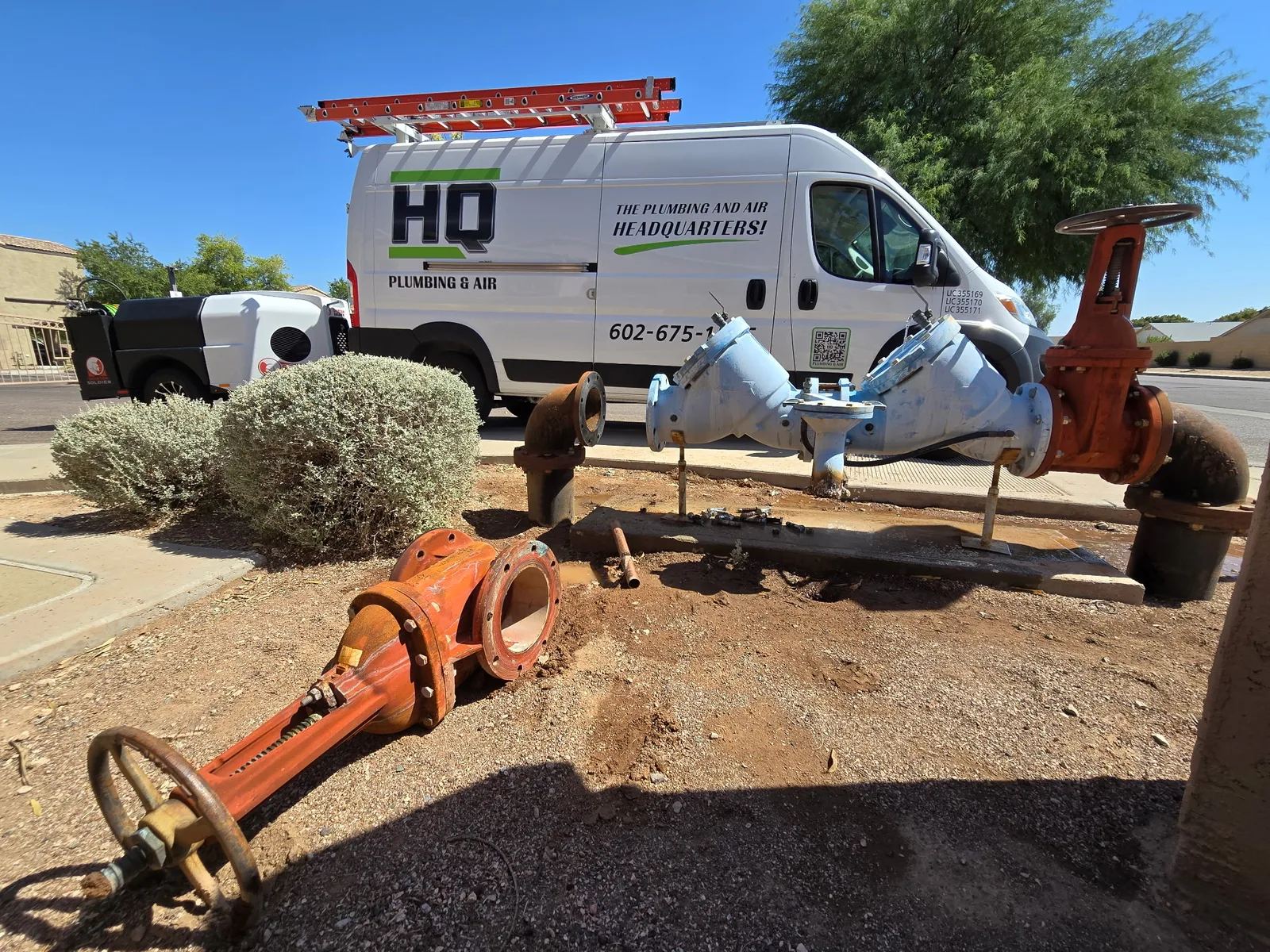
Backflow Protection for Reclaimed and Canal Water Sites
When reclaimed, canal or well water serves the landscape, the city water service needs the highest level of protection. Here's how each city says it.
If a property has reclaimed water, canal water or a well on site, Valley cities treat its drinking water service as a health hazard. Mesa, Scottsdale and Gilbert require a reduced pressure (RP) assembly on the potable connection, and Phoenix and Chandler require an RP or an air gap. That assembly is tested every year.
The rules that apply
Each rule links to the official text we read it from. Cities change these, so check the source before a big decision. Last checked 2026-10-04.
Second source on the premises
ArizonaA water system must require a backflow assembly where a source of water exists on the user's premises that the system has not accepted or the Department has not approved.
Source: A.A.C. R18-4-215(B)(2)Auxiliary water
PhoenixAuxiliary water systems need an air gap or RP. The city's code defines reclaimed water as wastewater treated by a treatment plant for reuse.
Source: Phoenix City Code 37-144Also: Phoenix City Code 37-1Reclaimed or non-potable irrigation
MesaProperties where reclaimed water is accessible on site, where non-potable water is used for irrigation, or with auxiliary supply capability need an RP. Auxiliary supply includes wells, springs, rivers, streams and canals.
Source: Mesa City Code 8-1-1, 8-1-8Non-potable irrigation
ScottsdalePremises using non-potable water for irrigation, or potable water with non-potable piping, need an RP. So do auxiliary water systems.
Source: Scottsdale Revised Code 49-62(a)(5), (31)Reclaimed water customers
GilbertCustomers receiving reclaimed water must install a reduced pressure backflow preventer on all potable water meter connections, to the town's standard detail.
Source: Gilbert Backflow FAQAuxiliary supply and testing
ChandlerPremises with an auxiliary supply, which includes treated effluent, need an air gap or RP. Devices on the potable service are tested yearly; devices installed on reclaimed water services are exempt from the annual test.
Source: Chandler City Code 52-36Also: Chandler backflow testing processWhy a second water source changes the assembly
The city can only vouch for water it delivers. Once a property also has reclaimed water in purple pipe, a canal turnout, a well or a lake fill line, there's a path for that water to reach the drinking water side through one mistake: a hose run between two bibs, a jumper during a repair, a swapped valve. Mesa's code counts exactly those things as cross-connections: "bypass arrangements, jumper connections, removable sections, swivel or change-over devices."
So the state rule, A.A.C. R18-4-215(B)(2), requires an assembly wherever a water source the system hasn't accepted exists on the premises. The Valley cities then pick the top levels of protection for it: an RP, or an air gap.
How each city says it
| City | Trigger | Protection on the potable service |
|---|---|---|
| Phoenix | Auxiliary water systems | Air gap or RP (37-144) |
| Mesa | Reclaimed water accessible on site; non-potable irrigation; auxiliary supply such as wells or canals | RP (8-1-8) |
| Scottsdale | Non-potable irrigation; potable water with non-potable piping; auxiliary systems | RP (49-62) |
| Gilbert | Any reclaimed water customer | RP on all potable meter connections |
| Chandler | Auxiliary supply, including treated effluent | Air gap or RP (52-36) |
Mesa's program page casts the net wide. Its list of auxiliary water includes reclaimed water, well water, impoundments, another provider's water, grey water and recycled rain water, and it says such customers need an RP on all potable connections.
Two details catch owners off guard. First, Mesa's definitions say an air gap is the method required for backflow protection of sewage or reclaimed water, which matters where potable water tops off a reclaimed system or pond. Second, Gilbert's rule applies to every potable meter on the property, not just the one near the landscape.
Which assemblies get the yearly test
The assembly on your drinking water service is tested at least once a year by a certified tester, like any other required assembly. Chandler draws one line worth knowing: devices installed on reclaimed water services are exempt from its annual testing requirement, while the assemblies protecting city potable water are not. Chandler also handles one case itself. Under City Code 52-34.3, when new homes use reclaimed water, the city installs an RP in the right-of-way at the homebuilder's expense and tests and maintains it.
For commercial, HOA and school campuses, the potable-side RP is yours. It's tested on the same notice cycle as any other assembly. See commercial backflow testing for filing by city.
Keeping the two systems apart
The assembly is the last line, not the only one. Day to day, the risk is people. Here's the play:
- Label and color. Reclaimed piping is typically purple and marked, so keep it that way after repairs. Our FAQ on what purple pipe means explains the color code.
- No shared hoses. A hose that moves between a reclaimed bib and a potable bib is a cross-connection waiting to happen.
- Watch repairs. A landscaper who ties a broken reclaimed lateral into a nearby potable line has created the exact hazard the RP exists for.
- Know your assemblies. Phoenix's report form records whether an assembly protects a fire system, landscaping or potable water. Keep a list so each one gets its test.
When this isn't your situation
If your irrigation runs on city water through its own meter and there's no other source on site, the ordinary landscape rules apply. A PVB may be allowed. See commercial irrigation backflow testing. Fire service protection on reclaimed sites (Gilbert's rule names fire services too) goes to a fire protection contractor. Fire backflow assemblies and fire sprinkler work are outside what HQ does.
What HQ does
HQ tests, repairs and replaces the domestic RPs that protect the drinking water service on reclaimed, canal and well water sites, and files the results with the city. We don't work on the reclaimed system's pumps or controls. If an RP is dumping water or failed its test, we rebuild it and retest it on the same visit when we have the parts. You get an upfront price before work starts and free estimates for replacements. Related: HOA plumbing, school plumbing, backflow assembly repair and leak detection.
Services and tools
Backflow for Reclaimed and Canal Water Sites: common questions
Anything else, call (602) 675-1555.
What is purple pipe (reclaimed water)?
Purple pipe carries reclaimed water, which is municipal wastewater treated to a high standard for non-potable reuse like irrigating parks, golf courses, and medians. Purple is the national color code for non-potable reclaimed water, and the pipe is marked do not drink. Never connect it to drinking water.
Read full answer: What is purple pipe (reclaimed water)?Can a commercial building use reclaimed water to flush toilets in Arizona?
Commercial toilet flushing with reclaimed water requires the appropriate water-quality class, direct-reuse authorization and an approved building connection design. Arizona lists Class A as the minimum reclaimed-water class for toilet and urinal flushing; Class A+ may also be used. Confirm utility availability, permits and cross-connection safeguards before treating a purple pipe as an approved fixture supply.
Read full answer: Can a commercial building use reclaimed water to flush toilets in Arizona?Does HOA common-area irrigation need backflow testing?
Yes. Common-area irrigation is a cross-connection, and Arizona requires each backflow assembly on it to be tested at least once a year by a certified tester. The duty falls on the water customer, which for common-area meters is usually the association. Failed tests must be repaired and retested.
Read full answer: Does HOA common-area irrigation need backflow testing?What is a cross-connection and why is it dangerous?
A cross-connection is any actual or potential link between your drinking water and a non-potable source such as a liquid, solid, or gas. It is dangerous because it gives contaminants a path to flow backward into clean water through backflow, fouling the supply you drink, cook, and bathe with.
Read full answer: What is a cross-connection and why is it dangerous?Sources
- Arizona Administrative Code R18-4-215, Backflow Prevention
- Phoenix City Code 37-144, Backflow prevention methods
- Phoenix City Code 37-1, Definitions
- Mesa City Code Title 8 Chapter 1, Backflow Prevention (2025)
- City of Mesa: Backflow Prevention
- Scottsdale Revised Code 49-62, Backflow prevention assemblies required
- Chandler City Code 52-34 to 52-36, Cross-connection control
- City of Chandler: Backflow Testing and Maintenance Process
- Town of Gilbert: Backflow FAQ
- City of Phoenix TRT 00335: Backflow Assembly Test Report Instructions
Related commercial services
Who may test, what the report must show, how long the water is off, and where each Valley city wants the results.
Which kitchen and bar connections carry a testable assembly, which cities require one at the meter, and how to test without losing a service.
Master meter rules by city, the assemblies a typical complex carries, who the city holds responsible, and how to batch the yearly tests.
When a PVB is allowed on landscape water, when the city requires an RP instead, and what fails most on irrigation assemblies.
Who may repair an assembly in Phoenix and Scottsdale, the parts that usually fail, and each city's clock for repair and retest.
Repair or replace, picking the assembly type the hazard calls for, and how permits differ for a replacement across the Valley.
Reclaimed Water on Site?
Talk to a real dispatcher who knows commercial work. Upfront pricing before work starts, 24/7 for emergencies.