
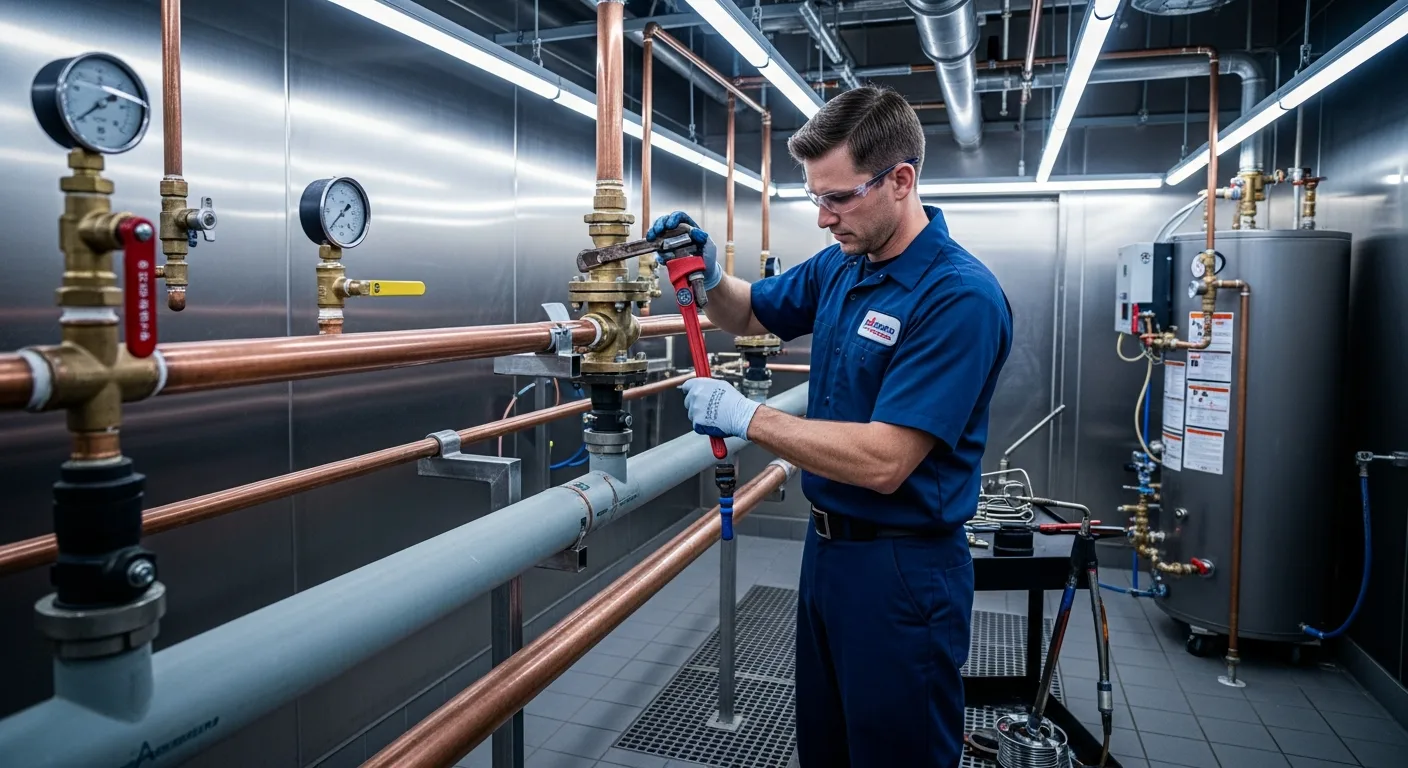
Commercial Pressure Regulator and Hose Bib Repair
A failed regulator sends street pressure into every fixture, and a broken hose bib can leak or siphon dirty water back. Both are small jobs that prevent big ones.
A failing pressure regulator lets city pressure into a building's pipes, and a broken hose bib leaks or lets dirty water back into the supply. HQ replaces commercial pressure-reducing valves, repairs or swaps hose bibs and vacuum breakers, and fixes the exposed outdoor piping that feeds them. Phoenix requires a regulator on the customer's side of the meter.
The rules that apply
Each rule links to the official text we read it from. Cities change these, so check the source before a big decision. Last checked 2026-10-04.
Phoenix requires a regulator after the meter
PhoenixPressure above 80 psi needs action by the owner. The city requires customers to install a pressure regulator on the customer's side of the water meter so pressure in the home or business does not exceed 80 psi, and private regulators are the owner's responsibility.
Source: Phoenix Water Services, General Service IssuesRegulator design: strainer, fail-open, serviceable in line
2024 IPCWhere static pressure in the building exceeds 80 psi, an approved regulator (ASSE 1003 or CSA B356) with a strainer reduces it to no more than 80 psi. The valve must remain open in a failure, and must allow repair or removal of parts without breaking the pipeline.
Source: 2024 IPC Sec. 604.8, 604.8.1, 604.8.2Quick-closing valves need water-hammer arrestors
2024 IPCFlow velocity must be controlled to reduce water hammer, and an arrestor conforming to ASSE 1010 is installed where quick-closing valves are used.
Source: 2024 IPC Sec. 604.9Every hose connection gets backflow protection
2024 IPCSill cocks, hose bibbs, wall hydrants and other openings with a hose connection are protected by an atmospheric-type or pressure-type vacuum breaker or a permanently attached hose connection vacuum breaker.
Source: 2024 IPC Sec. 608.16.4.2Hose bibbs get their own shutoff and a label
2024 IPCA shutoff valve is required on the supply pipe to each sill cock, and service and hose bibb valves must be identified. Access must be provided to the valves.
Source: 2024 IPC Sec. 606.2, 606.3, 606.4No plastic water pipe in the sun
PhoenixNonmetallic potable water pipe, fittings and valves may not be exposed in exterior outdoor locations. Exterior exposed components must be metallic. Phoenix's stated reason is heat and UV softening, sagging and cracking.
Source: Phoenix amendment to 2024 IPC Sec. 605.25How do you know a pressure regulator has failed?
A regulator is failing when pressure downstream no longer matches what it is set to. The signs are a banging or humming sound in the pipes, relief valves on water heaters that weep, toilet fill valves that run or hiss, flushometers that slam, a gauge that reads above 80 psi after the regulator, and fixtures with wildly different pressure from one end of the building to the other. Our page on signs a pressure regulator is going bad lists the symptoms, and why pressure rises after a regulator explains the common cause: with a closed system, thermal expansion and a creeping seat can push pressure above the setpoint.
The test is simple and takes minutes. Put a gauge on a hose bib or a test port, record static pressure with nothing running, and repeat it at a different time of day. A reading over 80 psi means the regulator is bad, set wrong, or missing. Check the strainer and the adjustment screw too; a clogged strainer causes low pressure, which gets blamed on the regulator.
Who is responsible for the regulator?
The property owner, once the water passes the meter. Phoenix requires a regulator on the customer's side of the meter to keep pressure at or below 80 psi and says private regulators are the owner's responsibility. In a multifamily building or an HOA, the regulator is usually on a common line, so the association or owner of record pays, unless the governing documents or lease say otherwise. See HOA versus owner leaking pipes for how the split usually works, and where the regulator goes relative to the meter.
What does replacing a commercial regulator involve?
Replacement is a shutdown job, usually short. HQ closes the building main, cuts out the old valve, installs a new valve sized for the line, sets and verifies the outlet pressure with a gauge, and checks for thermal expansion trouble afterward. Under the 2024 IPC, a regulator must have a strainer, must fail open, and must be installed so parts can be serviced without breaking the pipeline, so a union-style or in-line serviceable layout is the standard approach. If the system is closed by a check valve or backflow assembly, an expansion tank may be needed; see when a regulator needs a thermal expansion bypass.
Pressure that is set too low causes its own complaints, so we set to the building's needs. Flushometer valves need adequate flow and pressure to operate, which is a reason not to turn the regulator down more than necessary. Plan the shutdown with tenants in mind; planning a commercial water shutoff covers notices and restart.
What goes wrong with commercial hose bibs and their piping?
Most hose bib failures come from heat, age and abuse. A Phoenix summer will soften and crack plastic pipe and fittings in direct sun, which is why Phoenix prohibits exposed nonmetallic potable water piping outdoors under its amendment to IPC 605.25. The city's own plumbing tips warn that exposed plastic such as PVC is more susceptible to extreme temperatures, leaks and breaks, and recommend relocating, insulating or burying it. A hose bib that drips at the handle is usually a packing or washer problem; one that leaks inside the wall is a cracked stem or fitting. See an outdoor faucet that leaks and the frost-free type.
The other failure is invisible. A missing or broken vacuum breaker lets a hose submerged in a mop bucket, a planter or a chemical tank siphon dirty water back into the building supply. The code requires a vacuum breaker on every hose connection, and our guide to hose bib vacuum breakers explains how they work. Replacing a broken one is a small job that matters more than it looks, particularly in a restaurant, a clinic or a common area. The same code also bars potable outlets below grade, so a hose connection in a pit or valve box is not an acceptable setup.
When a regulator replacement is the wrong answer
Do not replace a regulator that is working. If static pressure past the regulator is within range and the real problem is a banging pipe, the fix is often a water-hammer arrestor at the quick-closing valve, not a new regulator. If pressure is low everywhere, check the house valve, the strainer and the meter before spending money; Phoenix lists a partly closed house valve and a clogged aerator among the usual causes. If the problem is on the city side of the meter, the pressure is the city's to fix. And a hose bib that has been replaced three times at the same wall is a sign of a pipe problem behind it, which is a water line repair, not another faucet.
What to have ready when you call
Give us the building address, the size of the water service if you know it, your gauge reading if you took one, and where the hose bibs or regulator are. HQ offers free estimates and upfront pricing before work starts, and takes emergency calls 24/7. For wider context on property types, see multifamily plumbing, HOA plumbing and our emergency plumber page.
Services and tools
Do I need a pressure reducing valve, and what does it do?
You need one if your static water pressure is over 80 psi. The plumbing code and Phoenix's water standards both require a pressure reducing valve on the owner's side of the meter at that point. The valve drops street pressure to a steady, safer level, usually set between 45 and 60 psi, which protects pipes, fixtures and appliances.
Read full answer: Do I need a pressure reducing valve, and what does it do?What are the signs my pressure-reducing valve is going bad?
Watch for water pressure that is too low everywhere, pressure creeping above 80 psi, surging or fluctuating flow, banging pipes, and no change when you turn the adjustment screw. Confirm with a hose-bib gauge. Pressure over 80 psi is urgent and can damage pipes.
Read full answer: What are the signs my pressure-reducing valve is going bad?What is a hose bib vacuum breaker and do I need one?
A hose bib vacuum breaker is a small anti-siphon device on an outdoor faucet. It has a check member and an air vent that opens when supply pressure drops, breaking the siphon so contaminated water cannot get pulled back into your drinking water. Yes, you need one. Plumbing code requires it.
Read full answer: What is a hose bib vacuum breaker and do I need one?Why is my outdoor faucet (hose bib) leaking?
Where the water shows up tells you the cause. A drip from the spout means a worn rubber washer or seat. A leak at the handle means worn packing, fixed by tightening the nut a quarter-turn. Water only when a hose is on, or inside the wall, often means a frost-split frost-free stem.
Read full answer: Why is my outdoor faucet (hose bib) leaking?Related commercial services
How a meter test, section-by-section pressure test and acoustic listening locate a leak, and who pays once it is found.
Repair in place, reroute or open the slab, what Phoenix says about permits for concealed pipe, and planning around tenants.
Where owner responsibility starts, how a failed service line is repaired or replaced, and what comes before the excavator.
What HQ does and does not do on a fire line, the Phoenix certificate rule, and the owner's upkeep duties.
The first ten minutes, the valve Phoenix says to close, what to document, and the notification clock in Phoenix code.
What a TI plumbing scope includes, how fixture counts work, and how Phoenix, Mesa and Scottsdale review and inspect it.
Pressure Too High?
Talk to a real dispatcher who knows commercial work. Upfront pricing before work starts, 24/7 for emergencies.