
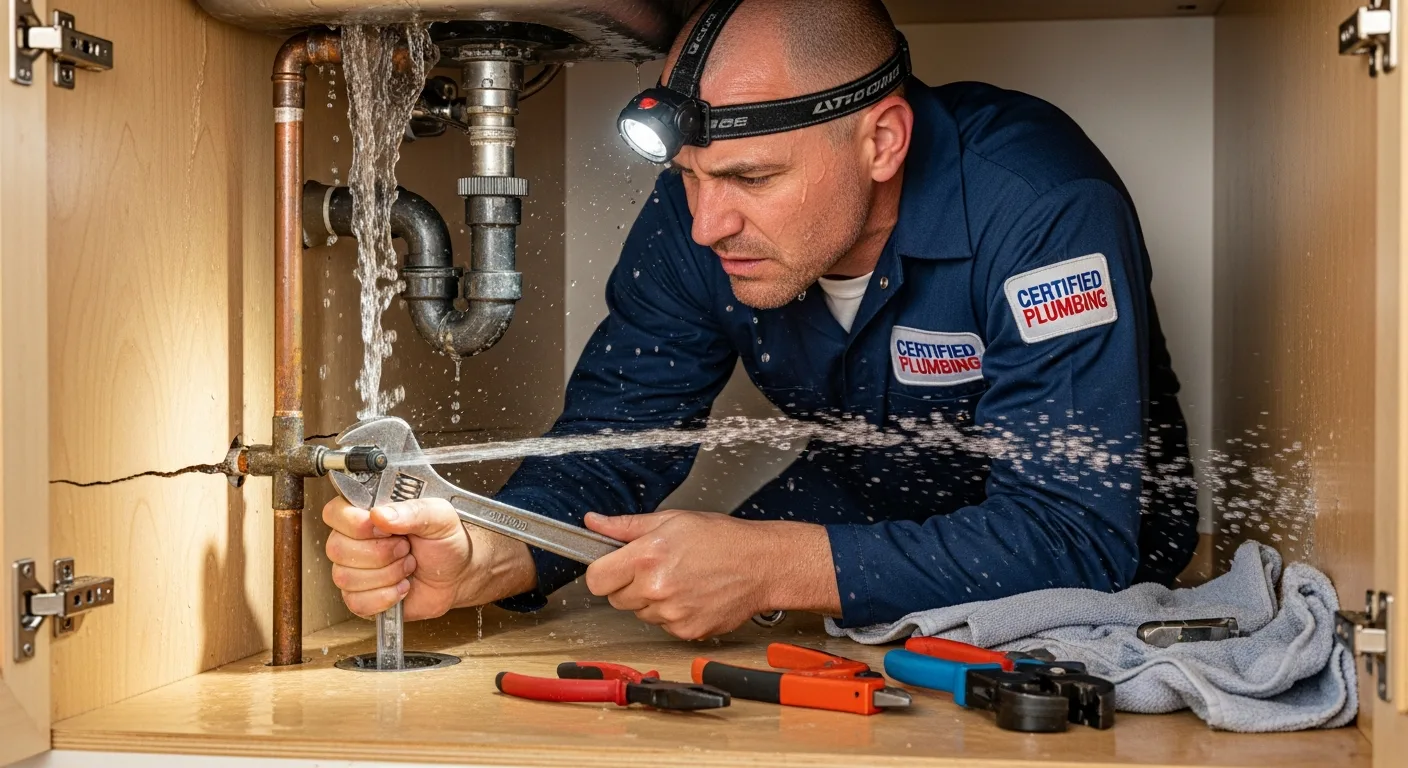
Leaking Water Supply Lines and Valves at Commercial Properties
Water dripping from a supply line, shutoff valve or fitting in a store, office or apartment. How we trace it, repair it and handle repairs that need a proposal.
A leaking supply line or valve is traced by isolating sections and shutting off valves until the leak stops, then opening up the line to see the damage. We replace the failed part or cut out and replace the damaged pipe section. Bigger repairs get a written proposal first.
What was wrong
A tenant spots water dripping from a ceiling tile. A maintenance worker finds a wet wall behind a restroom, a valve weeping in a mechanical room, or a fitting spraying under a sink. Leaks are among the most frequent calls in commercial buildings, and they range from a loose fitting to a pipe that has corroded through.
Where it shows up is rarely where it starts. Water follows pipes, framing and drywall, so the wet spot can be a long way from the leak. That is why the repair starts with tracing, not cutting.
How we find the cause
We start with what we can see: open the access panel, lift the ceiling tile, look at the line and the fixture, and run water to confirm. A leak that only shows when water is flowing is a different problem from one that drips constantly.
When it isn't obvious, we isolate sections. We close valves one at a time to find which branch is leaking, because the leak stops when we close the right one. That narrows the search to a run of pipe or a single fitting, and we open that area to see the damage. Narrowing it down this way is how we limit how much of your wall or ceiling comes apart.
What fixes it
We stop the leak first. That may be replacing a failed valve, fitting or fixture connection, or cutting out the damaged pipe section and replacing it. After the repair we run water and check that it stays dry.
If the pipe is old and corroded in more than one spot, we tell you. A pinhole is often the first of several, and the honest answer may be to replace a longer run. That gets a written proposal with the options. Larger repairs need customer approval before we start, and your work order's not-to-exceed limit applies. If we need to cap or isolate a line as a temporary measure while a proposal is approved, we'll tell you exactly what's been done and what is still open.
What to know before you call
Shut off the water to the affected area if you can reach the valve, and move anything valuable out of the way. If water is near electrical equipment, shut off the main and call us right away. We offer 24/7 emergency service.
Tell dispatch where the water shows up, whether it runs constantly or only when something is used, and whether it's reached another unit or space. For managed properties, give us the access details, who authorizes the work and any check-in or PIN requirement. We can upload the invoice to your facility platform and provide photos for sign-off.
At home
The same approach works in a house. Close the valve nearest the leak, or the main if you can't find it, and check the water meter with everything off. If it keeps moving, the leak is somewhere in the house and we can trace it.
Last reviewed 2026-10-05. This page describes a pattern we see on service calls; your building, fixtures and city rules decide the details.
Services that fix it
Questions people ask
Seeing This at Your Place?
Call or send the details. 24/7 emergency service, licensed and insured, free estimates, price up front.